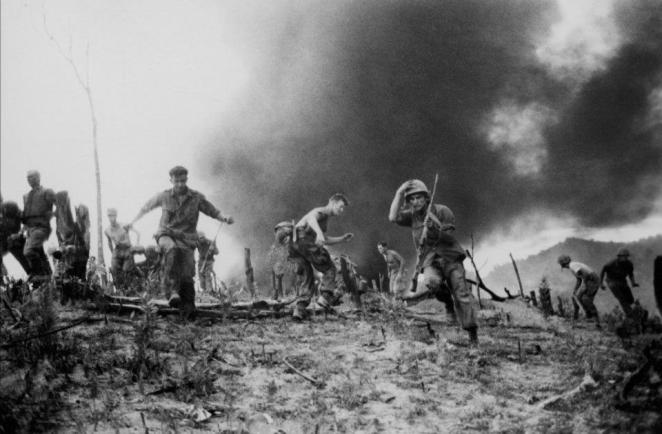
Sunday, February 9, 2014

LÍNH MỸ TẠI VN , PHONG TRÀO PHẢN CHIẾN .
14 Votes

Hello all,
I’ve recently completed my latest project – A video titled “Boots on the Ground“.  It’s only 6 1/2 minutes long and comprised of pictures taken during the Vietnam War and synchronized to music.  I think you’ll really like it!  You can either view it directly on youtube, or for your convenience, watch it below.  Looking forward to your feedback!
WARNING:  SOME PICTURES ARE VERY GRAPHIC – PARENTAL GUIDANCE IS REQUIRED!
 Vietnam:  Boots on the Ground
If you enjoyed this video and want to learn more about the Vietnam War – subscribe to this blog and get each new post delivered to your email or feed reader.   Click on the title at the top of this page to be redirected to my main page – a directory on the right side lists similar articles, videos and points of interest.

Fighting the VC and NVA in III Corps

Posted in The Vietnam war story with tags , , , , , , , , , , , , , , , , , , , , , , on December 7, 2013 by John Podlaski

3 Votes

This is a guest blog by  

An Eyewitness Account by SSG Arnold Krause


In Vietnam, the NVA and VC organizations fought a very different war to the one we (the U.S. army) were attempting.Guerilla warfare was the best tool the North Vietnam forces employed against our mega-sized campaigns in the early years, and, later, the numerous search and destroy and reconnaissance in force missions we came to employ daily in conjunction with night operations.
A Reconnaissance In Force (‘RIF’) Mission gets airborne (Dennis Buckley, 212warriors.com)
The night ambushes were designed to catch the enemy’s movement by surprise, knowing they had to avoid aerial detection during daylight hours. It was also our attempt to strike some fear into them, but the success ratio of night ambushes rarely matched the efforts to conduct them. The NVA knew full well that they could not battle us strength to strength without air and artillery support, so they chose to play cat and mouse and just wait us out, which is exactly what they did for more than a decade. Eventually public opinion and politics overtook any military strategies we used and without public support, our efforts eroded and we gave up.
North Vietnamese Fighters in action during the Tet Offensive
Clearly, the largest military campaign by North Vietnam was the TET offensive launched on January 30, 1968. Not until most of the U.S. ground forces had departed the county by mid 1971, did the North begin to expand their military effort against the South Vietnamese Army unencumbered by outside intervention. Only upon our official departure from RVN in 1973, under the banner of the Paris Peace Accords, when the last of U.S. troops were gone, did the North began to invade the South and ultimately defeat the South Vietnamese Army and overthrow the government on April 30th, 1975.
This was 4 years and 1 week after the 2/12th was withdrawn from Vietnam.
Most of the skirmishes between opposing forces during the war varied in size from individuals using sniper fire, to squad and platoon size battles against equally sized U.S. forces. Only on rare occasions, when the North felt that they had a tactical advantage which included a combination of manpower, firepower, and good escape routes, did they choose to engage us full on.
US soldiers patrolling through a rice paddy, as life goes on around them (212warriors.com)
Most of these pitched battles occurred at night and mostly against U.S. forces that were in some type of fire support bases or defensive positions using makeshift firing positions, shallow foxholes, two or three rows of concertina wire along with claymore mines for protection.
One could conclude with 99% certainty that the outcome of these battles always favored the U.S.
There were occasions when U.S. forces on patrol were ambushed (squad and platoon sized units) in which the enemy inflicted great damage, but when it came to company and larger forces in direct battle, the north was always defeated or withdrew from the engagement regardless of the situation. We always had the support of artillery and air power to help defend our positions, whereas the enemy was always fighting only with what they could carry (portable .51 Cal machine guns and 82MM mortars and 122mm rockets) except in the North (I Corp) where they had some artillery and at times attempted to use tanks.
Captured Viet Cong Soldier (Corbis)
However, the North Vietnamese soldiers fighting for their beliefs were a dedicated, tenacious, battle hardened, fearless group not afraid of dying for their cause, which was the reunification of the North and South Vietnams.
They firmly believed that our arrival to this country was to assume the power position of the French, who were cast out of the country in 1954 after being defeated by Ho Chi Minh at the battle of Diem Bien Phu. The North Vietnamese believed the U.S. was attempting to colonize the country or so the story is told, to justify the North’s invasion of the South. When the South announced its “independence”, the North was not EVER going to accept that as reality and embarked on a long war to repatriate the two countries.
The war became a game of the hunter and the hunted. The daily operations directed by our S2 intelligence operations sent us far and wide through all types of terrain. The southern end of Vietnam was vastly different geographically to the hilly and mountainous areas of I & II Corps. See attached photo of how Vietnam was divided up operationally.
Military regions of South Veitnam during the Vietnam War
Military regions of South Vietnam during the Vietnam War
Being stationed in III Corp for my tour, in the area to the north west of Saigon, stretching to the Cambodian border I experienced the hilly terrain of the Razorback Mountains north of Dau Tieng and the jungle that stretched along the base of the range. To the east and west of Dau Tieng were the vast Ben Cui and Michelin Rubber plantations, then later in my tour the Hobo and Boi Loi Woods and a healthy dose of rice paddies, hamlets, villages and hedgerows with occasional pockets of heavily wooded forests like the Straight Edge Woods south of Tay Ninh.
A Viet Cong soldier emerges from a spider hole
A Viet Cong soldier emerges from a spider hole (Corbis)
What did not change as we marched our way through all this land was the continual discovery of tunnels, spider holes, trenches, bunkers, above and below ground, both old and new – and booby-traps.
Viet Cong mines discovered at a base camp (Craig Schoonderwoerd, 212warriors.com)
The enemy was doing the same things we were doing to protect themselves. While we created defensive positions in the open areas of forests, jungles and rice paddies to create fields of fire, they chose to use the cover of vegetation, hedgerows and any other heavy cover they could conceal themselves from detection and generate the most damage to us if we managed to stumble into their fortifications. It created a formidable shield for us to penetrate, let alone the idea of whether it was worth the effort to root them out of their positions using brute force.
There seemed to be hardly a day that did not pass that someone tripped a booby trap or stepped into a punji pit.
A punji trap – sharpened bamboo stakes in a camouflaged hole.
A punji trap – sharpened bamboo stakes in a camouflaged hole. They could pierce a solder’s boot.
The VC would use any type of ordnance they could find to set up a trap. They were all nasty, deadly at times, and very effective in maiming our troops. On December 6, 1968 while on patrol out in the Hobo Woods, the 1st Platoon from my company triggered a booby-trapped artillery round that killed 5 G.I.s and wounded another dozen or so.
It was a devastating blast.
Viet Cong Bunker uncovered (212warriors.com)
MACV (Military Assistance Command Vietnam) put great emphasis on the enemy’s infrastructure. You can clearly see this by reading the statistics after every engagement. The report would read how many bunkers or feet of trenches were discovered and how much was destroyed by artillery, gunship or aerial bombardment. Not that any of this mattered to us, because the enemy just rebuilt wherever and whenever he needed to.
Intelligence gathering by our SOG’s (Special Operations Groups), sometimes CIA operations run along and inside the borders of Cambodia and our own LRRP’s (long rang reconnaissance patrols), RECON (reconnaissance platoons), CRIP’s (Combined reconnaissance and intelligence platoons) both housed within the maneuvering battalions and aerial reconnaissance were all out looking for enemy activity, direction and purpose.
Captured from a Viet Cong base camp – flags, typewriter, sewing machine and weapons (212warriors.com)
Using this information, occasionally we would find a fresh base camp of bunkers, trenches and makeshift quarters. If we surprised the enemy, we might find fresh food stores of rice, weapons caches and occasionally medical supplies.
Camouflaged Viet Cong bunker entrance (212warriors.com)
If the enemy had a choice, once they were discovered, it was to leave the food but to take the weapons.
We found their fortifications in the densest areas of cover. They could effectively handle a platoon (25-40 men) to a company sized force (80-160 men). The VC and NVA were constantly on the move from one point to another, and they crisscrossed the land as much as we did.
NVA pass through a base camp in a forest
These base camps, both small and large could either be above ground, or, if below, connected via spider holes, and camouflaged trap doors which led down through a maze of tunnels connecting other bunkers or sometimes leading to hollowed out rooms used mostly for concealment.
Comparing the construction of fortifications in the field between the NVA/VC and US/ARVN forces was dramatic.
Headquarters, 4th Infantry Division (darrellpeck.com)
Not taking into consideration our large brigade and division base camps where materials and manpower seemed endless, out in the field, our options were smaller.
A U.S. Firebase ( Vaughn Banting, 212warriors.com)
A U.S. Fire Support Base (‘FSB’) ( Vaughn Banting, 212warriors.com)
Take, for example, our FSB’s (fire support bases) that we created. Some of these were intended to be used for one operation or just a brief period of time, a month or less. The firing positions could be foxholes with polypropylene sandbags placed in front of the positions and no overhead cover. For the more permanent locations, where we stayed for months at a time, we dug our bunkers, then surrounded them with sandbags and for a roof, we used PSP (perforated steel plate) sheets which were about two feet wide and 8-10 feet long, normally used to create temporary runways for planes.
These sheets were then covered with two or three layers of sandbags to protect the bunker from mortar attacks. Some of the firing positions may have chain link fence strung out in front to guard the position from RPGs (rocket propelled grenades), a very dangerous and effective weapon used against personnel.
Logs and earth: Viet Cong bunker entrance, with US M-16 rifle in the foreground (212warriors.com)
The NVA/VC was “stuck” for the most part with creating their fortifications with the materials they had around them. They did not have the luxury of having a Chinook Ch-47 bring out sandbags, PSP and concertina wire for the troops. No, they had to rely on concealment mainly.
Their bunkers were dug in the dirt, under trees or bamboo stands and any protection they had was fashioned from sticks, tree limbs and bamboo for their roofs, with dirt piled on top. This would hardly stop a bullet, let along mortar or artillery fire.
Viet Cong cooking area (212warriors.com)
If I was the enemy, I would find little comfort in trying to hide behind these makeshifts bunkers fighting against heavy weapons fire. You have to keep in mind, that their fortifications were only temporary intended for a day, maybe a week or two, and then they were on the move. Whereas for us, our structures were built for months, and, in a few cases, for more than a year, such as FSB Pershing (October ’68 – February ‘70).
Arnold served his time with the 25th Division in III Corp area between March 1968 to March 1969, mostly operating northwest of Saigon and around Duc Hoc, Hoc Mon, Cu Chi, Trang Bang, Tay Ninh, Dau Tieng, the Hobo Woods, Iron Triangle, War Zones C and D and all the area to Cambodia’s border from the Angel’s Wing to the Fish Hook.
Fighting the Viet Cong, Part 2: Base Camps and Weapons Caches
Above Photo: Viet Cong Guerillas in South Vietnam
It’s October 1, 1968. I’ve been an NCO for about six weeks. The men (boys?) in my squad and I are adjusting to each other. We have moved from our location south of Hoc Mon into a new area just north of Trang Bang and west of Cu Chi where the 25th Div. base camp is located. The battalion is set up in two fire support bases, Stuart (one company) and Pershing (three companies). The companies rotate between the two FSB’s every couple of weeks.

Map shows part of the Iron Triangle (north of the Mushroom and the Saigon River), and a Viet Cong supply route in red. Our operational area is shown in yellow. (Arnold Krause)
The area is mostly rice fields, divided by large areas of brush and trees. The rice paddies are lined with hedgerows which serve as natural fences and property lines. Winter is over, but many of the fields still have water in them, which will have disappeared by the time we reach November.
Just to the north of our fire support base (FSB Pershing), lies the areas designated the Boi Loi Woods on the left, the Hobo Woods in the middle and to the east and directly north of Cu Chi is the Filhol Rubber Plantation. These three areas reach north and touch the Saigon River which is one of our boundary lines for our tactical area of operation.
Flight operations picked up and each company took turns with eagle flights (combat assaults) to our north and east searching for “Charlie” (VC). A major supply route drops down from Cambodia, runs east of the Michelin Plantation near Dau Tieng, through the Iron Triangle, a stronghold for the VC before we defoliated much of the vegetation. (See above map).
The trail then cut across the Saigon river continued south west of the Filhol Rubber plantation and Cu Chi and on into the Saigon area. It is heavily traveled and many local villages are sympathetic to the VC.
Pensive soldiers aboard a Huey
Our task is to interrupt this supply route and to engage from the 9th VC Division, the 101st and 272nd NVA Infantry Regiments that are located in this region, which we believed might number 4,000 – 5,000 troops.
It’s evening and everyone has had chow, and is settling down to what we usually do with our free time. Some are cleaning weapons while others are jaw boning in some friendly conversation.
I, along with the other NCO’s of third platoon, are notified that SFC John L. Partee and 1LT David Riggs want to go over tomorrow’s mission. I make my way over to their tent. Our mission tomorrow will be an eagle flight east to an area near X. Sa Nho, a village, which we have been having a lot of trouble with. Bravo Co. will be joining Charlie Co. and will work the area to our west. They are supporting our flank in a blocking and attack position. We are going to sweep the wooded area to the northwest of the village to see if our intelligence is correct with information that says there is a large force holed up there. 2nd and 3rd Platoons will be handling the combat assault and each platoon will provide 30 men including the Platoon leader, his radio man and our Forward Observer. 1st Platoon is assigned road security along Alpha 6.
Eagle Flight (James Tamash, 212warriors.com)
The 187th AHC (Assault Helicopter Company) is assigned to provide transportation in 2 lifts of 12 ships each. At 0745 we move out into the pickup zone which is outside the perimeter on the east side of the FSB and get into groups of 6 men and ready ourselves for the chopper’s arrival.
On time, the Crusaders from the 187th arrive and we scamper onboard at 0800 for the 10 minute ride to our LZ. Arriving at the LZ, two gunships are circling the area providing cover. We fly into the LZ and set down in an open and large rice paddy area and hop off of the slicks. There is no enemy activity and for the moment, all is quiet.
Eagle flights in the Iron triangle (Bill Benson 212warriors.com)
On the ground we fan out to create a perimeter of defense while we wait for the rest of the unit to arrive. Once all the “lifts” (more than one eagle flight, depending on how many choppers have been allocated to move the battalion’s troops for the day’s operations) have been completed, the lead platoon, in this case, it’s my platoon, sends out its flankers and we get into two files since the area is fairly open.
My squad has point and so I double check my topographical map and using a compass set the azimuth according to the first check point for the mission. Once we are in formation I wait for SFC Partee to signal for us to move out. Bravo Co. is just off to the left several hundred meters away but traveling in the same direction. The operation is hoping to create a blocking movement by one company and force the enemy to retreat  or try to escape by moving into the other company where we can catch them in a cross fire. I receive word to get moving, and tell PFC Ed Wales, my point man what direction I want him to take as we start out.
On patrol in the Iron Triangle (James Tamash, 212warriors.com)
As the day progresses we reach CP (check point) Alpha, then Bravo, and all is quiet. After a brief break where we stop to rest our feet, grab a drink of water and smoke a cigarette, then we head out to our third CP located inside a clearing in a wooded area.
By now we are outside of the village of X. Sa Nho. The advance is cautionary and slow as we approach the wood line. For some, the pulse rate climbs in anticipation and the beads of sweat slowing inch their way down the sides of the cheek bones. The moisture in the mouth gives way to a feeling like you have been chewing on a cotton ball and you try to swallow but can’t. This is the most dangerous time when the enemy could unleash their automatic weapons and pin everyone down in the open.  I whisper to Eddie to slow it down and really scan the area as we creep closer. This time nothing happens until we penetrate the brush and enter the woods.
Moving through vegetation in the Iron Triangle (Craig Schoonderwoerd, 212warriors.com)
Suddenly there is ‘movement’ in front of us and five men dressed in black pajamas are seen sprinting away toward Bravo Co. Wales flips off the safety on his weapon but can’t get a shot off because he is packing a M-79 Grenade Launcher and there wasn’t enough clearance to fire.
My line of fire is also blocked because I am behind Wales at the time. I yell to the men behind me that we have movement to our front and to fan out and find some cover.  LT David Riggs moves to direct the men behind him on where to advance.
Bravo Co. under the command of CPT Allan Wissenger sees and engages more of the enemy with automatic weapons fire over on our left flank, then 1LT R.W. McDaniel, Charlie Co’s C.O. directs 2nd platoon to swing around to our (3rd Platoon’s) right and join the firefight.
Viet Cong Bunker (Tom Burch)
There is more than just the VC we saw sprint away from us. The enemy is dug in and is located in the middle of the heavy wooded area we just entered. It is difficult seeing and targeting the enemy. CPT Wissinger calls for aerial support from Cu Chi.
I’m trying to keep an eye on the new guys in my squad, George Toto from Pennsylvania and Jesse Tostado from San Bernadino, Ca. Neither has seen any combat yet and I want to make sure they are in the right position to support the rest of the fire team.
I tell both of them to pick up on any muzzle flashes or smoke and keep their return fire just above ground level to hit the enemy. I tell them to keep their heads down unless they are firing their weapons, otherwise they’ll take a bullet.
Wales is firing his M79 into the trees just above the enemy positions.
The terrain is too dense for our two platoons to try and maneuver around and through the trees without taking on unnecessary risk and casualties, so 1LT McDaniel has us hold our positions and keep up the fire, hoping that when the LFT’s (light fire teams or gunships) arrive from Cu Chi they can try and get the enemy to move in Bravo Co’s direction or break and run from cover so they can hit them from above.
A Combat Assault (Dave Rittman vhpaphoto.org)
Two Huey gunships arrive on station with the call sign Diamondhead 26. CPT Wissinger’s RTO radios the LFT that we will pop smoke to mark our forward positions and that they are to hit 50 meters to the north of the markers. Wissinger has a better view and can direct the aerial support. LT Riggs tells us to pop smoke to our front.
The gunships calls out the color of the smoke as “purple” and we confirm. The gunships then hit the enemy positions with rockets and mini-gun fire. Just to top off their day, the other gunship hits them with CS gas which takes some of the fight out of them.
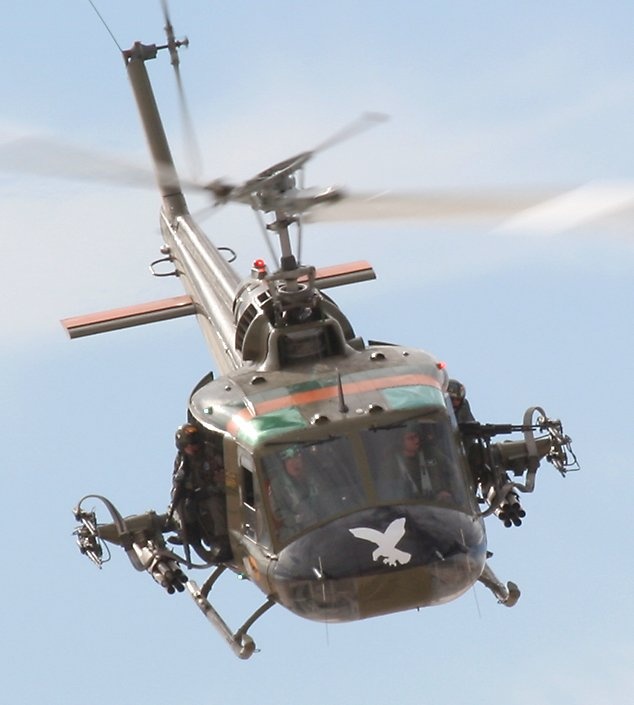
Cobra gunship armed with rockets and machine guns ( Vaughn Banting, 212warriors.com)
The fight lasts about an hour before the firing stops. The enemy is defeated, having no place to run to. 14 VC are killed and another 11 are taken prisoner. There are no U.S. losses in the battle.
Captured NVA (Ken Blakely, 212warriors.com)
Captured  Viet Cong soldier (Ken Blakely, 212warriors.com)
Battalion S-3 officer MJR Joe Rigby orders the two companies to look around the area and search the battlefield for weapons and anything we can find. As we scan over the area we see fresh bamboo bunkers along with some trench works skirting the edge of the hedgerows. Santiago, a Spec 4 from Texas and some of the guys are poking around and soon discover some concealed spider holes in addition to the other earthworks.
Viet Cong bunker ( Vaughn Banting, 212warriors.com)
Viet Cong bunker discovered at New Year ( Vaughn Banting, 212warriors.com)
One of Bravo’s ‘tunnel rats’ volunteers to check out one of these spider holes. It’s hard to believe how small some of these tunnel entrances are. For most of them, only a small man with a very slender build can squeeze into them.
A Tunnel Rat in Vietnam
Personally, I did not find it too appealing to go down into one of these armed with a flashlight, knife and a .45 Cal pistol. But, to each his own and Bravo Co. had a young kid who enjoyed the challenge and he started down into one of the openings.
What was sometimes waiting for them – a Viet Cong soldier in a tunnel.
A few minutes later he hollers’ out that it’s all clear. He discovers what appears to be a small underground hospital or aid station and a host of medical supplies in addition to an ammo cache which was partially concealed above ground. A lot of the items found come from the Red Cross and some of it was wrapped in U.S. newspapers, one from the Chicago area.
A Viet Cong base camp (212Warriors.com)
We’re standing around looking at the items that are being brought up from below ground and can’t figure out how this stuff arrived at its destination. Was it given to them through an international outlet and it made its way down from Hanoi? We never figured it out.
Examining Viet Cong supplies stored in ammo boxes (212warriors.com)
After all usable contraband is removed from this underground world, the 65th Engineers do their best to destroy what they can of the complex using shape charges. The ammo cache contained 87x82mm rds, 29 cases of RPG-2 rds, 30 cases of AK-47 rds, 73 Bangalore torpedoes, 15 cases of 60mm rds, 7 pistols (various), 1x60mm mortar tube, 5lbs of documents, 66,000 piasters, and 1 complete surgical kit.
Captured Viet Cong weapons’ cache, Cu Chi (Donald Patrick, Myspace)
Captured Viet Cong weapons cache, Cu Chi (Donald Patrick, Myspace)
The eleven detained suspects are part of the 7th Cu Chi Battalion Rear Detachment and are airlifted back to Cu Chi to be questioned, along with the first aid supplies that was uncovered.
Blowing a Viet Cong ammo cache (Richard Wiggins, 212warriors.com)
It’s getting late in the day and we have a pickup scheduled at 1530 Hrs to take us back to FSB Pershing. If we miss the hookup, we could be walking back to FSB Pershing. The extraction goes as planned and without incident. This was a good day for us and the unit. No one was killed and there were just some minor injuries that did not require a dust off. Nine days later, we would encounter a larger force in the same area which would result in a large firefight.
Approximate location of the Iron Triangle Area in red circle.

Thank you for your service SSG Arnold Krause!!!  Welcome Home Brother!!!

Peter Alan Lloyd maintains a website to promote his two published novels and a wide variety of articles related to the Vietnam War, backpacking through Laos and other interesting facts about South East Asia.  Please visit his website for more information of his offerings:  http://peteralanlloyd.com/category/the-vietnam-war/eyewitness-accounts/page/2/

If you enjoyed this article and want to learn more about the Vietnam War – subscribe to this blog and get each new post delivered to your email or feed reader.   Click on the title at the top of this page to be redirected to my main page – a directory on the right side lists similar articles and points of interest.

This is a teaser for my audiobook of Che

Posted in The Vietnam war story on December 5, 2013 by John Podlaski

Rate This

This is a teaser for my audiobook of Cherries. I used actual snippets from the narration and synched them with photos from the Vietnam War – offering listeners a visual slideshow as an added bonus. Click on the “YouTube” picture below to listen/watch this five-minute project. If you like what you hear and want more, both the written and audio versions of the complete first six chapters are posted on my website. For the sake of convenience, I have also included the direct links to those pages under the video. Looking forward to your feedback!
YouTube http://ow.ly/rut9N

▶Tribute to door gunners

Posted in The Vietnam war story on November 29, 2013 by John Podlaski

5 Votes

▶Dedicated to door gunners. Had a friend send this to me…A story by Marine Michael Rierson to celebrate the one abiding image we all brought home from Vietnam…it came in low and hot, close to the trees …Man in the Door -
  Tribute to Door Gunners

The Homecoming for Vietnam Veterans

Posted in The Vietnam war story with tags , , , , , , , , , , , , , , , , , , , , , , on November 26, 2013 by John Podlaski

3 Votes

 file
Here we are, almost forty years after the end of the Vietnam War, reminiscing on Facebook and other social websites about those experiences we endured in a war so long ago.  As we age, many of those memories have faded away, others, were purposely buried, destined to remain that way. However, some of these traumatic experiences continue creeping up to the surface, the details, clear as day and as if the incident occurred just yesterday. What if I told you that my reoccurring nightmare isn’t about encounters with enemy soldiers on foreign soil, but of a single incident that took place right here in the United States with my own countrymen?  That’s right, it’s about my homecoming after serving honorably for a year in the Vietnam War.
eating at 101st
The goal of every serviceman in Vietnam was to survive the brutality of war and return to the safety of “The World”.  I was happy, proud and thankful I survived – finally on my way home.  Our Pan Am jet landed at McChord AFB in Washington State and after disembarking, we had to walk across the tarmac to a large hanger almost a quarter of a mile away.  Unlike other wars, Vietnam Veterans did not come home as a unit, instead, they came home as individuals with 250 other strangers on a jet plane; a long single file line of veterans snaked toward their destination.  Large posters greeted us, announcing “Welcome Home”, “Thank you for your service”and “Our Country is Proud of you” among others.  Once inside, we were served steak dinners, completed a short physical examination and then issued new dress uniforms;  all are shocked and comment at their new measurements as this is something none of us paid attention to while overseas.  Every one of us lost an average of six inches around the waist. There is a feel of excitement in the air!  All are anxious to complete this process and leave for Tacoma International Airport to coordinate the final leg of their journey home.
vets in vn leaving outprocess
going home
plane
uniform
Dressed in my new  uniform; all ribbons, badges and sergeant stripes in place, I was ready to be welcomed home by the local populace, who had gathered in a large group outside the airbase; every one of us were looking forward to sharing the love.
home11111
homecoming11111
Instead of finding love, we were bombarded with hate!  People stood on the side of the road holding signs condemning the war and us returning veterans.  They chanted slogans as a group and yelled insults to us as we passed.  Once the bus began pulling away, tomatoes and eggs fell from the sky, splattering against the windows.  All of us on the bus sat quietly, shocked, jaws agape, unable to believe what had just happened.  Welcome to the new “World”!
Comittee for Non Violent Action (CNVA)
December, 1967 Stop the Draft Week
Comittee for Non Violent Action (CNVA)
protester
a
Comittee for Non Violent Action (CNVA)
We were treated like outcasts, blamed for a war we didn’t start, accused of killing innocent women and children, called dope heads, spit at and ridiculed by citizens most of the way to Michigan.  Don’t get me wrong, I did meet some very generous and friendly people on the way, but they were solely the minority and far and few in between.  Some uniformed soldiers with missing limbs were jeered at and told that they deserved their fate…   spit cartoon
spitting
no spit
spits1111
Nov 15, 1969 SF Moratorium Peace March
These actions, similar to the Westboro Baptist Church group that demonstrates at soldier’s funerals today, were not well accepted. Unfortunately, we didn’t have a Patriotic Guard to run interference for us and had to face the demons head on. pat guard
When arriving home, I was dumbfounded, ashamed, and depressed about our treatment – so this is the thanks for putting our lives on the line and for sacrificing what we did during the past year!  I began questioning myself – was I right in going to fight in Vietnam or did I make the wrong decision?  I soon discovered that it was better to not advertise and just keep quiet!
poster_schneider_war_lg
December, 1967 Stop the Draft Week
The news media had continued to flame the public opposition to the Vietnam War by broadcasting distorted and biased accounts from the battlefield. Reporting that the use of drugs in Vietnam was escalating, increased incidents of soldiers refusing direct orders to go out on patrols, and the military inflating body counts and misleading the public on the war – so the warriors were blamed for losing the war! ANTI-VIETNAM WAR PROTESTERS
sienna-miller-protest
protest on the mall
dont register1111
Clearly, it was unpopular for someone to be a Vietnam Veteran or even a member of the military.  In the 1970’s, Vietnam Veterans were discriminated against for jobs, publishing books of their war experiences and were referred to as the social delinquents in our society – even the VFW refused to allow us membership. It seems like every movie about Vietnam to that point portrayed the veteran as a killing machine with mental problems, bad marriages, hooked on drugs or alcoholics. 
rambo
rambo2
rambo3
They were considered an unstable and dangerous lot – a group that citizens should be wary of and avoid.  Vets clamped up, refrained from wearing military uniforms in public, grew beards and long hair to fit it with his peers, keeping primarily to themselves.  The truth was that our country just wanted to forget about Vietnam and didn’t want any reminders circulating. In my opinion, November, 1982 was the start of a new era for Vietnam Veterans – the wall in Washington DC was dedicated and the healing began.
wall1
wall2
Untitled
wall111111
Then, after Vietnam Veterans of America is founded in the mid-eighties, former combat veterans came out of their closets in droves, growing the organization by establishing local chapters throughout the country.  Finally, there is an outlet for veterans to talk about their tours and others who understood and listened intently.  The camaraderie is unsurpassed to this day!  The time had finally arrived for them to be recognized and appreciated. logo_wshadow chapter 154 vest
Not long afterwards Chicago and New York City both hosted “Welcome Home Vietnam Veterans” parades in attempts to recognize veterans and change public opinion.  I personally marched in that parade and have nothing but the greatest admiration for the Chicago residents – they went out of their way to sincerely make us feel wanted.
vets
parade1
parade2
How many of you are aware that in 1998, sociologist Jerry Lembeke published a book:  The Spitting Image:  Myth, Memory and the legacy of Vietnam, which completely discredits the claims that American Soldiers were spit on when they returned home and that it was a common urban myth, constructed to ruin anti war protesters.
spitting image
It stated, “that spitting on returning soldiers started somewhere around 1980 when Stallone mentioned it in ‘First Blood’.  Anyone who thinks that a number of U.S. soldiers were spit on and did not retaliate by whipping someone’s ass is admitting that they think U.S. Soldiers are wussies.  There is no way that you could spit on more than a select few soldiers and not get into a fist fight requiring someone to write a report about the incident.”  Since no reports or evidence was available, it never happened.  The truth is that these returning soldiers were still numb from the war and confused when confronted by the protesters.  They were unable to react or chose not to retaliate to further fuel the fires enveloping them.
Spring 1972 San Francisco March against the War in Vietnam
police car
Comittee for Non Violent Action (CNVA)
Looking further into this, I found that shortly after the book came out, a Chicago columnist, Bob Greene, came up with an idea for a newspaper column that eventually resulted in a published book.  The idea was prompted by rumors heard over the years.  In a column that is syndicated in 200 newspapers nationwide, he asked the following question:  “If you are a reader of this column, and you are a Vietnam Veteran, were you ever spat upon when you returned to the U.S.?” The response was overwhelming and more than 1000 soldiers wrote in.  The many letters confirmed the rumors and make a poignant, genuine statement on their own.  Taking excerpts from these letters, editing and verifying, Green put them together in a book called, “Homecoming”. homcoming by bob greene
Here are some excerpts from his book:
“In the Seattle airport as I was arriving home after serving in Vietnam in 1968-1969, a gang of 10 to 20 total strangers clustered in the terminal and shouted insults at me as I passed by in my uniform. It never occurred to me that people could … attack individual young soldiers who walked through the airport alone in their sacred hour of homecoming.`
When J. Leonard Caldeira returned from Vietnam he was walking with his fiancée in San Francisco. A rather nondescript man, “not a hippie,” he writes, spat at his uniform. “Nothing was said but the incident saddened and confused me. I took off my uniform later that day and never put it on during the rest of my stay in San Francisco…. The only mental scar that remains with me today of Vietnam was the unwelcome display of that man in San Francisco.
“ Frederick H. Giese of Arlington Heights, Ill., was evacuated from Vietnam to a hospital in Japan. While there he met a Japanese woman, married her and adopted her son.  When he returned to the United States in 1970, he was in uniform, wearing all his medals — including the Purple Heart and Bronze Star. “My family and I were standing in line, when, out of the blue, this middle-aged lady walked up to me with a bowl of potato salad in her hand.  She threw the salad smack in the middle of my chest and spat what salad she had in her mouth in my face. Then she proceeded to call me a `baby killer, a `warmonger`, and a lot of other vile names.  That was how I was welcomed home. That is how my family was first introduced to America.
” “It is dumbfounding to read letter after letter of such utter, personal viciousness Americans directed at Americans. These disquieting testimonies plumb depths of meaning on the war that volumes of analysis cannot”, said Greene. “I have no doubt that many returning veterans truly were spat upon,” Greene writes in his preface. “There were too many letters, going into too fine a detail to deny the fact.  I was profoundly moved by how, all these years later, so many men remembered exactly where and when they were spat upon, and how the pain has stayed with them.”
Bob Boughton, of Fredericktown, Ohio, recovering from injuries received in Vietnam was waiting for a bus home:  “An elderly woman came up to me, looked me square in the face and called me a hired killer.  But then, a young lady dressed in bell-bottoms, love beads and a peace symbol came up to me as the elderly woman walked away. She looked me in the face and told me she was sorry for the way the returning vets were being treated.  I could never forget her face and those few kind words.”
Greene writes, “I did indeed include the invitation for anyone who had spat upon a returning soldier to write in and explain his or her motives, and to reflect on how he or she feels about it now.“
“There were no responses.”
Many others, while not spat on, were called baby killers and war criminals by strangers, and occasionally by people they knew and friends from the neighborhood.  A number were welcomed back and thanked for the sacrifices they had made by citizens in public.  However, the vast majority of well wishes were from immediate family members.
welcome home pow
126th Homecoming , 15 May, 2008
homecoming111111
home111
home111111
Most of the spitting and jeering incidents in the book happened in San Francisco, where a large number of returning veterans stopped on the way home. Nevertheless, they also happened in the southwest and midwest. The veterans felt that the American people had turned against them.  From the soldiers I have known the common theme was they experienced this in some other areas of the country but it was virtually unheard of in the south.  This is only word of mouth and nothing is documented.
Spring 1972 San Francisco March against the War in Vietnam
gty_vietnam_war_protest_ll_130506_wmain
President Obama told a crowd gathered at the Vietnam Veterans Memorial Wall, “You came home and sometimes were denigrated, when you should have been celebrated and commended for serving your country with valor. It was a national shame, a disgrace that should have never happened. And that’s why here today we resolve that it will not happen again,” he said to applause.
obama Many Vietnam vets remain embittered by the treatment they experienced following the war.  The social alienation of Vietnam veterans, ostracized by the community instead of being welcomed home, has contributed to the problems of PTSD. OBAMA-articleLarge-v2
Today, the American psyche is ingrained with greater respect for the military, in large part, because people recognize that past treatment of Vietnam vets was a mistake.
Untitled
So does this mean we should forgive and forget?  Some scars are too deep to glaze over, and I, for one, will carry mine until I die.  What about you?
ggot nuthin coming home
001
If you enjoyed this article and want to learn more about the Vietnam War – subscribe to this blog and get each new post delivered to your email or feed reader.   Click on the title at the top of this page to be redirected to my main page – a directory on the right side lists similar articles and points of interest.

No comments:

Post a Comment

Simple template. Powered by Blogger.
CĂN CỨ MARY-ANN Ở QUÃNG NGÃI BỊ ĐẶC CÔNG TẤN CÔNG .

Running down the hallway of the battalion tactical operations center (TOC), Captain Paul S. Spilberg charged into a cloud of tear gas just as he reached the commander’s quarters. Staggering blindly back the way he had come, Spilberg made it to the north exit, crawled up the stairs and out the door into the fresh but bullet-ridden air. Forcing his eyes to focus, the shaken captain was stunned to hear the fire of AK-47s and the crash of rocket-propelled grenades from inside the base’s perimeter. In amazement he watched as numerous small figures darted catlike among the spreading flames. Everywhere he looked he saw the scurrying silhouettes, who were enemy sappers feeding the chain of explosions devouring Fire Support Base Mary Ann on that afternoon in 1971.
Four days before the fatal attack, Spilberg had arrived at the FSB by helicopter. He was an old hand there, having previously served at Mary Ann as a company commander. Along with three assistants, he now had returned as a marksmanship instructor. His team had established a training course using targets on a crude rifle range set up on the FSB’s southwest slope. The hill was garrisoned by Company C, 1st Battalion, 46th Infantry (1-46), 196th Light Infantry Brigade, assigned to the 23rd ‘Americal’ Infantry Division.
The battalion commander, Lt. Col. William P. Doyle, was a serious professional. Along with the Company C commander, Captain Richard V. Knight, Doyle had molded this handful of reluctant draftees into one of the better combat units still in the field in 1971. Mary Ann was in a generally quiet sector, and the soldiers atop the hill had come to regard their outpost as something of a rear echelon area rather than what it actually was — the division’s most forward firebase.
day bvefore
Three hours later the American firebase was rocked from within by a series of powerful explosions. Spilberg was asleep deep inside the TOC. The structure was a sturdily reinforced, half-buried bunker, and from its interior Spilberg initially had a hard time recognizing the muffled crashes. Thinking the base was taking mortar fire, he rolled off his cot and began pulling on his boots and shirt.
toc
Before leaving the bunker, he grabbed his .45-caliber pistol from under his pillow.On the afternoon of March 27, 1971, after the soldiers had completed their target practice, the three officers remained on the shooting range. They plinked with various weapons and talked awhile, and then Doyle and Knight headed for the mess tent. Spilberg remained behind to take a few more shots. He had only the base’s mascot dog for company. The mongrel suddenly bristled and began barking and growling at something downslope that Spilberg could not locate. He had never seen the amiable mutt behave like that, but try as he might he could not detect what was agitating the animal. Finally deciding the dog must have scented a tiger or cobra, Spilberg set out after the other officers. Much later he related: ‘I never said anything to Doyle about that dog being on alert, but I should have known. It bothered me for years and years. It was my second tour. I should have known.’
vc
One of the sappers had thrown tear gas into the TOC officers’ quarters, and Colonel Doyle was trying desperately to escape his gas-filled room. As he struggled to unlatch the plywood door, a satchel charge detonated in the hallway, blowing the door from its hinges and flattening him. Picking himself up, he turned toward the door and faced a sapper wearing nothing but bush shorts, a gas mask and a full-body coating of camouflage.
When the Communist drew back to hurl another satchel charge, Doyle raised his own .45 and shot him square in the chest. As the man fell backward the bomb went off, blowing him to bits and flattening Doyle a second time. Three more charges exploded in the hall before Doyle was able to dig through the rubble and leave the bunker.
colonel wwith 45
By then he was bleeding from fragmentation wounds in one leg and both arms. He was unable to hear through his blood-filled ears, and could barely see through gas-seared eyes.
For 45 minutes, the infiltrators sprinted throughout the firebase, expertly planting their charges among the frantic, befuddled Americans. As the assault concluded, the TOC was a towering pyre. Spilberg picked up a damaged M-16 he found on the ground. Wincing from three grenade fragments in his back, he made for Knight’s company command post to see if the captain had survived. The CP was a bonfire and beginning to collapse. As he reached the crumbling entrance, Spilberg could hear ammunition exploding in the flames. He peered inside but saw only a blazing vision of hell. Somewhere within that inferno, Knight lay dead.
knight
The company CP and battalion TOC had been the primary targets for the brilliantly executed sapper assault, and Knight was one of 30 Americans killed. On the morning of March 28, Doyle and Spilberg were among the 82 wounded GIs evacuated.
The first indicator that something bad was afoot had come on the night of March 25-26. Lieutenant Scott Bell was on patrol, on what was supposed to be his last night on the hill. As he squinted into the surrounding silent, mist-cloaked jungle, he sensed an almost tangible uneasiness in the air, and felt a primordial sense of dread that motivated him to organize one last big rat kill before his departure. Maybe that would keep his men alert.
maryann4
The soldiers knew the drill. They constructed ingenious rattraps from empty C-ration cans laced with cheese and blasting caps. All night the men counted miniature explosions as squirrel-sized Asian rats died in the competition between platoons. By dawn there were 130 dead rodents laid out in neat lines in front of the CP. These were the last fireworks here for Bell and Company A. The next morning they moved out and were replaced by Captain Knight and his Charlie Company, who were transferred in from Chu Lai.
Charlie Company settled into the new position and started policing the area in preparation for a visit from the brigade commander, Colonel William Hathaway, who had been unhappy with Company A on his last inspection. Knight hurriedly set his men to work disposing of dead rats, marijuana cigarette butts, empty whiskey bottles and other such junk left behind by their predecessors. When Hathaway, accompanied by Doyle and Knight, walked the perimeter that afternoon, he was delighted with the improvement over what he had seen a week earlier. Hathaway, however, did not inspect the tactical outer wire because, he later explained,’somewhere along the line you have to put the trust in the company commander.’
day after
Additional trip flares were triggered by the prop blast of CH-47 helicopters as they landed at and took off from the FSB. The Americans did not replace the flares. In hindsight, Hathaway thought overconfidence might have been another factor contributing to the debacle. ‘Charlie Company, commanded by Captain Knight, was certainly the best company in that battalion, and probably one of the best companies in this division,’ Hathaway said later. ‘One of the problems was that they were so good they were a little contemptuous of the enemy. They were the hunters, not the hunted.’But the outer defenses were not in order. As Lieutenant Jerry Sams, leader of C Company’s 2nd Platoon, later explained: ‘The sergeant major was on everybody’s ass about policing the area before the inspection, and they had my platoon out there picking paper off the wire. Those helicopters would come in and kick up all kinds of crap. I had to send the guys out two or three times, and it was one of those typical Army things where everybody’s bitching and raising hell. They were accidentally setting off trip flares in the wire — all our early warning devices that would have come in mighty handy later on that night.’
con thien
Another cause for the false sense of security was that there had been no signs of an impending attack. Major Alva V. Hardin, the 196th Infantry Brigade’s intelligence officer, later testified, ‘We had no intelligence to indicate there would be an attack on Mary Ann.’
The lack of listening posts outside the wire was another critical mistake. When Hathaway learned Doyle had not deployed LPs beyond the outer perimeter, he concurred. ‘Listening posts were not a policy,’ explained Hathaway. ‘I considered listening posts outside the wire a hazard. I considered the danger of people getting wounded, either by defensive fires or somebody getting excited and firing on the perimeter, to be greater than the necessity for the listening post.’
base
Mary Ann had been constructed on the bulldozed summit of a ridge running northwest to southeast. In profile the elevation looked like the back of a camel, with the base stretching 500 meters across both humps. It was 75 meters wide between the humps, and 125 meters broad at each end. A continuous trench that was knee- to waist-deep and had 22 bunkers formed the perimeter. Inside the perimeter were 30 buildings of various styles, giving the appearance of a shantytown. The whole thing was surrounded by two belts of concertina wire.
layout
Two dirt roads interrupted the trench and wire line of the perimeter. Doyle had tried unsuccessfully to have chain-link fencing flown in to close the openings, but higher headquarters, noting that the base was soon to be turned over to the ARVN, decided against providing construction materials for the soldiers of South Vietnam. The road openings remained.
With the 196th Infantry Brigade already scheduled for redeployment to Da Nang, Doyle had ceased all construction projects within and around Mary Ann and had started packing for the move. By March most of the base’s mortars and artillery had been airlifted to nearby LZ Mildred to fire on enemy positions in that sector. By March 27, all of Mary Ann’s starlight scopes and ground radars had been shipped to the rear for maintenance.
On the night of the attack, the infantry under Doyle at Mary Ann consisted of 231 Americans and 21 South Vietnamese, plus the battalion training team, battalion intelligence officer, the sergeant major, an interpreter and 22 transient soldiers from Companies A, B and D. The transient troops spending the night at the base were in no mood to remain on alert. Specialist 4 Harold Wise was one of those who had just arrived. ‘Thirty percent of the guys on the hill were heads,’ he said later. ‘Marijuana, heroin, whatever you wanted. The guys in the sensor hooch next to the tactical operations center were potheads, and a lot of people congregated there to buy stuff, but unless they knew you, you didn’t come in. They had locks on the door of their hooch. Nobody did it in the open. It wasn’t brazen. If an officer saw somebody doing it, he’d bust the guy. Some of the officers and sergeants knew what was going on, but as long as you did your job, they didn’t say anything.’
The drug problem on the base, although not as pronounced as in other areas, was still sufficient to benefit the enemy. Battery C, 3rd Battalion, 16th Field Artillery (155mm), was aligned in battery formation atop the base’s highest elevation. The infiltrators quickly destroyed both of the unit’s howitzers. Staff Sergeant Easton Rowell, the chief of the firing battery, was wounded six times. He later groused, ‘We took a screwin’ because the grunts on that hill were a bunch of potheads!’
5
The attackers were from the Main Force VC 409th Sapper Battalion. This unit was known for operating against the ARVN in Quang Nam province, and at that time was thought by out-of-date U.S. intelligence to be 15 to 20 kilometers east of Mary Ann, preparing for a major push against the South Vietnamese.At 0200 hours on March 28, an American searchlight crew conducted a cursory 20-minute illumination sweep of the slope outside the exit to the firing range. The hillside had been cleared of vegetation, but still was punctuated by boulders and tree stumps, all of which provided good hiding places for the small enemy. Seeing nothing unusual, the GIs shut down their light and headed for their bunker. The explosions started 10 minutes later.
sapper2
The 409th sappers were experts in their trade. With AK-47s strapped to their backs, grenades in their belts and satchel charges fastened to their chests, they wore nothing but khaki shorts and soot. They crawled silently, slowly and steadily through the jungle, using their fingertips as probes.
claymores
When they detected trip flares, they used lengths of bamboo, carried in their teeth, to tie down the strikers. When they felt wires leading to Claymore mines, they used wire cutters to cut the lines. They were careful to cut only two-thirds of the way through the strands of concertina, then used their fingers to break the rest of the way through the wire silently and without shaking the large coils.
6
Approaching from the southwest, the infiltrators cut four big gaps through the concertina, two holes on each side of the road where it left the perimeter. They repeated the procedure 50 meters farther on, through the second barrier, although the wire there was in such a state of disrepair that many sappers simply walked across the rusty, breaking steel strands. Another 30 yards and they came to the final concertina barrier. Rather than risk having the snip of cutters heard by some alert sentry, the infiltrators simply spread a gap through the wire, tying it open with bamboo strips.
sapper
The sappers were well-rehearsed. Splitting up into three- and six-man squads in the zone between the inner wire barrier and the bunkers facing southwest, the assault teams waited until 0230 hours. Then their supporting mortars opened with accurate fire on the TOC and CP on the base’s southeast side, and on the remaining U.S. mortar and artillery positions in the northwest area.
1
A card game in the radio room was just breaking up when the first rounds hit. The explosion hurled Wise onto his back, knocked off his glasses, broke his left arm and sprayed the front of his body head-to-foot with fragments. Using his right arm to drag himself into his hooch, he shook awake his roommate, Pfc Peter Detlef, and then hid behind his reel-to-reel tape deck as he seated himself on the floor and tried to cover the door with his M-16. When Detlef, still half asleep, tried to go through the door, another explosion blasted the door off its frame and on top of him.
sppers1
As the VC had anticipated, most defenders were immobilized by confusion. One radioman never bothered to crank up his radio to report the situation, but simply rolled off his cot onto his hut’s dirt floor and hid beneath his mattress until the shooting stopped.
Inside the TOC, Spc. 4 Stephen Gutosky grabbed his radio mike and reported: ‘Be advised, we are taking incoming at this time! Stand by and I’ll see if I can get a direction on it!’
When he realized with a start that he was still inside the TOC, he shouted into his microphone: ‘I can’t get outside to see where it’s coming from! Just fire all the counter mortars and counter rockets you got ASAP!’
fire
By that point the south end of the TOC was burning from the inside after a satchel charge set off a case of white phosphorus grenades. Yet Doyle still refused to abandon his position. After ordering Gutosky to radio for helicopter gunships and illumination, the wounded colonel said, ‘I’m going out to see what’s going on!’
Doyle did not realize how badly he was hurt. He was almost deaf and blind from tear gas, powder burns and explosion concussions. The shrapnel wounds in his arms and legs would take months to heal. Nonetheless he made it to the top of the exit steps, raised his M-16 and started to aim at a couple of infiltrators outside the bunker — but a third, unseen enemy soldier threw a grenade at him. It landed at his feet and exploded as he turned to head back inside, blowing him down the stairs.
sachel charges
The entire TOC was now burning. Lieutenant Edward McKay, the TOC night duty officer, started to panic in the ovenlike bunker. ‘We gotta get outta here!’ screamed McKay.
‘Not yet!’ hollered Doyle.
‘We’re all going to die!’ sobbed McKay.
Summoning his last element of strength, Doyle slapped the hysterical junior officer hard across the face and snarled, ‘Shut up, lieutenant!’
It was now 0251, and radio telephone operator (RTO) David Tarnay managed to raise LZ Mildred.
artSpilberg heard Tarnay shouting into his microphone, he bounded back inside the blazing TOC. Grabbing a handset, he shouted to Lieutenant Thomas Schmitz at LZ Mildred: ‘I want artillery 50 meters out, 360 degrees around our position. On my command be prepared to fire on the firebase!’
arty
Spilberg realized that calling down fire on his own position was likely the only way to save the surviving Americans there.
vietnam-war-artillery-granger
Doyle next grabbed the mike and informed Schmitz they were being forced to evacuate the TOC and would temporarily lose radio contact. With Tarnay and Gutosky carrying all the radio equipment they could, and with the now-incoherent McKay slung over Tarnay’s shoulder, the handful of resolute GIs made their way to the firebase aid station, where Tarnay put McKay on a cot and then tried to get a radio working.
artill
Doyle and Spilberg left the aid station and crossed the compound to the Charlie Company CP. When they arrived they found that it too was an inferno, its sandbagged entrance collapsed.  Throughout Mary Ann, unprepared Americans were shot and blown apart by the VC sappers, who seemed to know precisely where to concentrate their assault.
fight back
Later, some survivors would accuse the South Vietnamese of cooperating with the attackers. Specialist 4 Steven Webb was the only U.S. soldier who was with the base’s ARVN contingent throughout the fight. Despite later rumors that ARVN troops had fired on Americans that night, Webb said he never saw it happen.
Nevertheless, suspicion and bitterness lingered. One of Knight’s NCOs, Staff Sgt. John Calhoun, later remarked, ‘It was an inside job.’
Specialist 4 Edward L. Newton concurred. ‘That morning before the attack, an ARVN officer came up to our bunker and asked how we got out of the perimeter,’ he recalled. ‘We asked him why he wanted to know. He said because he and his men wanted to go down there fishing. We thought it was kind of peculiar. We said we did not know for sure.’
The officer, who wore the insignia of a South Vietnamese first lieutenant, persisted in his questioning of the Americans until some of them told him the easiest way in and out was the south end and on the road running past the rifle range to the water point.
Specialist 5 Carl Cullers later claimed: ‘[I saw] an ARVN going behind the rifle range. It was more or less a joke at first. One of the cooks said, `Hey Cullers, there’s an NVA down there,’ and I said, `Quit joking,’ and he said, `Wait, and I’ll point him out to you.’ I knew he was an ARVN by his size. He had gone out beyond the rifle range, and down the slope for about 20 minutes. I took it for granted he had gone down to defecate.’
Vietnam War
Sergeant Andrew Olints of Company D was next to the helipad at dusk on the 27th when ‘an ARVN chopper came out, and fifteen of those little suckers got on,’ as he later reported. ‘They were thrilled to death, jumping on, pushing each other. I didn’t think the thing would take off, it was so overloaded. We had no idea what was coming, but in retrospect it sure looked like they did.’
maryannm
Specialist 4 Gary Noller, an RTO at LZ Mildred, later wrote: ‘I remember an incident where a GI came to the TOC and said that an ARVN was signaling with a flashlight to someone outside the wire.’ He said he went to check it out. ‘[I] did encounter an ARVN with a GI flashlight near the east perimeter wire,’ Noller remembered. ‘I told him not to use it, in English, which he probably didn’t understand, and then reported this to an officer. The incident was not treated seriously by the officers, but added credence as far as the GIs were concerned that some of the ARVN were not on our side.’
hilltop perimeter for fbase
In one of the most dramatic events of the night, Lieutenant Barry McGee, who had been sleeping atop bunker No. 10 when the attack started, stumbled half asleep into his platoon CP with several of his men just as the enemy targeted the position. McGee was the leader of C Company’s 3rd Platoon, which manned bunkers Nos. 9 through 13. As he and his men grabbed their weapons and prepared to return outside, two mortar rounds hit the bunker, half demolishing it and dislodging a heavy ceiling beam that fell on the lieutenant, seriously injuring his head. A medic dressed the wound, and after about 15 minutes the men in the platoon CP noted that the explosions outside seemed to be ending.
hill.jgp
McGee had just lurched to his feet, turned to the door and said, ‘All right, let’s go!’ when a grenade sailed through the door, exploded and blew the medic, Spc. 5 Carl Patton, back into McGee. Realizing he had lost his weapon, McGee grabbed Patton’s M-16 and again headed for the door. Another satchel charge detonated on the roof, caving it in and killing 22-year-old Sergeant Warren Ritsema when a beam fell on him. The blast knocked down McGee, who again lost his weapon. He staggered to his feet and stumbled outside, incoherent with pain and frustration. When the short, stocky, powerfully built and unarmed lieutenant collided with a sapper outside the bunker, McGee wrestled him to the ground and strangled him with his bare hands. It was quite a feat for somebody already half-dead from a fractured skull. The lieutenant’s corpse was later found atop the VC he had choked lifeless. Another sapper had shot McGee in the back.
At 0320, Spilberg and Doyle were at the southern end of Mary Ann, believing the attack was almost over. But then, partly obscured by the billowing smoke, another team of sappers started back up the hill, throwing grenades in all directions.
H25
Apparently searching for their own dead and wounded, the VC broke contact and withdrew when the first helicopter gunship finally arrived overhead.
www.richard-seaman.com
It was commanded by Captain Norman Hayes, Troop D, 1st Squadron, 1st Cavalry. Hayes radioed LZ Mildred that he had arrived at his objective and to lift and shift the artillery fire Spilberg had earlier ordered. Mildred ceased firing except for illumination rounds. When Hayes’ searchlight illuminated VC in the wire, they opened up on the gunship with small arms. As Hayes later put it, ‘We engaged, and I know that anything we fired on ceased firing on us.’
maryann3
Hayes made repeated passes over the base, dropping grenades and strafing targets of opportunity, despite two of his guns becoming inoperative almost immediately after his arrival on station. He made repeated radio calls for additional gunships and medevacs, but by the time he ran low on fuel and had to return to Chu Lai, no additional aircraft had arrived. Because of the chaotic state of communications, the brigade and division were under the misconception that Mary Ann had been subjected to nothing more than mortaring. Hayes actually had time to return to Chu Lai, refuel, reload and repair his guns, and then fly all the way back to Mary Ann, before medical helicopters began arriving. Colonel Hathaway and Lt. Col. Richard Martin, commander of the 3rd Battalion, 82nd Field Artillery, arrived with the medevacs. Spilberg was almost amused at their reaction to the devastation, later remarking: ‘They were in a state of shock. They had just walked into Auschwitz.’
medivac
Despite having a gutful of fragments, Spilberg at first refused to leave the base. He wanted all his wounded men taken out before him, and when Doyle told him to board a chopper he simply climbed in one door and out the other side. Not until Hathaway gave him a direct order did Spilberg finally leave. He was later awarded the Silver Star.Spilberg also recommended Doyle for a Silver Star, but Hathaway refused to endorse the nomination. He later said he was tortured by the decision, explaining, ‘I just felt that although he had conducted himself with a certain amount of valor, the situation had occurred because of shortcomings on his part.’
2
At 1600 the next day, the enemy hit the ruins of Mary Ann with 12.7mm machine gun fire, sweeping the enclosure from a ridgeline to the north.
18
One GI was wounded in the attack.Fifteen dead sappers were collected from within the base, although blood trails indicated several dead and wounded had been dragged back into the jungle. After the debacle, however, the South Vietnamese decided they did not want to garrison Mary Ann. The FSB was closed and abandoned on April 24, 1971.
General Creighton Abrams, commander of the U.S. Military Assistance Command, Vietnam, held 23rd Infantry Division commander Maj. Gen. James Baldwin responsible for the disaster, and relieved him of his command. The 23rd ID’s name had been eternally tarnished three years earlier because of the My Lai massacre. Many in the U.S. Army suspected that Baldwin would not have been fired had he been in any other division.
What happened at Mary Ann was a failure at the most basic level of soldiering. The Company had been warned by its South Vietnamese Kit Carson scout that it had been infiltrated by enemy spies posing as ARVN (Army of the Republic of Vietnam) soldiers.
Stengle_Khunt_MilesB
All electronic sensors had been pulled from the perimeter the day before the attack. Not a single ARVN soldier came to the aid of the Americans, and the enemy left their Vietnamese brothers alone throughout the assault. The Americans also took fire from the ARVN part of the compound. Mary Ann was a classic case of intelligence failure. The clues, quite simply, were never added up.
Fire Support Base Mary Ann was scheduled to be turned over to the ARVN in a matter of days. Nobody had bothered to tell the soldiers who died defending it.
fly out day after
Both Hathaway and Doyle received career-ending formal reprimands. Being blamed for the Mary Ann tragedy was a crushing blow to Doyle. He and his wife divorced soon after his release from the hospital. He remarried in April 1972 — just two weeks before receiving his letter of reprimand from Army chief of staff General William Westmoreland. Doyle cut his honeymoon short in order to make a personal but futile appeal to Westmoreland. Doyle developed a severe drinking problem, and he died of a heart attack in March 1984. He was 52. Hathaway and Spilberg were among those following his caisson to the gravesite at Arlington National Cemetery. While delivering the funeral oration, Spilberg spoke for many when he referred to Doyle as ‘the last casualty of Firebase Mary Ann.’
This article was written by Kelly Bell and originally published in the April 2006 issue of Vietnam Magazine.  Pictures provided from the internet and placed into the story line by John Podlaski

Battle of FSB Mary Ann

Part of the Vietnam War
Date March 28, 1971
Location 15°18′20″N 108°6′37″ECoordinates15°18′20″N 108°6′37″E Quang Tin provinceSouth Vietnam MGRS AS 962-998
Result Viet Cong victory

Belligerents

 United States  Viet Cong

Commanders and leaders

William P. Doyle Unknown

Units involved

 23rd Infantry Division “Americal”   1st Battalion, 46th Infantry Regiment2nd ARVN DivisionBattery B, 22nd Field Artillery  Military Region 5409th VC Main Force Sapper Battalion

Strength

231 U.S.21 ARVN ~50

Casualties and losses

33 KIA,
83 wounded
15 found dead

In memory of those who lost their lives that night:

Capt. Richard V. Knight, Company C, 1-46th Infantry
1st Lt. John L. Hogan, Battery B, 1-14th FA, attached to 1-46th Infantry
1st Lt. C. Barry McGee, Company C, 1-46th Infantry
S.Sgt. Terry H. Price, Company C, 1-46th Infantry
Sgt. Michael L. Crossley, Company C, 1-46th Infantry
Sgt. Warren P. Ritsema, Company C, 1-46th Infantry
Sgt. Ronald James Becksted, Company C, 1-46th Infantry
Sp4 Victor R. Bennett, Company C, 1-46th Infantry
Sp4 Richard J. Boehm, Company C, 1-46th Infantry
Sp4 Richard R.. Carson, Company C, 1-46th Infantry
Sp4 James E. Edgemon, Company C, 1-46th Infantry
Sp4 Myron B. Johnson, Company C, 1-46th Infantry
Sp4 Robert J. Schumacher, Company C, 1-46th Infantry
Sp4 Donald M. Stotts, Company C, 1-46th Infantry
Pfc. Druey L. Hatfield, Company C, 1-46th Infantry
Pfc. Michael S. Holloway, Company C, 1-46th Infantry
Pfc. Laymon Palmer, Company C, 1-46th Infantry
Pfc. Dallas D. Robinson, Company C, 1-46th Infantry
Pfc. Paul A. Sheer, Company C, 1-46th Infantry
Pvt. Steven D. Plath, Company C, 1-46th Infantry
Pvt. Clark V. Shawnee, Company C, 1-46th Infantry
Sp5 Kyle S. Hamilton, HHC, 1-46th Infantry
Pfc. Wilbert S. Dupree, HHC, 1-46th Infantry
Sgt. Michael J. Bayne, Company A, 1-46th Infantry
Sp4 Larry W. McKee, Company A, 1-46th Infantry
Sp4 Larry D. Austin, Battery C, 3-16th FA
Sp4 Clifford W. Corr, Battery C, 3-16th FA
Sp4 Roger D. Whirlow, Battery C, 3-16th FA
Pfc. Donald C. Bennett, Battery C, 3-16th FA
Pfc. William W. Kirkpatrick, Battery C, 3-16th FA
If you enjoyed this article and want to learn more about the Vietnam War – subscribe to this blog and get each new post delivered to your email or feed reader.   Click on the title at the top of this page to be redirected to my main page – a directory on the right side lists similar articles and points of interest.

Photos: The Pacific and Adjacent Theaters in WWII

Posted in The Vietnam war story with tags , , , , , , , on December 24, 2013 by John Podlaski

3 Votes

***************************************************************************************************************.
This is why  we are The Land Of The Free And The Home Of The  Brave.  CENSORED  PHOTOS OF  WW II ACTION IN THE PACIFIC Many have not seen  photography like this before. Beautiful, stark black &  white pics, about 110 of them, of historical significance  in  this collection. For many of us, our fathers and/or  grandfathers participated in this action… Although this post isn’t about The Vietnam War, I still feel it is important and I’m honored to share it with you.  /  John

Saturday, February 8, 2014

Kinh nghiệm về bảo vệ tác quyền (copyright) .
Thư viện chánh của TP có quày sách cũ : bày bán sách mới hay cũ , DVD , v.v... do dân cho hay từ các TV chi nhánh bỏ đi (do rách bìa , mất trang , v...) . Có lần , anh bạn tôi cho 1 dvd , sang lại từ 1 phim do VN sản xuất . Sau khi xem xong tôi đem cho quày sách này . Cô SV Mỹ gốc Mễ , (làm thiện nguyện cho quày sách) ,  ko nhận dvd này  và nói , nó vi phạm bản quyền (phạm pháp) . Tôi nói , anh bạn tôi mua dvd gốc khi du lịch vn và khi sang Mỹ đã sang lại vài copy cho bà con .
Ở Mỹ , bạn có thể sang lại 1 dvd gốc để dự phòng dvd gốc bị hư thì thay thế . Nhưng đem dvd này cho người khác là phạm pháp.
Họ coi trọng bản quyền vì đó là tài sản của trí tuệ . VD : hệ điều hành Windows của Microsoft được viết bởi VÀI NGÀN KỶ SƯ với chi phí 3-4 TỈ ĐÔ trong vài năm . Thành ra giá bán 1 HDH khoảng trên dưới 200 đô . Tháng 8/ 2001 , Windows XP ra đời , sau đó là Vista , Windows 7 và tháng 8/2012 Windows 8 ; nghĩa là chĩ có bốn HĐH Windows trong 11 năm .
Ngoài HDH này , còn có OS của hảng Apple và các HĐH của cộng đồng Linux . Đây là tập hợp các programmer toàn cầu nhằm tạo ra 1 HDH  miễn phí , bạn có thể download từ mạng hay mua dvd chừng 5-10 đô . Vì là đóng góp thiện nguyện từ nhiều người nên nó ko có nhiều chức năng như Windows hay OS . Với người  ko có tiền mua Windows hay OS thì nó vẫn hữu dụng (có thể lướt mạng , dùng FB , Skype ,  ko có Yahoo Messenger , thảo văn bản bằng OpenOfffice ,v.v...)
Trước đây , khi chưa mua được Windows , tôi đã xài HDH Linux như Ubuntu , Lubuntu , Olivia 15 hay Knoppix .
NHÂN BÁO ND CÓ BÀI VỀ ẢNH HƯỞNG CỦA FB TẠI VN . (đã đăng trên FB của tôi)
Dù fb đang gây tác hại cho chính phủ vn , như báo ND đề cập , nhưng rất khó cấm vì 2 lẽ : 1/ sợ dư luận quốc tế . 2/ nhu cầu quảng cáo của các doanh nhân và công ty trong/ngoài nước ; chứ việc cấm đoán này nằm trong tầm tay của CP VN . Vì các Internet Services Provider (nhà cung cấp dịch vụ hay nhà mạng) ở VN như Viettel , v.v... đều do CP quản lý toàn phần hay từng phần . Không như ở Mỹ hay các nước DC khác thì ISP là tư nhân như ATT , Comcast , v.v...
Do ISP ở VN gần như bị quản lý hoàn toàn bởi CP , nên mọi hoạt động trên mạng của bạn đều bị theo dỏi (monitor) hay điều tiết (regulate) . Ví dụ như bạn định viết vài dòng vào stt của bạn trên FB ; nhưng trước khi máy bạn nối kết với máy chủ (máy chủ/server đặt tại TP Palo Alto ở Bắc Cali) , bạn phải được ISP như Viettel , v.v... nối kết với máy chủ . Nếu ISP được lịnh mới của CPVN thì bạn ko thể nào vào được FB của bạn . Ở 1 số nước Hồi giáo , do giáo lý khắc khe , thì họ có lý do để cấm đoán FB hay Youtube , v.v... Trong khi đó , VN mới vào HĐ nhân quyền của LHQ mà lại đóng FB thì sợ mang tiếng với QT củng như gặp sự chống đối của các nhà đầu tư , hay các doanh nhân , vì họ cũng cần FB để quảng cáo sản phẩm của họ . Lấy 1 VD nhỏ : bạn có 1 tiệm uốn tóc nhỏ , bạn dùng FB để quảng cáo tiệm mình , vừa rẻ tiền mà lại update hằng ngày . Nếu cấm FB thì bạn QC cách nào , chẳng lẻ QC trên vietnamnet hay VTV vì giá rất đắc mà người xem ko để ý .
Vừa rồi BNG Mỹ vừa bị 1 vố khi cuộc nói chuyện tối mật về UKRAINE đã bị tình báo Nga nghe được (theo BBC) . Họ đã post lên Twitter của 1 nhân viên TB Nga ; và clip này đã được tung lên Youtube , 1 chi nghánh của Google , đặt tại Mountainview , Bắc Cali . CP Mỹ hiện nay chưa làm gì được với clip này vì nó không vi phạm bản quyền (copyright) . Nếu yêu cầu Google rút xuống thì lại vi phạm tự do ngôn luận , nên đành 'ngậm đắng nuốt cay' mà thôi .

1Like · · Promote ·
  • Duyen Duyen Tran and 2 others like this.
  • Duyen Duyen Tran Thông tin rất hay bác ạ.
  • Hoang Ngoc Diep · 3 mutual friends
    Chả có FB nào gây tác hại cho chính phủ VN cả! Nếu không có FB thì thiên hạ có chỗ khác để vạch trần tội ác của chúng thôi!

    Và ai bảo là CSVN đã và đang không cố gắng ngăn chận? Firewall liên tục, dày đặc ra đó kìa!


    Còn nếu đi đổ thừa cho FB thì nên đi đổ thừa cho Internet và cắt luôn Internet như bọn Bắc Triều Tiên đi!
  • Tai Tran Tôi có thằng cháu ở vn vừa cho biết : vừa rồi , nó đã gặp khó khăn khi tạo 1 tài khoản cho 1 người chưa bao giờ xài FB . (Có lẽ vì CP VN ko muốn gia tăng số người tham gia FB) . Nhờ nó có tay nghề nên đã đi vòng quanh chướng ngại để tạo được TK này . Hiện nay , CP VN có khả năng điều tiết sự lưu thông (traffic) trên mạng vì các nhà mạng (Intenet Services Provider) đều do họ nắm như Viettel , v.v...
    1/ Cái lợi thứ 1 của FB là chĩ cần vào vào trang nhà của mình là có thể đọc tin tức 'hot' về VN hay thế giới - đã được post trên FB của bạn mình . (Giống như có hàng chục hay hàng trăm người khác đọc báo giùm cho mình) . Rồi ở mỗi FB của bạn mình , mình có thể comment từ những bạn của bạn mình .
    2/ Lợi thứ 2 : các tin này lan truyền đi rất nhanh theo cấp số nhân . Các cuộc cách mạng ở Tunisia , Ai cập . . . có được thành công cũng nhờ có FB . Trước đây , khi FB chưa được phổ biến , ta vẫn có thể vào blog của lề trái , đọc bài hay để lại còm . . . nhưng độ phát tán ko nhanh bằng FB .
    Tôi mới xài FB chừng khoảng hơn 1 năm dù đã có tới ba blog . Các blog của tôi , nhiều khi 3-4 tháng mới có 1 khách để lại 'còm' . Các học trò cũ của tôi từ lâu đã khuyên tôi dùng FB để quảng bá bài vở của mình ; nhưng tôi không nghe . Mãi tới lúc gần đây , do thường hay còm trên blog của chị Vũ thị Phương Anh , tôi biết được FB của chị nên đã vào FB của chị (để viết còm) . Từ chổ đó , bắt đầu giới thiệu các bài viết của mình . Và kể từ ngày đó , tôi có rất nhiều bạn bè mới . Có nhiều bạn trẻ muốn làm bạn với tôi qua FB , nhưng tôi không nhận vì lý do sức khỏe (chĩ cần nhóm/circle chừng vài chục người người là đũ , kể cả bà con bạn bè) .
    Tuy nhiên , blog vẫn có cái hay là mình có thể hệ thống hóa các bài viết để khi cần thì tìm dễ dàng .
Nhìn gốc cây chết khô tại Mỹ mà suy nghĩ đến VN  .
Tôi ở TP không nổi tiếng như New York hay San Francisco . Tuy nhiên câu chuyện sau đây làm cho tôi suy nghĩ khá nhiều . Một hôm , trên đường đi bộ từ nhà ra trạm xe bus , tôi trông thấy một thông báo treo trên một cây nhỏ , gần như trụi lá chu vi chừng 2 tấc . . .  nói rằng TP sẽ đốn bỏ cây này trong thời gian tới vì nó bị sâu tàn phá , không thể sống . . . ai có ý kiến về việc chặt bỏ cây này xin gọi đến VP ở số phone . . . .
Tôi đã suy nghỉ rất nhiều : một cây trồng trên lề đường nhằm tạo bóng mát cho dân cũng như cung cấp thêm buồng phổi cho TP . Nay cây bị sâu tàn phá , không thể sống được , họ phải nhổ bỏ để trồng cây khác . Thế mà TP cũng sẵn sàng đón nhận ý kiến của dân : có nghĩa TP muốn làm cái gì củng phải hợp lý , đúng qui định , cũng như sẵn sàng lắng nghe ý kiến của dân . Nếu dân có ý kiến hợp lý hơn (để xử lý cây này) này thì TP sẻ nghe theo .

2/ Nhìn lại VN , dù có  tai nạn bùn đỏ ở Hungari , TT Dũng vẫn ra lệnh nghiên cứu làm con đường đưa sản phẩm từ 2 nhà máy khai thác bauxite ra bờ biển mà không đếm xỉa đến những ý kiến phản biện của  nhiều trí thức . Điều này nói lên sự  coi thường ý kiến của dân của TT Dũng . Với tình trạng làm ăn cẩu thả truyền thống của nghành xây dựng VN , liệu những hồ chứa hàng triệu m3 bùn đỏ có bị vỡ ra , làm trôi hay ngập lụt bao nhiêu làng mạc ở phía bên dưới không ? Hay là cứ tiến hành khai thác bauxite , hồ chứa có vỡ , trôi nhà trôi cửa thì cụ TT nhà ta lại có một màn photo-op qua cảnh cụ mặt sơ-mi trắng lốp , phát thùng quà cứu trợ rất đẹp cho những người còn sống tại một trung tâm tiếp cứu cách nơi xảy ra tai nạn hàng trăm km (xem hình) . Theo ý kiến của các nhà khoa học , nếu các hồ chứa bùn đỏ bị vỡ thì tai họa sẽ nhiều hơn ở Hungari vì có chênh lệch lớn về cao độ (cả ngàn mét) giửa nơi đặt nhà máy và bình nguyên đông dân sinh sống bên dưới .


3/ Sinh mạng con người VN sao quá rẻ rúng như vậy . Ở nước người , chặt bỏ 1 cái cây nhỏ bị sâu đục mà CQ còn hỏi ý kiến của dân , còn VN ta , một nguy cơ tiềm tàng có thể gọi là một quả bom nguyên tử nổ chậm mà CP cứ phớt lờ , coi ý kiến dân không ra cái gì ? Hay đã ký hợp đồng , tiền đã bỏ vào túi riêng ; nếu hủy thì phải trả lại tiền cho nhà đầu tư Trung quốc ! Thôi ta cứ vô tư tiến hành , vì bên thi công nhà máy đã cam kết không để xảy ra tai nạn !?! . Nếu có xảy ra tai nạn thì đỗ lỗi cho nhau , coi như không ai chịu trách nhiệm (đây là truyền thống của quan chức VN) và cụ TT Dũng chỉ lên TV xin lỗi dân là xong ! Than ôi , sinh mạng của bao nhiêu con người VN không bằng 1 gốc cây nhỏ chết vì sâu bệnh tại Mỹ !!! Ô hô ! Ai tai !
San Jose ngày 13.12.10 lúc 8:19 tối .

Friday, February 7, 2014

Anh thông cảm cho tôi : méo mó nghề nghiệp đấy . Vì dầu gì cũng làm thông dịch cho một NGO của Pháp trong 4 năm (1990-1993) và dạy Toán 3 năm tại tư gia ở Mỹ (do thiên hạ nhờ cậy ) chứ tôi có vổ ngực xưng tên là thày giáo dạy học gì đâu ; vì trước 75 chĩ làm biết cầm súng . Mới xong lớp 11 trường tư là phải vào QĐ vì lịnh tổng động viên năm 1968 . Nhưng do tự học thêm trong thời gian đi lính và sau khi ra tù năm 1981 .
Thành ra , anh thấy tôi viết lách rất regle (phải có thêm dấu sắc trên hai chử e) , tạm dịch là chuẩn mực . Trước đây , khi dạy toán , nhìn sơ qua thì biết sai chổ nào , học trò rất sợ tôi . Mặc dầu chưa học ĐH ngày nào từ VN hay Mỹ . Sau này chuyển qua sửa chữa vi tính miễn phí cho bạn bè .
Anh có con đi học ở Mỹ như vậy rất tốn nhiều tiền vì bọn nó còn học high school . Nếu tôi ko lầm , tuition mổi năm cũng phải 15000 đô . Chưa kể ăn ở (nếu có bà con lo thì đở mặt này) .
Phải nói nền GD của Mỹ là tiên tiến nhứt TG : ko phải tôi ở Mỹ mà khen đâu . Có 1 lần , 1 GS người Đức được CP Đức mời làm Viện trưởng 1 ĐH ở Đức - mà anh bik , KHKT Đức cũng thuộc hàng đầu TG (ở Mỹ xe Đức có giá hơn xe Mỹ/nhựt) . Ông này từ chối , sang Mỹ dạy học cho 1 ĐH nổi tiếng . Khi hỏi tại sao ko nhận position cao hơn ở Đức , ông nói ở Mỹ ông được tiếp cận với KH tân tiến nhứt TG . Hiện giờ các phát minh mới nhứt phần lớn từ Mỹ và các giải Nobel cũng do Mỹ nắm rất nhiều . Trường Stanford , ở gần San Francisco , là nơi có nhiều GS có Nobel . ĐH Berkeley ở gần đó . Các hảng điện tử nổi tiếng của Mỹ như HP, Yahoo , Facebook , Google , Ebay , hay Apple , v.v... đều nằm ở bắc Cali . Có 2 đại gia Amazon và Microsoft thì đặt gần Seattle ở bang WA .