Showing posts with label cambodia. Show all posts

Monday, August 11, 2025

 SYNOPSIS  MACV-SOG, or Military Assistance Command Vietnam Studies and Observation Group, was a joint service unconventional warfare task force engaged in highly classified operations throughout Southeast Asia. The 5th Special Forces channeled personnel into MACV-SOG (though it was not a Special Forces group) through Special Operations Augmentation (SOA), which provided their "cover" while under secret orders to MACV-SOG. These teams performed deep penetration missions of strategic reconnaissance and interdiction that were called, depending on the location and time frame, "Shining Brass," "Daniel Boone," "Salem House" or "Prairie Fire" missions.

During 1968 and early 1969, CCS had been inserting 6-man reconnaissance patrols into the Fish Hook border area between South Vietnam and Cambodia. The hard reality was due to the intense enemy presence continuously operating in the region, if a patrol could be inserted and stay on the ground undetected for three days, it was very lucky. Many teams were discovered within 30 minutes of insertion and forced to be extracted under fire shortly thereafter. Another major factor faced by reconnaissance teams, including the Hatchet Force, was locating an unguarded landing zone (LZ). Locating one large enough for a single helicopter insertion was one thing, however, finding an unguarded LZ large enough to accommodate four helicopters was quite another.

To shift the balance of power and disrupt the NVA's influence in the region, a direct attack on the North Vietnamese headquarters for operations in South Vietnam known as the Central Office for South Vietnam (COSVN) was developed by Military Assistance Command, Vietnam. The headquarters bunker complex was located just a mile inside Cambodia in the Fish Hook area; approximately 14 miles southeast of Memot, Cambodia; 20 miles southeast of Quan Loi and 28 miles northeast of Tay Ninh, South Vietnam.

After receiving his mission days before the Hatchet Force was to be inserted, Lt. Col. Earl Trabue, Commander of Command and Control South, informed OP-35, MACV-SOG in his opinion their plan to attack the COSVN complex was not viable. The plan included the Hatchet Force snatching NVA prisoners as well as reporting on the effects of a B-52 Arc Light air strike against the COSVN complex that was also going to be used to cover the team's insertion. Lt. Col. Trabue fully understood the complexities of the mission and believed it to be too dangerous to insert only an augmented platoon and should be cancelled. Further, he believed the B-52 Arc Light air strike would not stun the enemy as projected.

The size of the Hatchet Force was limited as only 9 US Army Huey helicopters assigned to the 195th Assault Helicopter Company were available for the 10 minute, 20-mile flight from Quan Loi Airfield, MACV-SOG's southern launch site, to the target - 4 Huey transport insertion helicopters supported by 4 Huey gunships and 1 Huey command and control aircraft for directing the overall mission. Because of the flight configuration, only one platoon-sized force could be assigned to this mission.

On 24 April 1969, Capt. William H. O'Rourke, Jr., company commander and ground mission commander; Capt. Paul D. Cahill, assistant ground commander; 1st Lt. Gregory M. Harrigan and 1st Lt. Walter L. Marcantel, then SFC Jerry M. "Mad Dog" Shriver, Hatchet Force exploitation platoon leader; Sgt. Earnest C. Jamison, team medic; and their Montagnard soldiers comprised the augmented Hatchet Force that was to be inserted into Cambodia by helicopter 1½ miles north of the Vietnamese/Cambodian border.

All US Army helicopters were under the operational control of the air commander in the command and control helicopter. The only other air asset assigned to this mission was an Air Force Forward Air Controller (FAC) who was to call for and coordinate fixed wing air assets should their participation be necessary.

Shortly before takeoff at dawn, SFC Shriver boarded the first helicopter. As the aircraft lifted off the ground for the flight, the B-52s were to be making final preparations for their bomb run against COSVN. At the same time the helicopters prepared to takeoff, the Huey carrying Capt. O'Rourke and 5 team members developed mechanical problems and was forced to abort the mission. Because of this, Capt. Cahill, the assistant ground commander, took over the responsibilities of ground commander for the remainder of the mission.

The original plan was for the helicopters to insert the team as the air strike's dust settled. Unfortunately, when the helicopters arrived at the designated coordinates, it was the wrong location. The aircraft flew around for 30 to 45 minutes searching for signs of dry bomb craters, which would mark the correct site. When the pilots finally found three dry ones, the helicopters descended in-trail toward them and landed. After the members of the Hatchet Force leaped off, the helicopters' pulled up and away from the landing zone (LZ) for their return flight to Quan Loi.

As soon as the landing force was on the ground, the men took cover in one of two craters located side by side and roughly 30 to 50 yards from the bunker complex. Immediately after discharging their passengers, the helicopters pulled up and away from the LZ. They had reached an altitude of only 20 feet above the ground when the NVA opened fire from concrete bunkers and entrenched positions with a withering barrage of gunfire wounding or killing those men who had not reached the safety of the craters.

From his position in the western-most bomb crater, Jerry Shriver radioed other team members stating that a machine gun bunker to his left front had his men pinned down and asked if anyone could fire at it to relieve the pressure. Capt. Cahill, 1st Lt. Marcantel and Sgt. Ernest C. Jamison, who had taken cover in the center crater, reported they were also pinned down and unable to help. The air commander notified the Hatchet Force that he was bringing in the gunships for air support. Immediately he directed all gunships to use their mini-guns and rockets to attack the NVA positions. Further, to make sure no short rounds or bombs hit our troops, all attack passes were made along the bunker line, not head on into it. As the aircraft made their attack passes, one of the door gunners noted that the bunkers were made of concrete.

From his vantage point overhead, Maj. Benjamin T. Kapp, Jr., the southern launch site's senior launch officer who was also in the command and control aircraft as coordinator to assist Lt. Col. Trabue should the situation necessitate it, observed the battle site. From his vantage point, Maj. Kapp could see the platoon members in the bomb craters. According to one report, he witnessed North Vietnamese machine guns firing into the bodies of the men lying in front of the enemy positions. These machine guns also covered the open ground covered in ankle-high brown grass with grazing fire effectively trapping the members of the exploitation platoon.

Approximately 10 to 15 minutes into the raging battle, Capt. Cahill heard SFC Shriver transmit over his radio that he and five Montagnard soldiers were going to enter the tree line on the west edge of the LZ in an effort to flank an enemy position. Paul Cahill observed the 6 men as they broke from the crater and ran across the 30 yards of open ground between the crater and the treeline. As the men raced through the low grass toward the trees, Jerry Shriver maintained radio contact with the command and control aircraft and Capt. Cahill continued to monitor their progress.

As he watched, Paul Cahill saw SFC Shriver being struck by several rounds of automatic weapons fire at the treeline and fall to the ground. At the same time, radio contact between Jerry Shriver and the command aircraft was severed in mid-sentence. During the remainder of the mission several attempts were made to reestablish radio contact with the exploitation platoon leader, however, all attempts failed. Later Paul Cahill reported he believed "Jerry Shriver was dead when he hit the ground."

Also early in the fierce fighting, Sgt. Jamison left the protection of the crater to retrieve one of the wounded Montagnards. The team medic reached the soldier, but was immediately struck by a burst of machine gun fire that killed him instantly. Later in the heat of battle, Capt. Cahill lifted his head above the crater rim to evaluate the situation and was struck in the mouth by an AK-47 round that deflected upward into his right eye. This resulted in his total blindness for the next 30 minutes and the permanent loss of his right eye.

At the same time the Hatchet Force was engaged in vicious combat, several other teams were conducting reconnaissance operations from CCS's northern launch site located at Ban Me Thuot. When it became apparent that the gunships on hand did not have the necessary firepower to adequately suppress the NVA enough to evacuate the survivors, those teams from the northern launch site already on the ground were ordered to find secure positions to remain in until further notice. When the teams acknowledged they were in safe locations, the gunships assigned for their protection were sent south to rescue the Hatchet Force. Those helicopters, whose aircrews were assigned to the US Air Force's 20th Special Operations Squadron, arrived at the COSVN battle site approximately an hour and a half later.

After the contingent of gunships grew from 4 to 8, 1st Lt. Harrigan requested all gunships to press their attack with rockets and mini-guns. The increased airpower was successful in stemming the NVA ground fire, but not in halting it. After the enemy's ground fire was suppressed, Greg Harrigan reported that over half his platoon was dead or wounded, and then continued to direct the aerial attacks for another 45 minutes before being mortally wounded himself.

Meanwhile, to bolster and support the Hatchet Force already on the ground, a reconnaissance team comprised of two Americans and four Montagnards was inserted into a third bomb crater located roughly 80 yards east of the other two craters and only 10 yards west of the nearest grove of trees. Their mission was to attempt to flank the NVA bunker line in order to drop grenades into the bunkers' firing slits or rear entrances. However, after being safely inserted into the crater, the recon team reported they were also pinned down by heavy and accurate automatic weapons fire and could not move.

All the while, the 8 gunships continued to rotate between the area of operation and the mission’s launch site to rearm/refuel and drop a continuous barrage of mini-gun and rocket fire on the entrenched enemy positions.  Some time later in the day, 2 US Army Cobra gunships, call sign “Blue Max,” arrived onsite to add their firepower to that already being laid down by the Huey gunships.  The Cobras were assigned to the 2nd Battalion, 20th Artillery (ARA), Quang Loi, South Vietnam.  When it became apparent to Lt. Col. Trabue that the 10 helicopters still did not have the necessary firepower, he radioed the FAC asking him to arrange for Air Force strike aircraft to assist in the operation.  Shortly thereafter, the FAC notified the overall mission commander that “jet aircraft were not available to support this operation.”

Undeterred, Earl Trabue sent his request through the launch site's communication center to CCS Headquarters and then on to OPS 35, MACV-SOG. The end result was that a flight of US Air Force jet fighters arrived on station roughly 45 minutes later. After the fighters made several attack passes with bombs, rockets and machine gun fire, the survivors on the ground reported there was still too much enemy ground fire for an evacuation attempt to be made.

Weighing all the options and weapons available to him, Lt. Col. Trabue made the decision to use napalm against the NVA bunkers in an attempt to break the communists' grip on his beleaguered men. Once the decision was made, Lt. Col. Trabue requested the strike aircraft to make their napalm run along the line of concrete bunkers instead of over the heads of the Hatchet Force. After two napalm sorties, the Americans on the ground reported a sizable decrease in enemy activity and that it was now safe for them to be evacuated.

Immediately after the last napalm strike and after some 8 hours of brutal combat, all four recovery helicopters were able to dash in to extract the ground team. Three aircraft evacuated the Hatchet Force from their two craters and one recovered the recon team from the third. The battle site was ringed by clumps of trees with only two major openings in them, one approximately 20 yards wide on the northeast corner of the LZ and the other roughly 50 yards wide on the eastern end of the south side of the battle site near the eastern-most crater. Three of the pilots' made their approach from east to west. The pilots knew that because the treeline to the west was so close to the craters that they could not clear them with a heavy load, they swung their aircraft around so the tailboom's were pointing west in preparation for departing to the east. The forth helicopter entered the LZ through the gap in the trees at the northeast corner, set down close to the last crater and also departed through the east-southeastern gap in the trees.

As the aircraft lifted off, several crewmen in one of the helicopters saw movement in the center bomb crater. The helicopter again set down near the crater and 1st Lt. Daniel Hall raced over to it to recover the survivors. On his first trip 1st Lt. Hall recovered the team's badly wounded radio operator. On his second trip, and with the NVA firing at him and the waiting helicopter, he successfully dragged the body of 1st Lt. Harrigan to the aircraft. Once 1st Lt. Hall was safely back on board, the Huey rapidly pulled up and away from the battle site under fire.

Of the 18 men inserted for the mission and the 6 later inserted in support of the Hatchet Force, only the members of the recon team were recovered uninjured. Of the original 18 members of the Hatchet Force, 10 were wounded and safely evacuated. Greg Harrigan's remains were recovered, Ernest Jamison was reported as Killed in Action/Body Not Recovered, and Jerry Shriver, along with his 5 Montagnards, was reported as Missing in Action.

After the exploitation platoon was decimated, other Special Forces personnel assigned to Command and Control North were listening to a North Vietnamese propaganda broadcast made by "Hanoi Hanna" when they heard her boast that "Mad Dog Shriver had been captured" by NVA forces. A second broadcast aired by Hanoi Hanna some time after the first stated that "they had Shriver's ears," which was a euphemism for Jerry Shriver being dead and the NVA having his body. The first broadcast was later substantiated by a US military intelligence report declassified in 1993 that acknowledged "Vietnamese voices were later heard (which) stated that one American was in the process of being captured."

In June 1969, SFC Jerry Shriver's comrades at Command and Control South, commemorated his life and the unparalleled level of esteem to which they held him by hanging his prized Chinese smoking jacket in a prominent place of honor in the camp's club. The following inscription was displayed underneath the silk smoking jacket:

In Memory of Sergeant First Class Jerry M. Shriver

Missing in Action 24 April 1969

The above is by no means meant as a vulgar display. It is meant as a humble tribute to a man who was a legend among the members of CCS. A tribute to an individual who was one of the most courageous men ever to wear the Green Beret. SFC Jerry M. Shriver spent 3 ½ continuous years in Vietnam. During his tour he volunteered for almost every hazardous, classified project run by the 5th Special Forces Group (Airborne). Due to the classification of the missions in which he participated, we are unable to give him the recognition he deserves. Those who knew him can attest that he personally killed over 100 enemy and the information that he obtained caused the death of thousands more. His accomplishments were so well known that Radio Hanoi nicknamed him "MAD DOG" and offered a reward of $10,000.00 for his death or capture.

Below is a list of the personal decorations he received:

                                                                    2 Silver Stars
                                                                    3 Army Commendation Medals for Valor
                                                                    1 Soldier's medal 1 Air Medal
                                                                    7 Bronze Stars for Valor
                                                                    1 Purple Heart

At 0615 hours on 24 April 1969, SFC Jerry M. Shriver boarded a helicopter in Quan Loi for a mission that he stated the night before he would not return. The last words he was known to speak as he turned to board the helicopter were, "Take care of my boy," referring to Klaus, his German Shepard that he left behind. Klaus, the smoking jacket displayed above and a little over one dollar in MPC constituted most of his personal possessions.

SFC Shriver spoke Radhe fluently and had a deep concern for the Montagnards. He spent the majority of his pay buying food and clothing for the families of the Montagnard members of his platoon.

The smoking jacket is a biographical summary of the life and feelings of SFC Jerry M. Shriver. It not only reflects the hate he had for the enemy, but the love and dedication to duty that he had for his country. The embroidered Ogdaa means "One Good Deal After Another." A deeper interpretation is a meaning every volunteer understands, "IF you're a man, you've got the guts, and you want to fight with the best - Volunteer."

The accomplishments, courage and the attitude of SFC Jerry M. Shriver will long serve as an inspiration to those who wear the Green Beret. This jacket will remain here as a reminder that such a man did live and that he should not be forgotten ……. "One Good Deal After Another."

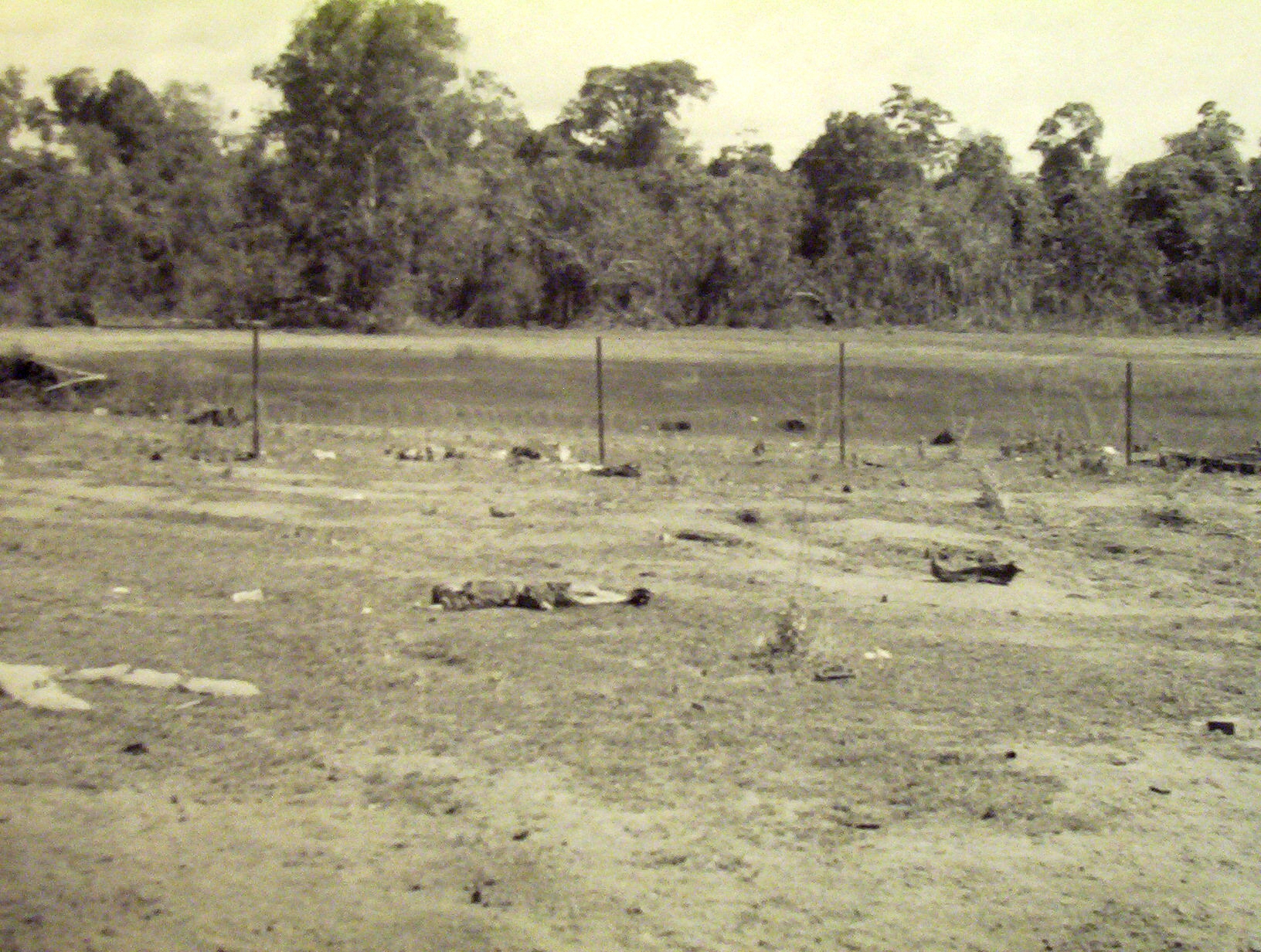
On 12 June 1970, a team from Graves Registration was inserted into the COSVN battle site to search the area for the 2 missing Special Forces Sergeants. They recovered human remains that were later identified as belonging to Ernest Jamison and 1 of the missing Montagnards. However, they found no trace of Jerry Shriver, the other 4 missing Montagnards or their equipment anywhere in or around the battle site.

For every insertion like this one that was detected and stopped, dozens of others safely slipped past NVA lines to strike a wide range of targets and collect vital information. The number of MACV-SOG missions conducted with Special Forces reconnaissance teams into Laos and Cambodia was 452 in 1969. It was the most sustained American campaign of raiding, sabotage and intelligence-gathering waged on foreign soil in US military history. MACV-SOG's teams earned a global reputation as one of the most combat effective deep-penetration forces ever raised.

If Jerry Shriver died in this savage battle, he has a right to have his remains returned to his family, friends and country. However, if he survived, he most certainly was captured and his fate, like that of other Americans who remain unaccounted for in Southeast Asia, could be quite different. Either way there is no question the Vietnamese could return him or his remains any time they had the desire to do so.

Since the end of the Vietnam War well over 21,000 reports of American prisoners, missing and otherwise unaccounted for have been received by our government. Many of these reports document LIVE American Prisoners of War remaining captive throughout Southeast Asia TODAY.

Military men in Vietnam, Laos and Cambodia were called upon to fly and fight in many dangerous circumstances, and they were prepared to be wounded, killed or captured. It probably never occurred to them that they could be abandoned by the country they so proudly served.

At the time he became Missing in Action, Jerry Shriver had less than three weeks left on his third tour of duty in Vietnam.

also see "Mad Dog Shriver"

Tuesday, April 15, 2025

 Assault on LZ Brown (Cambodia, May 12 & 13, 1970)

Robert J. Gouge   

Tuesday, May 12th, 1970, dawned as another unbelievably hot, sweltering day. It ended in an unusually heavy monsoon rainstorm that utterly drenched the already saturated jungle.  For the exhausted grunts from Bravo and Charlie Companies of the 5th Battalion, 12th Infantry, 199th Infantry Brigade (Sep)(Lt), that day, especially late that evening and into the early morning hours of May 13th was anything but ordinary.  Unbeknownst to them, before the sun broke over the horizon ushering in a new day, they would fight in a bloody, savage, and desperate contest for survival against an equally tough, motivated, and battle-hardened enemy.      
   

Eleven days prior, after spending nearly six months patrolling the rolling hills and triple canopy jungles of Long Khanh and Binh Tuy Provinces in the III CTZ, the 5-12th Infantry and Delta Battery, 2-40th Artillery were op-conned to the 2nd Brigade of the 1st Cavalry Division.  This rapid shift in control was done in anticipation for the much-awaited cross-border Cambodian Incursion, which kicked-off with both a military and political boom on May 1st, 1970.  
   

Beginning in the early morning hours of May 1st, after a ground-shaking mission of thirty-six B-52 “Arc-Lights,” a World War I vintage walking artillery barrage, and 151 tactical air strikes, a trooper from C/2-7th Cavalry became the first American trooper to combat assault into the Fishhook region of Cambodia.
    For those organic and attached units of the force being deployed into Cambodia, specifically into the Fishhook region, their primary mission was to neutralize the COSVN Headquarters and wipe Base Area 351 from the face of the earth.      

On May 3rd, after a pleasant but intoxicated two-day stand-down at Camp Frenzell-Jones, the Brigade Main Base for the 199th Infantry Brigade, the entire “Warrior” battalion reluctantly made the journey northward from Bien Hoa Airbase towards the Vietnamese-Cambodian border.       

Reid Mendenhall, a combat veteran Echo Company, 5-12th Infantry describes the wave of emotions that came along when they were told they were going to Cambodia.  “It all started with rumors, like so many other things, and nobody could have imagined something quite so bazaar.  We all knew that Cambodia was a major problem, but we thought that it was out of reach, until now.  We had heard stories about covert units going into Laos and Cambodia, but now the story was ours.  Soon after the rumors began, the word finally came down that we were going.  There was some trepidation in our small unit, but we were all together, at least for the moment, and that was of great comfort.” 
   

Ironically, when the battalion reached Bien Hoa Airbase, they were given their monthly pay.  Many soldiers in the battalion wondered, “Just what in the hell are we going to do with this money in Cambodia?”

Packed aboard noisy Air Force C-123 cargo planes at the 8th Aerial Port at Bien Hoa, the trip was a solemn one as the young soldiers could sense that they were getting into something big.  Horseplay and joking around was kept to a minimum as the men were preoccupied with thoughts of home and a foreboding feeling about what was to come.  By 1905 that evening, the airlift was completed at Duc Phong, with all companies of the battalion on the ground and dispersed to FSB Buttons.      

From May 4th to May 11th, the Redcatchers conducted mundane screening operations and short-range patrols along the Vietnamese side of the border at Song Be and Bu Dop.  Elements of the battalion also guarded the dilapidated earthen airstrip at Bu Gia Map, located just two kilometers from the Cambodian border.     
   

John Wensdofer had been with Charlie Company since January 15th, 1970.  “When we started the move to Cambodia, we were sent up north to Song Be for a little over a week.  As soon as we got there, action started to pick up.  They expected the place to be hit and hit hard when we moved in.  Where we had been operating in Vietnam, the Viet Cong rarely moved in groups larger than four or five soldiers.  Around Song Be and once inside Cambodia, they moved in groups anywhere from 20 to 100.”  
   

With each passing day, the young men from the 199th LIB wondered just when the time would come when they too would cross the border and take part in what was commonly called “The Great Souvenir Hunt.”  
    The time came on the morning of May 12th, when Colonel Carter Clarke, the commanding officer of the 2nd Brigade, 1st Cavalry Division, summoned his reserves.  The Redcatchers were ordered to take up the slack left by the 5th Battalion, 7th Cavalry, and quickly re-deploy to a place called LZ Brown after the Cavalry soldiers had been ordered to assault an enemy basecamp several klicks to the north.    Landing Zone Brown had been a target hit by the 5-7th Cavalry on the first day of the Incursion. 

Located approximately three kilometers north of the border and two kilometers west of Route 14-A (one of the only major roads in the region) in a natural clearing that was surrounded by the thick Cambodian jungle, the “hole called LZ Brown” was used as a patrol base by the 5-7th Cavalry for the first week and a half of the Cambodian operation.  The site was also in the middle of a huge North Vietnamese logistical complex.
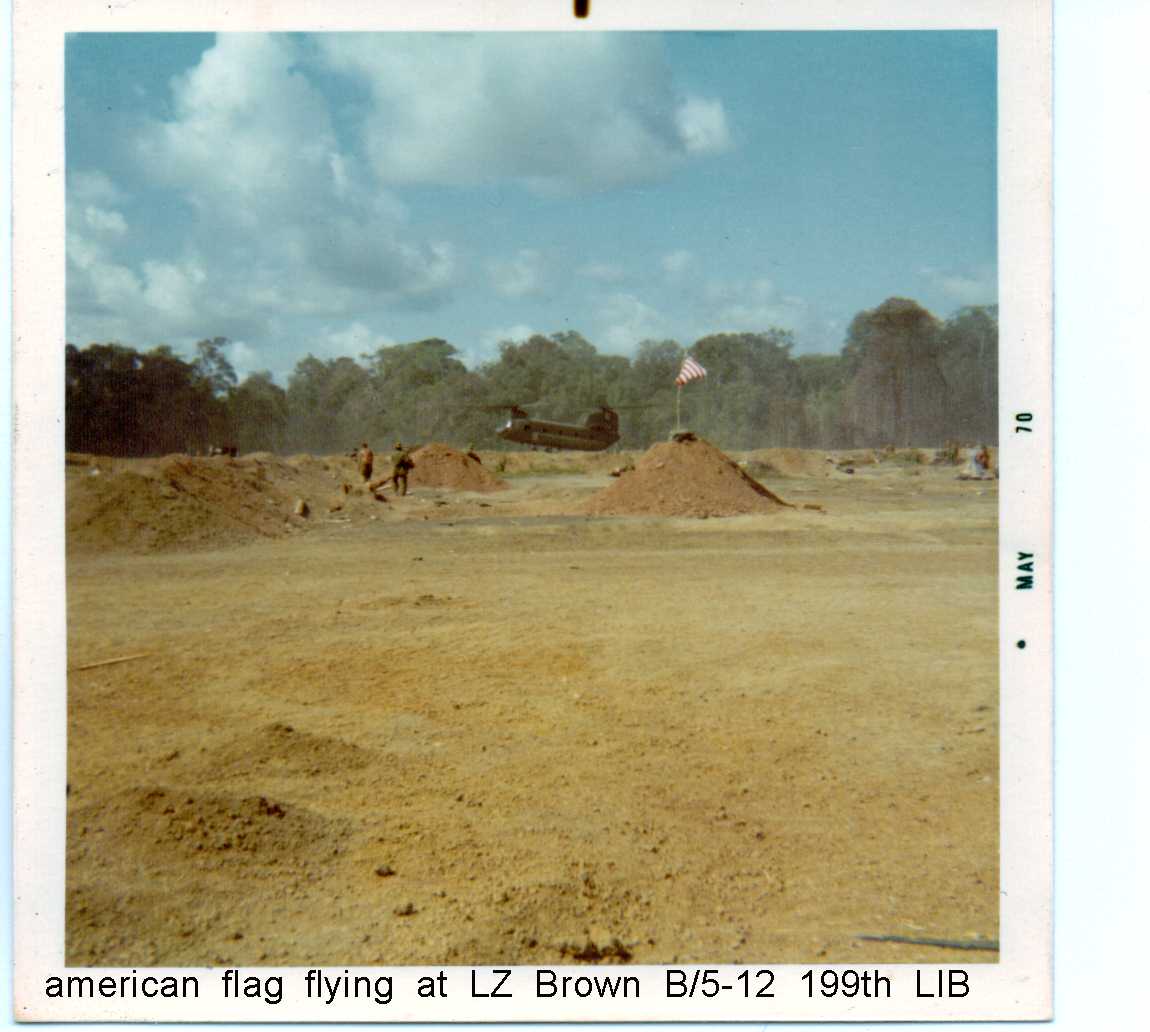
    By midday on May 12th, the 5-7th Cavalry had vacated LZ Brown, taking anything of use with them and leaving the small perimeter all but vacant and bare.  The patrol-base now consisted of a pitiful-looking dirt berm roughly four feet in height and a single strand of floppy razor wire. 

“When we received the word to go into Cambodia,” relates John Wensdofer, “Charlie Company flew in by Huey late in the afternoon of May 12th.    “We were the first ones from the battalion to cross the border.  Bravo Company came in later that evening by Chinook.  For some reason, we dug no foxholes or fighting positions on our side of the perimeter.    
   

The 1st Platoon of Charlie and the Company CP were the first elements of the battalion to land at LZ Brown.  They began the lift at 1800 hours and were flaring into the landing zone at 1810.  It took six sorties for them to get in.  The rest of the company followed.  Bravo Company did not start the move until 1825.  After 17 sorties, all of Bravo was inside by 1930, quite late to be settling into a new and unfamiliar area of operations.
   

Allen Thomas had been with the 2nd Platoon of Bravo Company in the field as an infantryman since July, 1969.  He had 63 days to go in-country when the battalion moved to Cambodia.  Thomas remembers that, “When the Chinooks started ferrying troops out, it was late in the day.  Everyone who could held back and waited.  LZ Brown, when viewed from the air, looked like a very small, very dirty hole in the middle of the jungle.  We built no bunkers nor did we dig any foxholes.  I was on the last Chinook to arrive and it was almost dark when I walked over the berm.”    

Terry Braun, a veteran sergeant and squad leader with the 3rd Platoon of Bravo Company states, “My squad arrived by Huey’s about an hour before sunset.  It was a magnificent sight.  The afternoon rains were finally beginning to lift and the sun sparkled off the green vegetation surrounding LZ Brown.  It almost had the appearance of a well-kept golf course.  LZ Brown consisted only of dirt surrounded by a berm.  The entire base could have fit inside a football field.  It was more oblong than circular and had a smaller berm located within the larger perimeter towards the western half.  One single strand of concertina wire surrounded the entire landing zone.  It was located about 35 to 40 meters from the berm.  There were no bunkers, just mud and dirt pushed up about chest high.  Those of us arriving had no idea that the Ho Chi Minh Trail was approximately 100 yards to our west.  Also, as we were leaving the Bien Hoa airport a few days earlier, we were issued M8 bayonets for the first and only time in Vietnam.”    

By the time complete darkness had crept in, only Bravo and Charlie Companies of the battalion and one 81 mm mortar from Bravo Company’s mortar platoon had been airlifted into the perimeter.  All other lifts for the night were cancelled.
    CPT David Ashworth, the S-4 officer for the Warriors during Cambodia recalls, “When all the lifts were called off going into LZ Brown, only Bravo and Charlie Companies down.  No 105’s from Delta Battery made it in that night.  The guns were not flown in until the morning of the next day.”   For the exhausted infantrymen of Bravo and Charlie Companies, all that could be done the night of May 12th was to set up the small number of claymore mines and trip-flares that were on hand a few meters beyond the perimeter wire, eat a cold meal of C-rations and huddle silently on the soggy ground, hoping that nothing major happened until the next day.  There was, however, an unexplained, deep feeling of apprehension amongst most there that night that something big was about to happen.Terry Braun remembers this dreadful premonition.  

 “That evening, we sensed that something was different.  As we positioned our claymore mines by the concertina wire, we listened to the Armed Forces Radio Network, which was something we normally did at basecamp as we were getting ready to pull guard.  We set up five soldiers to a position that night, not the usual four.  LZ Brown was split in half.  On a clock, Charlie Company took the western half from 6 to 9 to 12.  Bravo Company took the eastern half from 12 to 3 to 6.” 
 

 In the surrounding jungle, the change in tempo and activity at LZ Brown did not go unnoticed by the NVA.  As early as mid-afternoon on the twelfth, the 1st Cav’s, 2nd Brigade intelligence units began receiving reports from roving aviation and reconnaissance patrols that the NVA had watched the cavalrymen vacate the base.  There were even a couple of reports stating that large numbers of NVA had been spotted moving in the direction towards LZ Brown.  
   

Stealthily moving toward the LZ were veteran NVA regulars from the 174th North Vietnamese Regiment.  Originally formed in North Vietnam in the early 1960’s, the regiment had seen considerable combat in the II and III Corps Tactical Areas of South Vietnam.  Barely two and a half years before in November of 1967, the 174th NVA Regiment had fought against the 173rd Airborne Brigade and the 4th Infantry Division in one of the Vietnam War’s largest and costliest battles.  The battle was Dak To and it was fought on a little-known mountainside called Hill 875.  By the time the hill was secured by the weary paratroopers on Thanksgiving Day, 1967, the 174th NVA, along with several other supporting Communist units had lost over 1,600 personnel killed in action.


 Sometime after midnight on May 13th, the last of the sputtering afternoon monsoon rains slackened and then finally quit.  The muggy and humid temperatures immediately returned, along with the serenading noises of millions of tropical insects and mosquitoes.
   

Unnoticed and slowly inching closer to the dirt berm were enemy sappers.  Clad in only dark loincloths, their deliberate movements and sounds concealed by the thin layer of ghostly fog that was emanating from the tree line, the sappers proceeded to disarm or cut the wires on the claymore mines that were pointed outwards surrounding the Redcatcher positions.
    

On Charlie Company’s side of the perimeter, John Wensdofer, draped in heavy belts of 7.62mm machine-gun ammunition, peered into the darkness from behind his M60.  Suddenly, less than ten feet to his right, an enemy sapper with his AK-47 at the ready jumped up on top of the berm and cut loose with a long, sweeping burst of automatic rifle fire.  
   

According to Wensdofer, “The AK fire hit my squad leader, who was a muscular black sergeant with a size 15 jungle boot.  The rounds missed me and plowed into the foot of the guy who was to my right.  Despite being hit, our squad leader then killed the NVA soldier on the berm.”  Sp4 William Barry, who was also on that side of the berm, saw the opening shots.  “One enemy soldier got on the berm and was shooting into the camp.  He was the first to get it.”
    Staff Sergeant Malcolm Smith had previously served as a platoon sergeant in the second platoon of Bravo Company from September of 1969 until April of 1970, at which time he was moved to the Company CP.  When the battalion moved into Cambodia, he was then on his second of three combat tours.  Smith recounts his version of the opening shots.     

“Shortly before the fireworks started, I remember making rounds and speaking briefly with exhausted Bravo Company soldiers.  At approximately 0310 hours, the firing suddenly began in the C Company area, followed by a brief stillness.  Our lone mortar fired a flare or two to illuminate the night.  After this brief exchange of gunfire, which was immediately followed by the crump of grenades and the deafening crack of claymore mines, there was a brief silence around the firebase that seemed almost surreal.
 Smith continues.  “Then, all hell broke loose.”   

Terry Braun, who was just a few meters from SSG Smith remembers, “My second shift of guard duty was to begin at 3:15 AM.  At 3:00 a.m., I awakened and watched PFC Davis from Tennessee pull his final few minutes of guard.  I approached the berm and joined him.  His attention was towards Charlie Company‘s position.  He pointed out to me three silhouettes standing on the berm.  His first comment was that although those guys must be having a tough time sleeping they should not be silhouetting themselves in the moonlight on top of the berm.  We immediately knew then that was not something a GI would do. 

Seconds later, M16’s and M60’s started firing and a claymore mine blew.  Then the battle started.”  
   

The waiting NVA assault force in the tree line cut loose and slammed the base with intensive rocket, mortar, and .51 caliber machine gun fire.  For 15-20 minutes, the North Vietnamese lobbed round after round of 60mm mortar and RPG rounds into the perimeter.  A full-scale ground attack by an estimated two reinforced companies from the 3rd Battalion of the 174th NVA Regiment was fanatically launched when the mortars stopped firing.
   

When the flares went up on John Wensdofer’s side of the perimeter, he quickly looked over the berm and to his shock, watched as a large human wave of screaming NVA soldiers charged crazily out of the tree line.  “When the flares went up, I could see them running at us and I immediately opened up with the M60.  On and on they came.  I fired so many rounds, the barrel got white hot.  We were firing so furiously, I think that we almost ran out of ammo.  I know that I had several belts of 100 rounds linked together.  It is hard to remember how much time went by from when the gook got on top of the berm to when I stopped firing the M60.  I can remember praying for daylight.”
   

Allen Thomas, who was on the eastern side of the perimeter with Bravo Company states, “The attack was mostly on Charlie Company’s side of the perimeter.  The fire was the heaviest that many of us had heard and experienced in Vietnam and I remember that the NVA were firing all different sorts of tracer rounds at us.  Red and green tracers were lighting up the sky, explosions were all over the place, both inside and outside, and illumination was going up from either parachute flares or from the smaller, hand-held white star clusters.  
   

John Wensdofer can testify as to how danger close the contact was.  “At times, the fighting was so close, we crawled up to the top of the berm and either emptied magazines from our weapons straight down at them or just rolled grenades off the top of the dirt and let them roll down.”  One of Wensdofer’s M60 bi-pod legs was literally bent from the force of an explosion from one of the grenades that he rolled over the berm.  Several of the claymore mines that had been placed outside the wire and armed before the attack were useless.  The detonation wires had been cut or the mine had been removed altogether by the sappers.
    At one point in the firefight, some of the men on the perimeter line could hear the NVA shouting commands and blowing whistles at one another.         

“Tracers were coming in and different colored tracers were going out from the berm.  It was actually very colorful.  The guys at our position, myself included, began singing ‘Sunshine Superman’ during the firefight for no apparent reason.  A Spooky gunship was called in to support us and we could see the tracers from their .51 caliber gun just missing the back of our aircraft.  Fortunately, they were not leading the aircraft enough so they continued to miss,” recounts Terry Braun.
    Jim Horine had served as a line grunt in Bravo for six months and was humping the battalion RTO at the time of Cambodia.  He remembers, “I was inside the LZ perimeter at the CP with our company commander.  It was the heaviest firefight that most of us had ever seen.  The noise from the machine gun and rifle fire was unbelievable.  While on the battalion net, I overheard the pilot of the Spooky gunship (call sign Blind Bat) that was supporting us call back and say that he had expended every single round for his mini-guns on targets of opportunity.  As he veered off, there was a long line of green .51 caliber machine gun rounds trailing him.”    

A Cobra gunship was also dispatched for close air-support.  The Cobra’s deadly 2.75 rocket and mini-gun fire was called in so close to the fighting that the men on the berm were actually ordered to pull back a few meters so the gunship could make gun-runs up, down, and around Brown’s perimeter.  
Terry Braun states, “The fighting had raged on for about an hour and a-half when unbelievably, Bravo got a call on the PRC-25 radio from our CO to, “Fix bayonets!  They’re coming in!!!”  Fighting persisted until dawn when the Air Force dropped a series of concussion bombs just west and slightly south of our perimeter.  When each of those bombs went off, there was a brief instant magnified by stillness in the air followed by a loud explosion that just seemed to suck the air out all around us.  The only thing I can recall that was more impressive was being in the vicinity of B-52s when they dropped their payload and the ground actually shook like an earthquake.”    

For two and a half hours, despite the withering fire coming from the Redcatcher M60’s, M16’s, and M79 grenade launchers, the determined NVA still kept coming.  The lone 81mm mortar crew from Bravo was loading and firing illumination their small supply of high-explosive rounds like men possessed.  While doing so, they were terribly exposed to the incoming enemy fire.
   

“We conserved our ammunition the best that we could,” remembers 1LT Charles Barnes, the Bravo Company mortar platoon leader.  “We fired our last round just prior to 5:45 a.m.” 
   

Throughout the firefight, enemy bullets and shrapnel whined and bounced around the mortar-men hanging rounds in the tube.  About an hour into the firefight, Sp4 Richard G. Desillier of the mortar platoon was shot and killed as he prepared to fire a round.  Despite the loss, the rest of the crew continued to thump out what rounds were available.     
   

Captain David Thursam, the Charlie Company commander at LZ Brown praises the mortar crew.  “The mortar gave my men great supporting fire.  They moved their gun around and hit on target every time.  What amazes me to this day about that fight was how we won.  With all of the fire that we were put out, an equal amount or more was coming in, including mortars and rockets.”
    Jim Horine watched from the CP as the mortar crew worked.  “They fired and fired and fired.  I would bet that they set some kind of record for the amount of both HE and Illumination rounds that they were putting out.”   

“We had a great medic in Bravo Company,” recalls Allen Thomas, “named Doc Uhde.  He was a Japanese-American from California.  The medics carried an enormous rucksack full of medicine, bandages and salves.  To keep from carrying the big rucksack around, he carried a smaller Claymore bag.  Doc Uhde made his rounds, as he called it, around the perimeter periodically to see if the men needed anything.  During the middle of this firefight, Doc Uhde decided go make his rounds.  Here came this little, black-haired Japanese-American carrying a shoulder bag, running with his head down.  My friend, Tony Reece, saw Doc and naturally thought that he was a sapper and drew a bead on him.  He could make out his silhouette in the flashes of light.  Reece, however, never pulled the trigger.  Something was telling him not to do it.”  
   

From 0300 to 0545, the opposing sides were locked in mortal combat for control of LZ Brown.  The North Vietnamese onslaught signaled the first major Communist counter-attack of the Cambodian Incursion.   
At approximately 0500 hours, much needed support from helicopter gunships, Air Force A-37 jets, and fixed wing “Shadow” gunships began pounding the attacking NVA from the air.  Incredibly, the NVA in the tree line responded to the thundering air strikes and gun-runs with more .51 caliber machine gun fire.Luckily, when the 81mm mortar fired its last round at approximately 0545, the fight for LZ Brown finally began to fizzle out.  Several minutes later, when the first rays of sunlight began streaking over the horizon, the firing eventually ceased and the surviving NVA melted back into the dark jungle, dragging away significant numbers of their dead and wounded.   

With full daylight, the rest of the 5-12th Infantry was hurriedly airlifted into the base.  Combat engineers from the 31st Combat Engineer Battalion, along with their heavy equipment, arrived at the base after literally carving a new road through the jungle.  One of the first tasks for the engineers was to dig a trench in which to bury the dead enemy soldiers.  
  

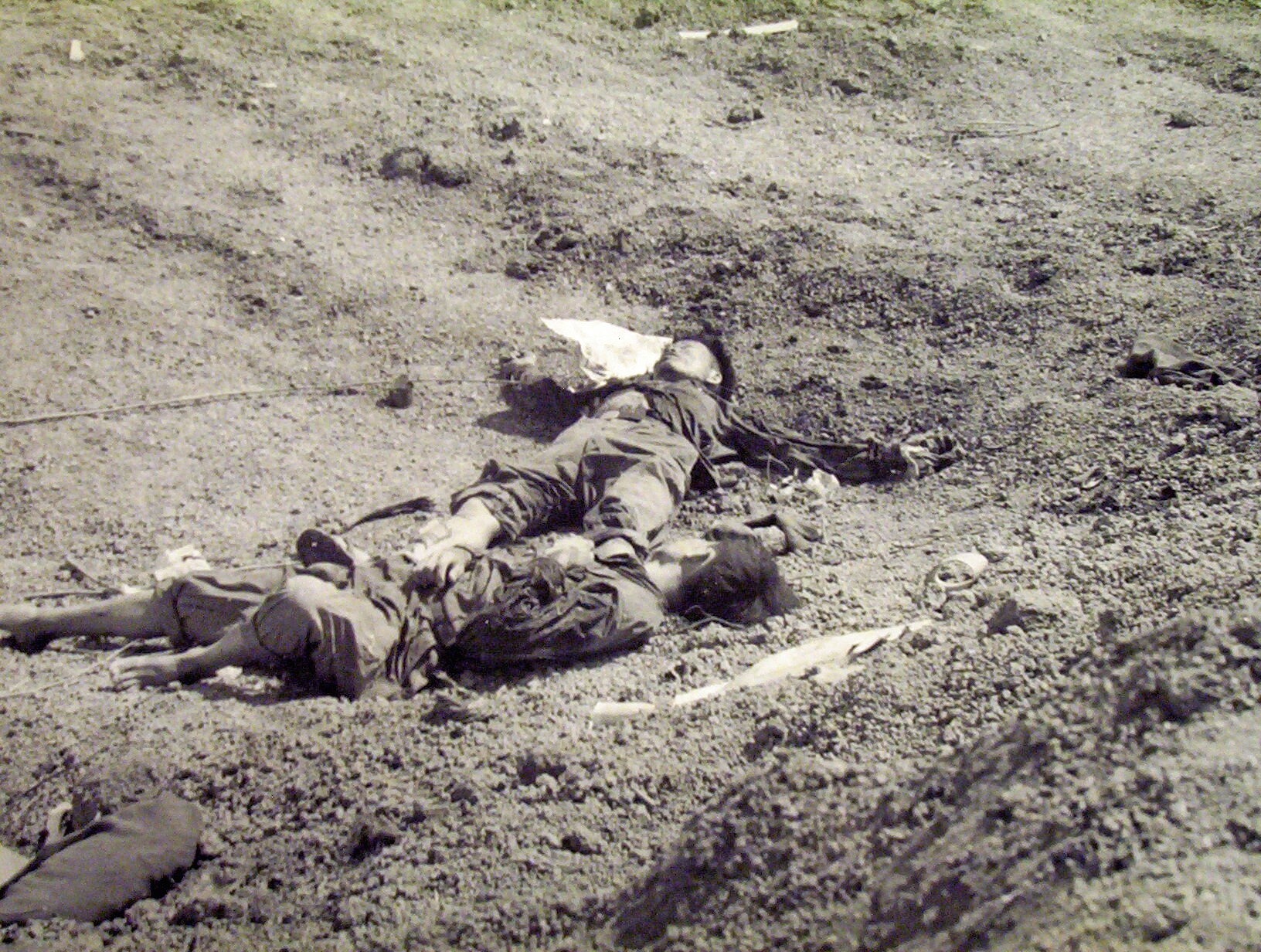
 The scene around Brown was one of utter death, carnage, and destruction.  Only those who have fought in war can understand its pitiful sufferings and tragic ramifications.  Fifty-three enemy bodies and pieces of bodies surrounded the perimeter.  Heavy blood trails were seen from the berm leading back into the jungle.  Discarded weapons and equipment were strewn everywhere.
    The Redcatchers lost one man killed in action along with eight others from Bravo and Charlie who were wounded.   “At the conclusion of the firefight, some of the Redcatchers started to shout expletives and vulgar comments at the retreating NVA, challenging them to stand and fight some more,” recalls Malcolm Smith.  “In the aftermath, I remember carrying the dead to the bulldozed hole and throwing them in.  Some of the enemy had been hit multiple times and were bandaged more than once.  Some were not complete bodies either.”     

Terry Braun states, “As the sun rose and daylight crept in, to our amazement the area west of Brown was littered with bodies and body parts.  It almost looked like an Easter egg hunt with the eggs poorly hidden.  Heavy blood trails led back into the jungle.  This was a sight that we rarely saw in Vietnam.  Usually after a firefight, the NVA would withdraw and we would see very few bodies.  My machine gunner from Chicago, Ken Burmeister, raised an American Flag that he had carried with him on a flag pole and placed it on the berm.  That picture appeared with headlines on the front page of the New York Times.  Burmeister was later verbally reprimanded for raising an American Flag in Cambodia, but at the time it seemed appropriate.”
   

In front of John Wensdofer’s red-hot M60 machine-gun were 12 dead NVA.  “They were all wearing regular green and khaki, NVA uniforms with pith helmets.  There were six enemy bodies inside the wire.  I took a 9mm pistol from what looked like to be a Chinese advisor.  His body was lying just inside the wire, close to the bottom of the berm.  I know he was not Vietnamese as he was taller than the rest and he looked to be about 180 lbs. or more.  He even had body fat on him.”
   

Allen Thomas explains that, “One thing that has always stuck out in my mind is that all of the enemy dead were facing the berm.  They didn’t die retreating.”
    Several soldiers also recall seeing what they believed were Chinese advisors among the dead.  Another odd find on the enemy KIA’s were what was thought to be drugs and vials of liquid speed.    According to Smith, “Some of the dead looked too big to be Vietnamese.  Most of the bodies were found with speed in their possession.  They had fresh haircuts and their uniforms, as I recall, were light green, khaki and even light blue.  I also remember that when we started to police up the enemy weapons, their bayonets were affixed.  What really stood out in my mind was the number of discarded bandages, blood trails and drag marks that were going in all directions from Brown.  The ground was even soft and mushy in spots.  I remember thinking to myself that the battlefield looked as if a blood bank blew up.”   

In addition to the bodies, blood trails and discarded equipment, 34 individual weapons were collected which included SKS and AK-47 rifles, three light RPD machine guns, four RPG’s, and two 60mm mortars.
    As for the 5th Battalion, 12th Infantry’s first day in Cambodia, Allen Thomas sums up of the thoughts of many that fought there.  “In Cambodia, we learned that the enemy stood and fought.  The enemy soldiers here were smart and hardcore.  Most of us wanted to go back to Vietnam, not stay in Cambodia.”


Scenes from the berm and immediate perimeter area of FSB Brown the morning after the fight, 13 May 1970.  Image by SP4 Peter Nagurny, 40th PIO.


                                                                Stanley Buchanan, B/5-12

Monday, October 4, 2021

 Vài điều học được từ Cambodia (KPC)

- "Chúng ta sẽ tiến hành xét nghiệm nhanh ở những khu vực cố định."-- Thủ tướng Hun Sen.

- Hun Sen chỉ ra những than phiền về xét nghiệm nhanh gây khó chịu và dẫn chứng kinh nghiệm bị ngoái mủi thường xuyên của ông. "Ngay cả mủi tôi cũng bị tổn thương," ông nói. (Theo báo Khmer Times ngày 19/2/21, FB của Hun Sen có hơn 13 TRIỆU THEO DỎI.--người dịch).


1/ Ngày 2/8/21, thủ tướng Hun Sen cấm bv công trên toàn quốc ko được thu phí xét nghiệm Covid và kêu gọi bv tư lấy giá test vừa phải.

CP hoàng gia cho phép bv tư nhập và dùng trang bị xét nghiệm, nhưng dân nghèo ko đủ tiền để trả. Vì vậy nhà nước tiếp tục lo việc này.

Thủ tướng ủng hộ việc "dân chúng biểu tình chống lại các bs nhà nước hay các bs thiện nguyện dùng phương tiện nhà nước và lấy tiền của dân". 

2/ Một sụt giảm mạnh về số ca mắc Covid mỗi ngày được ghi nhận ở KPC tiếp theo một thay đổi về chiến lược xét nghiệm, trùng hợp với thông điệp của TT Hun Sen rằng dân KPC phải học sống với đại dịch và chấp nhận TỬ SUẤT CAO.

Theo đài Tiếng nói Dân chủ (VoD), Hun Sen cuối tuần đã gửi một tin nhắn tới các viên chức về việc "học cách sống với Covid-19" bằng cách chấm dứt xét nghiệm nhanh mở rộng.

Ông nói chỉ những ai có triệu chứng mới phải xét nghiệm, một chính sách sẽ dẫn đến việc ko còn phải theo dỏi những ai đã tiếp xúc F0.

"Với ai ko có triệu chứng, chúng ta ko cần làm xét nghiệm nhanh vì đây là cách học sống với Covid-19. Nếu ko làm như vậy, mủi chúng ta sẽ bị TỔN THƯƠNG. 

Tuần trước, số ca mắc mỗi ngày đã đi lên từ con số cố định 600 tới hơn 800 và gần 1.000 trong ngày 30/9. Kể từ đó, số ca hàng ngày còn khoảng 200.

Xét nghiệm nhanh đã đc tiến hành tại các khu vực có ổ dịch lớn như chợ hay cửa khẩu biên giới và kiểm tra chéo (cross-check) với xét nghiệm PCR. 

Trong một bài đăng trong báo Khmer Times, một viên chức dấu tên đã nói rằng xét nghiệm nhanh đã được bỏ do thay đổi thái độ. 

". . . Sự khó chịu vì Covid đã được cảm nhận ở phần lớn dân chúng và ngay cả các định chế công cộng," ông nói. 

Ông nói thêm rằng thái độ đã thay đổi nhưng mọi người ko nên lầm lẩn. Nên cảnh giác cao nhưng bực bội vì gần hai năm đề phòng và hạn chế đã đẩy người dân tới một mức mới là sống theo cách của họ của bình thường mới.

"Do vậy xét nghiệm nhanh đã được bải bỏ,"viên chức nói. "Người dân phải làm quen với thực tế rằng số người chết có thể giữ nguyên vào lúc nào đó trước khi giảm dần (taper off).

Dịch từ: Khmer Times và Nikei Asia.

Tuesday, June 6, 2017

Tại sao KPC đã đi khá xa , nếu ko nói là "đôi hia 7 dặm" , so với VN , trên con đường dân chủ ?
(Tôi dịch bài này nhằm giải thích nguyên nhân đã khiến KPC có được ngày hôm nay : có sự can thiệp của Mỹ và đồng minh , của LHQ và chấp nhận dân chủ đa đảng từ đầu thập niên 1990 -- Tài)
"Chiếm đóng của quân VN và Chuyển tiếp .
Vào tháng 11/79 , quân VN tấn công KPC để đáp trả những đột kích dọc biên giới của Khmer Đỏ . Một nhà nước lãnh đạo bởi đảng Nhân dân Cách mạng KPC (được thành lập bởi VN từ 1951) , gồm những thành viên Khmer Đỏ từng trốn khỏi KPC để ko bị thanh trừng bởi Pol Pot và Ta Mok . Chính quyền này hoàn toàn nằm trong tay quân VN chiếm đóng , dưới sự chỉ huy của ĐS Việt Nam * (Ngô Điền . -- Tài) tại Phnom Penh . Vũ khí từ VN và LX .
Chống đối lại nhà nước này là 1 CP lưu vong có tên gọi CP Liên hiệp của KPC Dân chủ tạo nên năm 1981 gồm ba phe : Khmer Đỏ , phái bảo hoàng của Sihanouk , và MT Giải phóng Nhân dân KPC , được LHQ công nhận . Đại diện của Khmer Đỏ tại LHQ Thiounn Prasit được giử lại , nhưng phải tham khảo với các phe ko CS của KPC . Việc VN từ chối rút quân khỏi KPC dẫn đến cấm vận kinh tế của Mỹ và đồng minh .
Hòa đàm tại Paris đã bắt đầu năm 1989 do CHND KPC chủ trì đã kết thúc vào tháng 10/1991 bằng Giải pháp Hòa bình Toàn diện Paris . LHQ được ủy thác thực thi ngừng bắn , giải quyết ng tị nạn và giải giáp với tên gọi là Thẩm quyền Lâm thời của LHQ tại KPC (có 22.000 quân và nhân viên LHQ tham gia-- Tài) .
Tái lập nền quân chủ .
Năm 1993 , Norodom Sihanouk đc phục hồi chức quốc vương KPC , nhưng quyền lực trong tay của CP thành lập sau các bầu cử do LHQ tổ chức . Năm 1997 , một đảo chính do đồng thủ tướng Hun Sen tổ chức chống lại các phe ko CS trong CP . Sau đó ổn định chính trị đc tái lập .
Trong những năm gần đây , các cố gắng tái thiết đã tiến triển và đã dẫn đến một ổn định chính trị trong chừng mực nào đó thông qua DÂN CHỦ ĐA ĐẢNG dưới thể chế QUÂN CHỦ LẬP HIẾN" .
Dịch từ : https://en.wikipedia.org/wiki/Cambodia…
NHẬN XÉT : Câu cuối cùng của bài trên đã nói rỏ nguyên nhân khiến KPC đã đi khá xa , so với VN , trên con đường dân chủ .
* Thời đó , việc điều hành về CT và QS tại KPC thuộc về tướng Lê Đức Anh , ông này nhận lịnh của Lê Đức Thọ có biệt danh Sáu Búa tại Sài Gòn .
Ngày 6/6/2017 lúc 08:15 tối .

Tuesday, April 4, 2017

Campuchia, một con đường khác, một nhận thức khác

Đăng bởi Elvis Ất on Wednesday, April 5, 2017 | 5.4.17


Khám phá vẻ đẹp bí ẩn của thủ đô Phnom Penh Campuchia - Ảnh 2
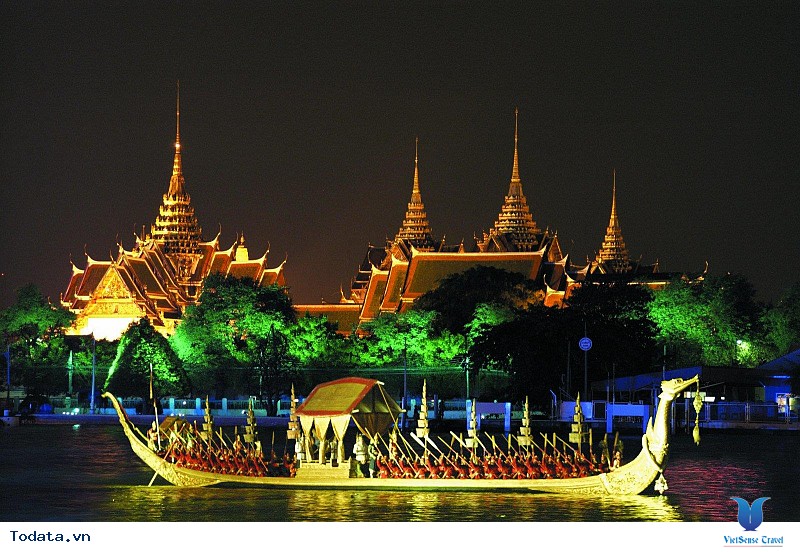
Phnom Penh về đêm
Ngoài chuyện tiền bạc, về tâm lý thôi mà nói, tôi thường đã rất ngại, không dám tính đi du lịch các nước giàu có bên trời Tây. Lý do là vì đi về chỉ thấy buồn, sao ở đó người ta sướng thế tử tế thế mà nước mình con người hư hỏng và xã hội trì trệ đến thế.

 Nhớ có lần đọc một câu của B. Russel, do Hà Văn Tấn dẫn lại, bàn về sự hấp dẫn của sử, đại ý nói là đọc sử để hiểu những ngu ngốc của thời xưa do đó dễ dàng chịu đựng hơn những ngu ngốc của thời nay.

Tôi cũng muốn làm theo lời khuyên đó, và chuyển nó từ trục thời gian xoay qua trục không gian. Tức là, nếu điều kiện cho phép, tôi thích đi lang thang ở những nước nghèo nước khổ, để khi quay về thấy yên tâm với nước mình. Ví dụ như đi châu Phi, hay mấy nước kem kem ở Trung Đông và Đông Nam Á.

Nói thế thôi, chứ bây giờ chả ai nghèo khổ nữa, không bằng Tây nhưng họ biết học Tây để phát triển. 

Chỉ có riêng ta, chả học làm ăn gì cả -- sau chục năm hô hào nay cái nghĩa của hai chữ hội nhập tóm lại ở một nội dung là mua hàng ngoại về mà xài - nên đằng sau vẻ sặc sỡ giả tạo là sự nghèo nàn thực sự, tìm nước chán hơn nước mình rất khó.

Tuy nhiên ở đâu thì qua sự so sánh cũng rút ra được ít suy nghĩ có ích . 

Tôi đến Campuchia tháng 11-2010 với tâm thế đó và đã ghi lại những cảm tưởng sau chuyên đi ba ngày này trong sổ, nay xem lại thấy có vẻ như vẫn tàm tạm, nên muốn trình ra với các bạn.

MỘT THỜI THANH BÌNH

Trên những con đường quốc lộ, tôi đã chứng kiến một sự bình thản. Làng xóm nơi đây yên lành, trên nền không gian rộng rãi. Người ta không đổ ra đường để buôn bán.

Đến Pnompenh, sự bình thản ấy vẫn còn. Đô thị không có nghĩa là chen chúc. Xe máy đã nhiều hơn xe đạp, nhưng không thành những dòng sông cuộn nước như ở ta. Ngay ở các ngã tư chưa có đèn đỏ, vẫn thấy có hiện tượng ô tô nhường nhau chứ không thúc vào đít nhau mà còi loạn lên như ở Hà Nội. 

Tôi đến Pnompenh vào một buổi chiều người đi đông nghìn nghịt ngoài đường, -- sau đó tôi mới biết là ngày hội té nước, cầu bắc qua sông bị gãy, tiếp đó là sự kiện bi thảm hơn ba trăm người chết và vài trăm khác bị thương.

Tuy nhiên, nếu như ở VN, việc đó sẽ làm cho cả thành phố rung động thì ở đây, mọi chuyện không gây hoảng hốt quá đáng. Nhà nước không làm ầm lên cái chuyện kịp thời lo cứu trợ cho dân. Sáng hôm sau, trước bãi cỏ hoàng cung, những người công nhân vệ sinh bình tĩnh dọn rác. Hàng đàn bồ câu bay lên. Trước cửa bệnh viện, người đến thăm nom không khóc lóc động trời mà xếp hàng vào thăm người thân khá trật tự. Họ tin rằng xã hội sẽ biết cứu giúp người thân của mình một cách tốt nhất.

NHỮNG CÁI KHÔNG Ở SIEMRIEP

Ở đây tôi càng như trở lại một thời thanh bình cổ điển. Nơi đây khách du lịch không thấy những đám thiếu niên làm ồn trên đường và chen chúc nhau trong các cửa hàng chơi game. Không thấy các thiếu nữ váy dài váy ngắn, mắt xanh mỏ đỏ. Không thấy các đám công chức túm tụm bia rượu. 

Tôi tự giải thích cho tôi về sự thanh bình này: Chiến tranh đã đi qua đất nước này, nhưng nó không xới lật lên tất cả, nó không biến con người trở thành những cái bã của chính mình thời tiền chiến. 

Nếu sau chiến tranh người Việt mình không ai bảo ai gần như phát cuồng lên lao đi kiếm sống thì ở đây, người Miên yên tâm với tình cảnh của mình 

Con người không quá nhiều ham muốn. Không muốn trả thù cho những năm tháng vất vả vì chiến tranh. Không tự biến mình thành một xã hội tiêu thụ.

Đặc biệt vì Siemriep là nơi nhiều du khách nước ngoài tới để thăm Ăngkor Wát Ăng co Thom, nên tôi lại chứng kiến một nét khác làm nên lòng tự tin của văn hóa Campuchia. Họ không coi người nước ngoài là cái nguồn kiếm sống. Lại càng không coi những cái ngoại lai ấy là cái mẫu để học đòi bắt chước từng ly từng tí. Họ tự tin ở cách sống riêng của người Campuchia và biết học hỏi người nước ngoài một cách khôn ngoan và thận trọng.

BÌNH THẢN TRƯỚC LỊCH SỬ 

Cả ở Pnompenh lẫn Siemriep, phố xá được đặt tên bằng các con số là chủ yếu Rất ít phố ở đây lấy tên người để đặt như ở bên ta.

Người Campuchia hình như không quá quan trọng đối với quá khứ của mình. Lại càng không coi việc đặt tên một người cho đường phố là cách thưởng công cho người đó, vô hình trung tạo nên một cuộc chạy đua lố bịch.

Sống sát ngay Angko Wat Angkor Thom, nhưng người dân Siemriep không coi đó là nguồn kiếm sống, không chen chúc vào trung tâm để mở cửa hàng. 

Mà người các địa phương khác cũng không rồng rắn kéo về cố đô để lây niềm tự hào .

Họ thản nhiên sống cạnh lịch sử, đến mức tôi cảm thấy hình như họ nghĩ rằng mình chưa đủ trình độ để giải thích quá khứ của mình.

Cảm tưởng này lại đến với tôi khi thăm Bảo tàng quốc gia Campuchia ở Pnomgpenh.

Mời xem Video: Đại Tá CA Nguyễn Đăng Quang - Nông Đức Mạnh & Chỉ thị 15 có cố ý bảo kê cho nội gián của TQ tại VN?


Giá vé vào cửa đắt, những 12 USD nên người bản xứ vào không nhiều. 

Thế sao chính phủ không tìm cách giảm giá vé để cho dân vào? Sau tôi mới biết thật ra bảo tàng này do người Pháp chủ trì xây dựng đâu từ 1925 và đến nay vẫn giữ nguyên theo cách trình bày ban đầu. Tức Bảo tàng này trình bày lịch sử Campuchia bằng con mắt người Pháp, chứ không phải bị cải tạo đi như ở ta. 

Nhưng cái du khách bắt gặp ở bảo tàng lại là một xứ Campuchia đích thực, và tôi ngờ khi tới thăm nó cả người bản địa lẫn người nước ngoài đều hiểu và yêu Campuchia hơn. 

Còn dân Việt từ quan đến dân do nghĩ rằng “không ai hiểu mình bằng mình”, chỉ biết làm ra những thứ bảo tàng quá nhiều đồ giả quá nhiều khẩu hiệu, phần xem được không bao nhiêu. 

Thử hỏi giữa ta với người hàng xóm ai biết tôn trọng quá khứ hơn ai?

Vương Trí Nhàn

(Văn Hóa Nghệ An)

Saturday, July 25, 2015

Trước năm 1975 VNCH không có cột mốc biên giới với Cam Bốt, rất người dân Việt sống bên Cam Bốt dọc theo biên giới với VNCH nhưng không có đụng chạm với nhau, bởi vì họ là người họ hàng với nhau cả trăm năm nay sống bên này và bên kia biên giới, hoặc là theo các tàu bè lên tận Tonle Sap sinh sống đánh cá mang về lại Việt Nam để bán..

Riêng tại Nam Vang thì có chừng vài ngàn người Việt sinh sống hầu hết là không công nhận VNCH và không chịu trực thuộc của Tòa Đại Sứ VNCH tại Nam Vang, mà trực thuộc vào Tòa Đại Sứ Cộng Hòa Dân Chủ Việt Nam & Chính phủ lâm thời Miền Nam Việt Nam. Chỉ có chừng chục thương gia và chừng chục nhân viên Tòa Đại Sứ VNCH ở Nam Vang vào đầu năm 1970.

Trước khi đảo chánh Shihanouk (lúc đó đang dưỡng bệnh ở France) thì ngày 8.03.1973 Lon Nol ban tối hậu thư cho Phạm Đồng là trong vòng 72 tiếng đồng hồ thì quân đội chính qui Bắc Việt và VC phải rút khỏi lãnh thổ của Cam Bốt vô điều kiện. Nhưng Hà Nội không trả lời từ đó làm cho giới sinh viên học sinh Cam Bốt nổi giận biểu tình ở Svay Rieng. Đến ngày 11.03.1970 Hà Nội cũng chưa chịu trả lời thì sinh viên học sinh biểu tình ở Nam Vang đánh phá vào Tòa đại Sứ của Băc Việt và của Chính phủ lâm thời MNVN, chứ không có đụng đến Tòa Đại Sứ VNCH ở Nam Vang.

Đồng thời người dân Việt thân cs Bắc Việt ở Nam Vang từng được Shihanouk che trở bị sinh viên học sinh Cam Bốt bắt dồn vào một sân vận động ở Nam Vang để bị bắt làm con tin. Ngày 16.03.1970 Phạm văn Đồng gởi điện tín đến Hoàng tử Sirik Matak đòi bồi thường thiệt hại cho tòa đại sứ và bắt Sirik Matak phải xin lỗi (mà chẳng đề cập đến "kiều bào" Việt sống ở Nam Vang, tiếng Việt NCH không có danh từ "kiều bào"). Thế là sinh viên học sinh bắt đầu đánh đập "kiều bào" trong sân vận động ở Nam Vang.

Trước tình trạng đó thì vào ngày 18.03.1970 Ông Trần Văn Lắm Bộ trưởng Ngoại giao VNCH lúc đó mới ra lệnh đóng cửa Tòa đại sứ VNCH ở Nam Vang, xin Ông Thiệu cho không quân ở Biên Hòa đưa một tiểu đội nhảy dù với trực thăng (sơn mày đen xử dụng cho các cuộc hành quân bí mật) và Chinook đến một trường tiểu học Công giáo ngoại ô Nam Vang để di tản chừng 45 người nhân viên Tòa đại sứ, đại sứ VNCH ở Nam Vang và những thương gia người Việt về Biên Hòa.

Chỉ có 1 vụ cáp duồn là vào giữa tháng 3 năm 1970, chứ không có 2 vụ cáp duồn.

Trong tháng 4 năm 1970 thì tình hình ở Cam Bốt chưa rõ ràng, Hoa Kỳ và VNCH còn đang chờ tín hiệu từ Mạc Tư Khoa là Kossygin và Breschnew sẽ tuyên bố gì. Kết quả là Shihanouk không nhận được sự ủng hộ của Liên Sô.

Đầu tháng 5.1970 Hoa Kỳ & VNCH đưa quân vào Cam Bốt là dưới sự đồng ý của Lon Nol & Sirik Matak cũng như người dân Cam Bốt để phá hủy các xào huyệt, mật khu, cục R của chính qui Bắc Việt & VC, đánh đuổi quân cs, rồi sau đó cuối tháng 6 như đã cam kết thì rút quân trở về VNCH. Quân đội Cam Bốt lúc đó không tham dự vào cuộc hành quân hổn hợp Hoa Kỳ-VNCH trên nước họ, ngược lại họ còn tán thưởng vui mừng khi nhìn thấy quân đội Hoa Kỳ & VNCH như là Đồng Minh.

Hận thù giữa người VNCH với người Cam Bốt không có, cũng không có trạm thu thuế hay cửa phòng quan thuế...

Trả lời