Showing posts with label đại đội 118 không vận. Show all posts

Tuesday, May 6, 2025

 1st Cav "Help!"

It was late spring 1970 and the 118th Assault Helicopter Company was on a routine mission near Cu Chi. The mission entailed picking up some ARVN troops at point A, taking them to relieve some US troops at point B, then taking the US troops back to Cu Chi. Then back to Point A and doing it all over again. I was in charge of a light fire team of "Charlie Model" Huey gunships (2). My ship was a "Hog" with 36 2.75" rockets and the other was a "Mini ship" with 14 rockets and 2 mini guns. The AC of the 2nd ship was WO1 William Hinton.
We were refueling at CU Chi when the Cu Chi Tower called out for available gunships to go to the help of a 1st Cav unit in heavy contact near the Razorbacks, a string of hills northeast of Cu Chi. I went over to Hinton's ship to consult with him about offering our aid. He said I'd better get clearance from our CO before committing to the mission. I went back to my ship and tried to contact some one with authority to authorize the mission. I was unable to contact anyone while Cu Chi tower kept calling for help. I decided on my own to go. We got the coordinates, the FM ground troop's frequency, and the UHF Medivac frequency from the tower and departed to the area.
Enroute we could hear the ground troops RTO hollering for help and trying to get the Medivacs to land. The Medivacs replied the area was too "hot" for landing at their area to pick up the wounded. The troops were hunkered down in some scrub brush and small trees no higher then 15-20 feet. The wind at ground level was strong and the marking smoke just ran along at ground level making it difficult to see their position from the air.
At about 5 miles out we could see the 2 Medivac ships circling to the southwest at about 1500 feet and 2 Cobras circling to the west at about 2 thousand feet. We called the Medivacs and suggested they follow us in. The RTO called to inform us they were almost out of smokes to mark their position. I told my Crew Chief to gather up a lot of smokes and wire tie them together. I then broke procedure big time and told Hinton to go into a "bulls eye" pattern over the troops. This put me in a small circular pattern over the troops and him in a larger circle around me. This put him over the enemy half the time. Normally, we would use a "racetrack" pattern around a landing zone at 180 degrees from each other to suppress the area around the entire landing zone.
I called the Medivacs to follow us in. At tree top level I could see the RTO and told the Crew Chief to drop the wired up smokes. We almost fell through (lost lift) and I had to overstress the aircraft to pull out of it. The Medivacs were behind me and Hinton was behind them and a little higher.
One of the Medivacs came to a hover above the trees for a moment and as I recovered, flying right over the enemy, the Medivac called out he was taking fire. He banked right and scooted out of the area. We went into the bulls eye pattern and having "eyeballed" the Cav's position we used our door gunners to suppress the enemy.
The RTO called to say he couldn't find the smokes we dropped. We were so low, I looked and could see them still wired together about 30 feet from the RTO and one had gone off. The Crew Chief had wired them through the pins and one had pulled on landing on the ground. I directed the RTO to their location. All this time we could see and hear the enemy shooting at us and them.
Then there was a lull in the fighting. I dropped a smoke over the enemy and we climbed up to set up for a rocket run. At about 500 feet we set up for the run and I couldn't see the smoke I dropped because the wind kept the smoke along the ground. So down I went to mark the enemy again. Back up and I couldn't see it again. Third time down, back up and nothing. I felt I could guess, but that would be risky. I called the RTO to get low as I would shoot 1 pair of rockets and have him adjust. He agreed as the enemy had started up again once we had left tree top level. I punched off 1 pair and the RTO said I was right on and away from his people. I unloaded about 6 more pair and told Hinton to shoot up the area I had hit. We continued the runs until we were both out of rockets. The RTO was hollering "right on, right on, we can hear them screaming". The Medivacs came back in and started loading wounded. We had to leave as we were out of rockets and low on fuel. The fighting had stopped and the RTO said "come up to Tay Ninh and I'll buy you a beer". I told him "we're here for you, come down to Bien Hoa and I'll buy you a steak".
Then their "CO" showed up in his "C&C" (Command and Control) ship and he started giving me orders to sweep and fire to the north. He strongly insisted even after I informed him of our condition and fuel. He ordered us again and I told him to "go to hell" and "where were you and those 2 useless Cav Cobras, while your troops were in the fight?" We left for Cu Chi to refuel and rearm. We then returned to our original mission never having contacted anyone in our unit for authority to leave our mission.
Later on that afternoon, back at Bien Hoa, I was watching AFVN television and saw a news report of 2 unknown "Charlie Model" gunships helping out the 1st Cav near the "razorbacks" killing about 35 enemy soldiers. On my way to the officers club for dinner I was confronted by our "CO" and he asked "what happened this afternoon?" I simply told him to watch the 10 o'clock news. He must have already seen it as nothing more was ever said. No report was ever filed.

Darrell L. Burkhalter CW2, Bandit 34
118th Assault Helicopter Company RVN '69-'70

 StoriesPage4

Monday, May 5, 2025

 I remember when......Page 2

 Ngày bi thảm của đại độ 118 không vận*

*Đại đội này có biệt danh Thunderbirds, thuộc TĐ 145 không vận, đồn trú tại Biên Hòa.

ngày 9/10/1969, là một ngày mà chúng tôi sẽ ko bao giờ quên vì đã mất phi hành đoàn 6 người và 6 người thuộc lữ đoàn 199 bộ binh. 

Ngày hôm đó, một trực thăng UH-1D mang số 63-08826 được lịnh triệt xuất một toán viễn thám tại 1 bãi đáp ở phía đông tỉnh Long Khánh. Bãi đáp rất gần bờ của Sông Đồng Nai nước chảy mạnh. Lúc cất cánh từ bãi đáp, cánh quạt của rotor chánh của chiếc trực thăng chở nặng đã chặt khoảng 45 feet hay 13.7 mét của bụi tre dầy. Đồng hồ RPM bắt đầu mất cao độ. (Nói thêm: Điều này có thể xảy ra hầu như bất cứ lúc nào và nó thường là kết quả của collective tay ga không đúng cách. Thường thì nó xảy ra vào lúc thephi công phải kéo collective lên để ngăn chặn sự hạ cánh của trực thăng và thêm sức mạnh để bay lơ lửng).


Máy bay quay qua phải và hướng về phía tây, bay trên sông để định tăng tốc độ. Một lúc sau đó, trưởng cơ, chuẩn úy hay CW 4 James Bailey đã buộc phải đáp xuống nước với độ sâu 15-20 feet hay 4,5 tới 6 mét. Bên trái của chiếc UH-1D đã chìm trong nước chưa tới 10 giây, theo báo cáo.

Các toán người nhái và trực thăng đã lập tức tiến hành việc tìm kiếm. Họ chỉ cứu được hai người: chuẩn úy Kilbourne và chuyên viên bậc 4 Cowherd. Năm người lính viễn thám mất tích. Những ngày sau đó, máy bay phát loa kêu gọi và rải truyền khắp khu vực. Đợt 1 từ 9-15/10 và đợt 2 từ 19-21/10/1969, chỉ gián đoạn từ 16-18/10/1969 vì thời tiết xấu.

Một thợ lặn thuộc toán viễn thám cố gắng tìm kiếm khu vực, dù mang theo dây, đã gặp nhiều khó khăn do nước chảy mạnh ở khúc sống này. Y báo cáo đã tìm thấy máy móc ở bờ sông kế nơi máy bay rơi. Nhưng người ta ko thể xác định bao nhiêu đã thoát khỏi máy bay sau khi lâm nạn. Một người cho biết đã cố gắng nhiều lần bơi vào bờ trước khi đến bờ sông. Một người khác nói bạn mình chìm cách y bốn feet nhưng ko thể cứu.

Chỉ có 2 người sống sót của chiếc UH-1D này là chuẩn úy Kilbourne và cơ khí phi hành, chuyên viên bậc 4 Cowherd. Hai tử thi được tìm thấy

 Tragic Day for the Thunderbirds

October 9, 1969

To borrow and word, October 9, 1969 was a day that will live in "infamy" in the history of the 118th Thunderbirds. October 9, 1969 was a terrible day because of the loss of 6 Thunderbird lives and 5 men from the 199th Light Infantry Brigade.

On October 9, 1969, a UH1D (63-08826) helicopter crew and 5 passengers were in the last aircraft of a flight of Thunderbird aircraft executing an extraction from a mined PZ (pick-up zone) in eastern Long Khanh Province, South Vietnam. The PZ was very near the shores of the swiftly flowing Song Dong Nai River. During the extraction, the heavily loaded helicopter's main rotor blades clipped some 45 feet tall bamboo while struggling out of the PZ as formation trail. The helicopter, already struggling with low rotor RPM began losing altitude. It turned right and headed west over the river in an attempt to regain air speed. Shortly thereafter, the aircraft commander, CW 4 James A. Bailey was forced to make a textbook water landing in 15-20 feet of water. The UH-1D sank on its left side in less than 10 seconds according to reports.


Continuous air and water searches were conducted immediately after the crash. They resulted in the rescue of two crew members, WO1 Steven. T. Kilbourne and SP4 O. Cowherd. None of the 5 passengers could be rescued and all perished! For days after that, loudspeaker broadcasts, and leaflet distributions to the locals were conducted. These took place during the periods of 9-15 October and 19-21 October, 1969. They were finally suspended October 16-18, 1969 only because of poor weather conditions. Recovery of most of the missing personnel aboard was accomplished. However, 5 were never recovered and classed as BNR.


A LRRP swimmer trying to search the site had difficulty working in the swift waters of the Song Dong Nai river, even with a rope. The individual reported that equipment was seen on the shore after the crash and it appeared to be alternately submerged and then to reappear. It could not be determined immediately how many persons escaped the aircraft. One who did escape reported that he could not make it to shore and went under numerous times. Another survivor reported seeing a man go down within 3-4 feet of him, but never saw him again. One of the individuals who was initially thought to have survived, later drowned or was lost in the incident.


The only survivors of the crash of UH-1D (63-08826) was WO1 Steven T. Kilbourne, the young pilot and the Crew Chief SP4 O. Cowherd. The two crew member remains located were identified as the crew chief, who had survived the immediate crash, but later drowned, and CW4 James W. Bailey, the aircraft commander, who was lost and remains recovered. However, the gunner SP5 James Henry Turner, was presumed drowned and he eventually classified as BNR.

The waters of the Song Dong Nai River were swift and treacherous that day apparently due to monsoon rains. It is particularly tragic that men who survived an aircraft crash would then drown trying to reach safety or aid others who were passengers. SGT James Lawrence Suydam, SGT Dallas Alan Driver, SGT Jimmy Ray Garbett, SGT Raymond Gregory Moore and SP5 James Henry Turner were listed as Killed, Body Not Recovered (BNR).

The fact that so many 199th Light Infantry Bde. Sergeants died in the last aircraft out of the PZ should not go unnoticed. Typically when a unit on the ground was extracted from a PZ, the unit places many Claymore mines around the PZ and then detonates them as the last men load on the aircraft to leave. These Sergeants did just that and were the last to leave the PZ and the ones to detonate the Claymore mines. True leaders and men doing the job of heros.


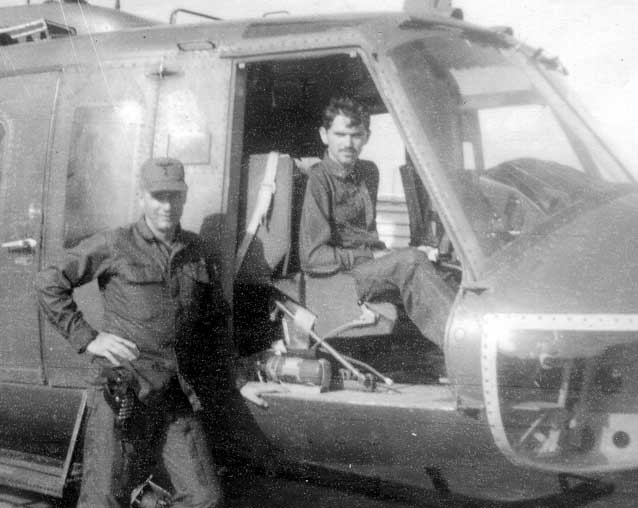
CW4 James A. Bailey, leaning against the aircraft before the incident. CW4 Bailey, a very experienced US Army Aviator,
at the age of 42, died tragically with 6 others when his aircraft crashed and sank into the Song Dong Nai River.
The pilot in the aircraft seat is Lawrence B. Smith, who was given this photo the day before the tragic crash.(69)
(Photo courtesy Lawrence B. Smith)
===========


A Bandit Crew Unfound for Days!

October 9, 1969

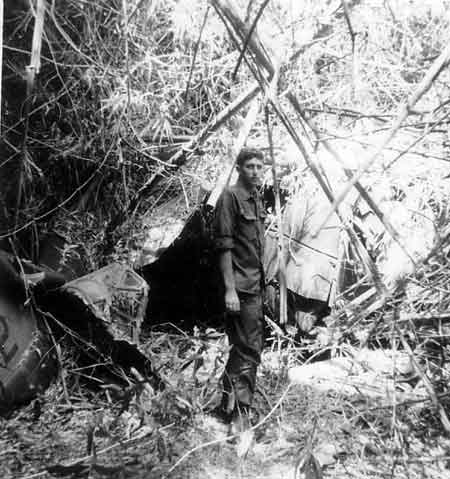
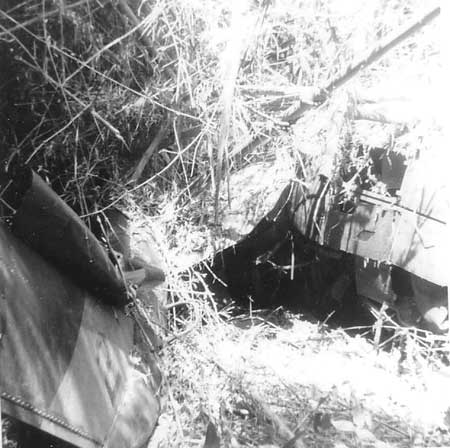
While supporting troops in heavy combat at coordinates YT 3025, about 7 miles East of Bien Hoa on October 9, 1969, Bandit 2, a UH-1C (66-00530) gun ship, was lost for days when it crashed in tall bamboo in bad weather. Bandit 2 with the bodies of the 4 killed crew members on board, was not found for many days afterward. Apparently, some Vietnamese wood cutters found the aircraft in thick bamboo, completely covered (See photos below).

According to the accident summary, Bandit 2, piloted by Aircraft Commander CW2 Owen Tetsumi Hirano, and Pilot 1LT Robert Scott Mason, Jr. and Crew Chief SP5 Greg Bradford Scott and Gunner SP4 Danny Ray Spencer, was flying wing with 1LT John W. Mack who was the fire-team leader of the light fire-team. CW2 Hirano's aircraft had a 20 minute fuel warning light on. It was dark and both aircraft experienced lost contact with the ground and began flying on instruments in very poor weather. They were within 500-600 feet above the jungle tops. They both new this was in the vacinity of the high tension power lines that followed Highway 1. CW2 Hirano called Lt. Mack and told him he had Highway 1 in sight with his search light and would pick it up and follow it back to Bien Hoa. 1LT Mack followed CW2 Hirano and shortly after passing over Trang Bom they ran into extremely heavy rain and went completely IFR. CW2 Hirano called and said he was making a 180 degree turn to the right. They both turned right and LT Clay A. Hinderliter, co-pilot with LT Mack, lost sight of CW2 Hirano's aircraft. LT Mack's aircraft made it back to Trang Bom and landed. They tried repeatedly to contact CW2 Hirano's aircraft by FM, UHF and VHF radios, but no contact.

After about 20 minutes on the ground at Trang Bom, the weather cleared sufficiently to take-off. LT Mack and LT Hinderliter took off and proceeded the short distance to Bien Hoa, but CW2 Hirano was not there. A search was conducted for many days, without success. However, following an intelligence report that some Vietnamese woodcutters had found an aircraft crashed in thick bamboo, the aircraft was finally found.

SP5 Dan Chase, Crew Chief of a 145th CAB, HQ,
aircraft, standing beside Bandit 2 wreckage,
which was lost for days in thick bamboo.(69)
(Photo courtesy Dan Chase)
 
 
A closer photo showing the "2" of Bandit 2 vertical stabilizer, above.(69)
(Photo courtesy Dan Chase)