Showing posts with label songdo. Show all posts

Monday, January 15, 2018

Inside Songdo, The City Designed From Scratch To Be Sustainable

Can this Korean development outside of Seoul be the standard for how we build new cities in the future?

Songdo is a massive new development about the size of downtown Boston, built from scratch over the last several years.

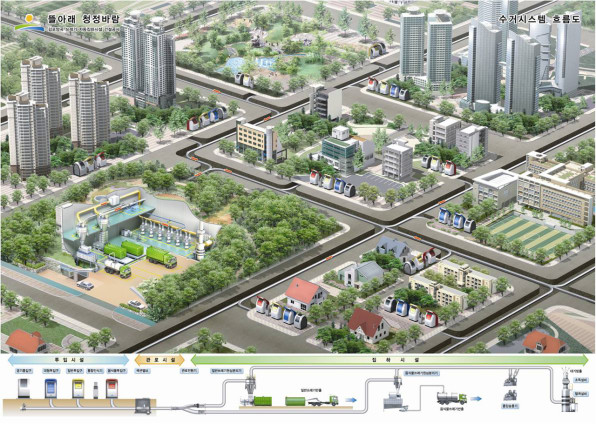
There aren’t any garbage trucks in Songdo, South Korea. Instead, trash is sucked through pneumatic pipes to a central sorting facility–in seconds–where it’s either recycled or turned into energy. Without a fleet of diesel trucks on neighborhood streets, Songdo has a lower carbon footprint.
It’s one of several ways that the area–a massive new development about the size of downtown Boston, built from scratch over the last several years–was designed to be more sustainable than a typical city like nearby Seoul. Compared to a city the same size, Songdo emits a third less greenhouse gases.
“Our vision from a design-build standpoint was, let’s start with the expectation of sustainability and efficiency,” says Tom Murcott, executive vice president of Gale International, the developer that led the master planning of the $35 billion urban development, built on reclaimed land along the Yellow Sea.
The whole area was designed so people might never have to drive. “A big goal of ours was to get people out of cars,” Murcott says. In a study, the team found that if people had to walk more than 12 minutes to a destination, they drive. So the developers put public transit stops within 12 minutes of every apartment building or business. Everyday errands can be accomplished on foot.
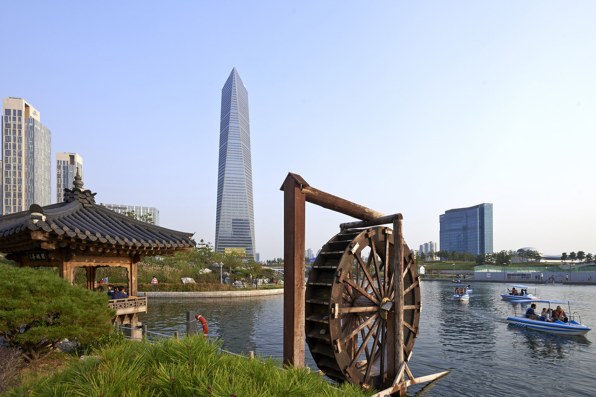
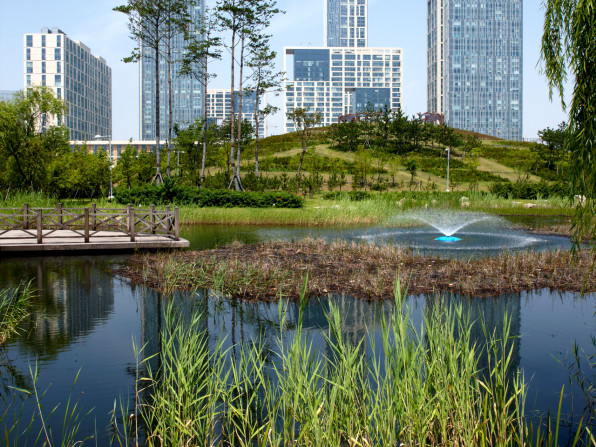
“You can pretty much walk to whatever you need, be it the supermarket, the dry cleaner, whatever it might be,” he says. Fifteen miles of bike paths loop through the district, connecting to another 91-mile network nearby. There are bike racks on every block. A 101-acre park–inspired by Central Park in Manhattan–stretches through the middle of the district, designed to make people want to walk. Forty percent of the area is green space.
ADVERTISING
For those who do drive, the development offers car sharing and gives priority parking to electric cars. Parking is underground, so cars don’t add to the urban heat island effect in the summer, and so there’s more space for pedestrians at street level.
The district holds 118 LEED-certified buildings; the entire development is also aiming for LEED certification at a neighborhood scale. The area is designed to use 40% less energy than a similar city. Everything is also wired to give feedback to residents, so someone can see how their heating or air conditioning or electricity use compares to the average for their neighbors.
“You’re using this technology to empower people living in the buildings to make good decisions,” says Murcott. (It’s not clear how effectively the system changes behavior; the utility companies haven’t shared their data with the developers.)
By 2020, the city plans to recycle 40% of the water used; effluent from buildings is used for flushing toilets and street cleaning. Stormwater is captured on green roofs and also used to irrigate parks.
Unlike some other notable attempts at building new eco cities–like Masdar City, which still has a tiny population–Songdo already has tens of thousands of residents in high-rises and tens of thousands more who commute to work in offices in the area.
That’s partly because there were already so many people living nearby. When the development created reclaimed land, that space was needed. “If you were to draw a 100-kilometer circle around downtown Seoul, 25 million people live in that circle,” says Murcott. “It’s very densely populated . . . we’re right in that circle. We were able to plug into a very thriving, vibrant, dense city.”
The area is still under construction; the development should be complete in 2020. In the meantime, the developers want to build similar cities elsewhere. In an early interview, they talked about building 20 Songdos, but they haven’t moved quite that fast. A project in China, called Meixi Lake, will be next.
As new cities follow the same pattern, planning gets faster. The master plan for Songdo took three years; Meixi Lake took six months to plan. “We’re constantly looking at other developments around the world that we can apply to this now,” says Murcott.

ABOUT THE AUTHOR

Adele Peters is a staff writer at Fast Company who focuses on solutions to some of the world's largest problems, from climate change to homelessness. Previously, she worked with GOOD, BioLite, and the Sustainable Products and Solutions program at UC Berkeley.
 More

Songdo, South Korea: the world's first smart city - in pictures/Songdo, Hàn Quốc: hình ảnh về thành phố thông minh đầu tiên của thế giới.
Songdo is due for final completion in 2015. It is sustainable, green and full of technological innovations – but what’s it like to live there?/ Songdo sẽ hoàn thành năm 2015. Đó là một thành phố môi trường bền vững , xanh và đầy các sáng tạo về kỹ thuật - nhưng cuộc sống ở đây như thế nào?
Dịch từ nguồn : https://www.theguardian.com/cities/2014/dec/22/songdo-south-korea-world-first-smart-city-in-pictures#img-8.

 San Jose ngày 22 tháng 12 năm 2014. 
Nhận xét: người ta có thể chỉ cần vài tuần để phá tan một thành phố nhưng phải cần 10 năm để xây một thành phố với môi trường bền vững, xanh và đầy các sáng tạo về kỹ thuật. 
Nói thêm: chi phí để xây TP này tốn 35 tỉ đô, do công ty Gale của Mỹ bỏ ra. Như vậy, chỉ có dân giàu mới mua nhà ở đây. 
http://www.tranthanhhien.com/2018/01/0.html
https://www.youtube.com/watch?v=CniraDbvcKc
https://www.youtube.com/watch?v=cVtvlQ4Jzbw


The truth about smart cities: ‘In the end, they will destroy democracy’

Cities is supported by

Rockefeller FoundationAbout this content

Maria Teresa Bilotta in Songdo

Mon 22 Dec 2014 07.22 ESTLast modified on Sat 13 May 2017 13.35 EDT

  •  
  •  
  •  
  • View more sharing options

Shares

450


Comments

4

Songdo International Business District has been built on 1,500 acres of reclaimed land.


FacebookTwitterPinterest

 Songdo has been built on 1,500 acres of reclaimed land; the final elements of this ‘smart city’ are due to be completed in 2015. All photographs: Maria Teresa Bilotta /Songdo đã được xây trên 1.500 mẫu Anh (1500 x 0.405 hectare = 607.5 hectare) trên đất lấn biển; công đoạn cuối cùng của thành phố thông minh sẽ hoàn tất năm 201.

A child plays with a smartphone in Songdo’s Central Park.


FacebookTwitterPinterest

 A child plays with a smartphone in Songdo’s Central Park, inspired by New York’s park of the same name/ Một trẻ em chơi với ĐTTM tại Công viên Trung tâm của Songdo, được xây với cảm hứng từ công viên trùng tên ở New York, Mỹ. 

The Incheon Tri-bowl cultural centre in Songdo.


FacebookTwitterPinterest

 The topsy-turvy Incheon Tri-Bowl, Songdo’s cultural exhibition centre in Central Park/ Kiến trúc ba cái chén lật ngửa - là trung tâm triển lãm văn hóa của Songdo tại Công viên Trung tâm.  

A bronze statue at the Central Park lake, Songdo.


FacebookTwitterPinterest

 One of three revealing bronze statues that perpetually urinate into Central Park lake, Songdo/Một trong ba tượng đồng đang đái vào hồ của Công viên Trung tâm của Songdo. 

A Songdo resident plays the flute in the shade of a traditional Korean wooden shelter.


FacebookTwitterPinterest

 A Songdo resident plays the flute in the shade of a traditional Korean wooden shelter/ Một cư dân Songdo chơi sáo dưới bóng râm của một nhà gỗ truyền thống Hàn quốc.

The 10-year development of Songdo is reckoned to have cost upwards of £100 million.

the park has a rain-saving facility to save on water consumption, and also its parking lots are located underground in an attempt to minimize carbon emissions.


FacebookTwitterPinterest

 The 10-year development of Songdo is reckoned to have cost upwards of £100 million/ Songdo được xây dựng trong 10 năm ước tính tốn trên 100 triệu bảng An .

At 101 acres, Central Park takes up about 10% of Songdo smart city’s total area.


FacebookTwitterPinterest

 At 101 acres, Central Park takes up about 10% of Songdo smart city’s total area/Với diện tích 101 mẫu Anh, Công viên Trung tâm chiếm khoảng 10/100 diện tích của TP thông minh Songdo.

A picnic in Songdo's Central Park.


FacebookTwitterPinterest

 A picnic in the park, South Korean-style/ Đi chơi picnic trong công viên, kiểu Hàn quốc. 

Rabbits island is located in the canal of Central Park


FacebookTwitterPinterest

 Songdo’s Central Park opened in 2009; the city is designed as a low-carbon, eco-friendly city/Công viên Trung tâm của Songdo đã mở cửa năm 2009; TP này được thiết kế là TP ít khí các-bon, thân thiện môi trường.