Showing posts with label tiền đồn 5 - kontum. Show all posts

Tuesday, September 9, 2025


Gia Vuc and the Song Re valley 
under Viet Minh control

Nguồn: Welcome to the Gia Vuc Website

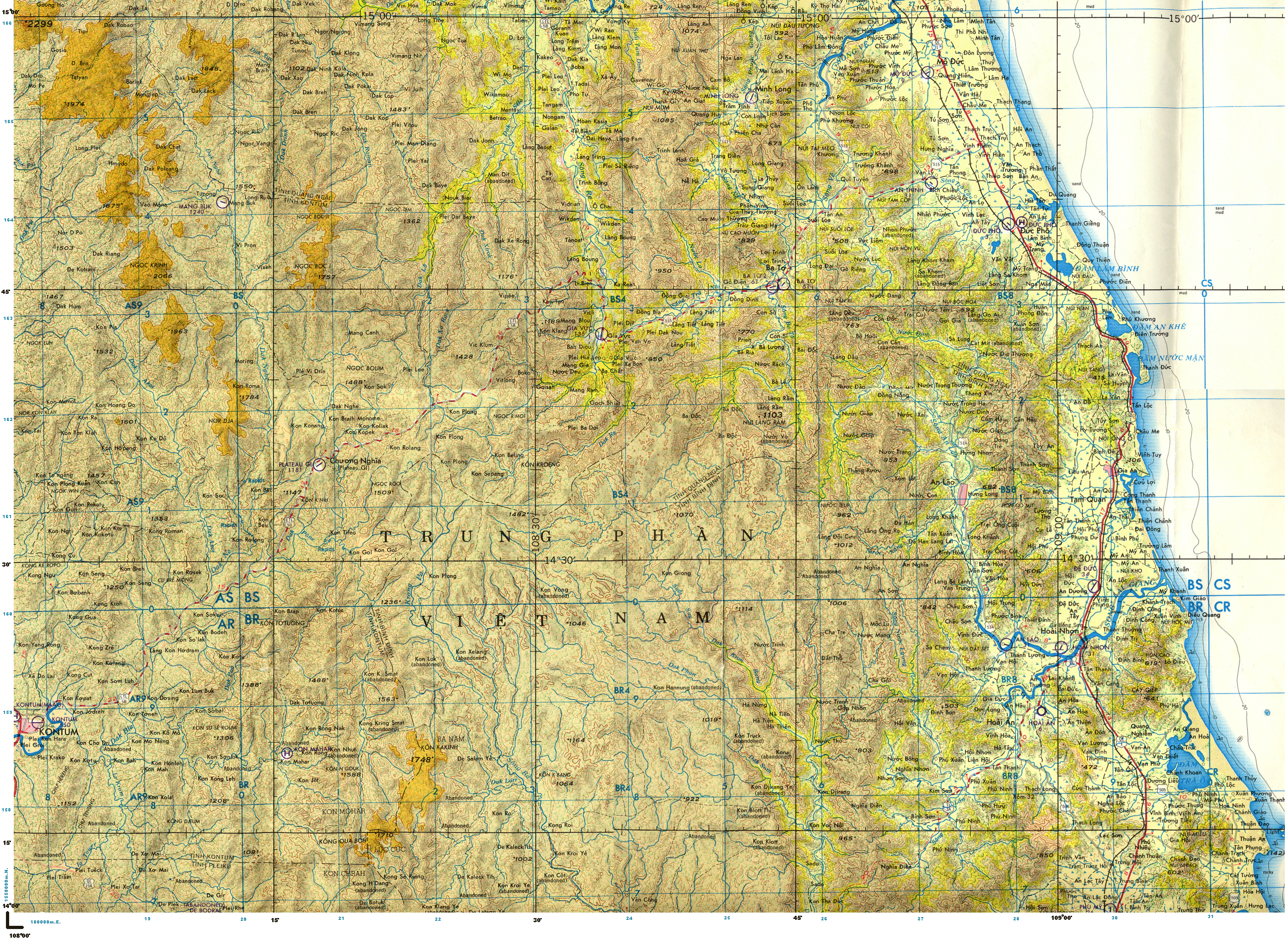
Bản đồ sau đây về vùng đông bắc của tỉnh lỵ Kontum, có làng Kon-Sơm-Luh, nơi xảy ra trận đánh lớn, sau HĐ Paris 1973, được nhắc đến trong các bài viết của Vương Mộng Long, Vũ đình Hiếu, Phạm Tín An Ninh, v.v...

ND495MAP.gif (2815×2054)

Một bản đồ cũng về vùng đông bắc Kontum: ND495MAP2insert.gif (1493×1106) 

Một bản đồ vẽ từ thời Pháp: New Page 1


DSC02923.JPG (945760 bytes)

Photo of a Viet Minh flag donated by a friend of my father.
The flag was captured by dad's friend brother while he fought in Indochina unfortunately both  are deceased and no more Information is known.

On the flag lay two daggers and some French GCMAnd Para insignias

Since having learned in the 90's about the French mine field around Gia Vuc and the hard standing building which became the infirmary, I always wonder if its USSF A-teams were walking in the footsteps of a French unit which would have been garrison there 10 years earlier?

Back in the late 40's and early 50's the Song Re valley and villages likes Gia Vuc, Bat To, Ha Thanh where under firm Viet Minh control. The situation was pretty reversed from the one in the 60's. The French forces in the central highlands were under strength and ill equipped, for the French high command this was not an important theater of operation and therefore received low priority on men and equipment. The French where strongly implanted around Kontum and Ban Me Thuot but were only able to organizing raiding parties on area further north. One of their most northern outpost was Kon Plong where a lot of the operations started from.

Two of the main units which orgenised operations in the Song Re valley was the 4e BMEO ("Bataillon de Marche Extreme Orient") and the GCMA   “Groupement de Commandos Mixtes Aéroportés” the French Special Forces in Indochina.

Here is a list of some of the recorded operations they did. (please note there is probably more and the period from 1953 -54 is unknown but this is all I have found so far)

Operations relating to Gia Vuc with the 4e BMEO, 1949-1951

This come from a French man who has retraced the two tour of duties (just under 5 years) of his uncle Maurice Millour in Indochina. http://philippe.millour.free.fr/index.html

On his first tour (37 months, 1948-51) Maurice Millour served with the 1/3ème BMEO and then 16e/4ème BMEO (16th Company, 4th Battalion de Marche Extreme Orient) at the outpost of 
Kon Plong in the central highlands, an outpost about 100k North East of Kontum situated on an elevated position nearby the dirt road /trail leading towards Gia Vuc, Ba To and finally the coast (what will be LTL58  during the Vietnam war.)

The Kon Plong outpost was surrounded by a vast expanse of forests and mountains, it was built on a small hill above a large valley housing a Montagnard village. The outpost was entirely made of logs, with the exception of two brick buildings and a few tin roofs. The main building was approximately 25 m long and 5 to 6 m high and wide with at one end the infirmary and the other end the radio room. Its most vulnerable part was the one facing the meadow and was made of a log wall pierced with fire ports. The post's enclosure was also made of logs: two parallel walls spaced 60 to 70 cm apart, filled with pebbles and earth, all reinforced with split bamboo set between the logs to limit erosion by rain. The build was carried out without a single nail and was held together with braided rattan. During heavy showers, running water did erode its construction resulting in holes which for ever needed filling up.


The 4eme BMEO consisted of one HQ company and 4 combat companies (13 to16 Co) totalling around 1000 men plus a training company the 17th Co.

The combat companies had a strength of around 173 men organised into 4 platoons with 3 squads per platoon. Each company had 2 French Officers, around 15 French or indigenous NCO and another 10 French corporals or PFC or soldiers. The montagnards were spread within the four companies according to their ethnic. 14 &16th been Sedang, the 15th Djarais and the HQ and the 13e with a mixture of both ethnics.

Armament of the 16th Co comprised of one heavy machine gun FM 24.29, a 120mm mortar in Kon Plong oupost, one 50m mortar for external operations, and a few grenade launchers.  The NCO had MAS 38 or STEN machine guns and most of the troop had old WWII worn out Canadian rifles.


1949

Early in 1949 Lieutenant Jaques Pierre arrived in Ban Me Thuot operational area and in February took command of the Kon Plong garrison which was under strength.

On the 25th of May, Lt Pierre left the Kon Plong outpost at the head of reinforced platoon of about 50 men, including seven Europeans. During this operation which did last two days, this small troop reached the valley of Song Re by Viklum and Violac, then went up the right bank of the stream until Gia Vuc. Lieutenant Pierre noted that the hamlet of Gia Vuc was home to a Vietminh food supply centre, whose staff, estimated at one section, has fled on their arrival. After setting fire to the food depot, the reinforced platoon of the 16/4eme BMEO headed back to Kon Plong via sometimes very steep paths: a stretch of less than ten kilometres took over eight hours. This operation was one of the first French reconnaissance in the Song Re Valley which was under Vietminh control.


On October 14, a reconnaissance party send in the Song Re Valley three days earlier returned to the Kon Plong outpost. They had been ambushed twice, north of Gia Vuc and east of Kon Plong, resulting into one KIA and two WIA. During the two ambushes, PFC Bellei, a Kon Plong medic who accompanied the patrol,  rushed forward several times while under fire to attend the wounded. For his bravery and dedication, he received 3 regimental citation with a Croix de Guerre with bronze star.

The two wounded were evacuated the next day to Pleiku Hospital .


1950

In February 1950, Hre Montagnards who had been forcefully enrolled into the Vietminh People's Army revolted. After having killed their cadres and Viet Ming commissars, they approach French posts to ask for their protection. Among these posts was Kon Plong. Lieutenant Pierre, the young and new CO of Kon Plong quickly realise the potential of that situation and supported the Hre revolt. He also organizes volunteers into a Hre paramilitary units of partisans under the name of "Action Hre".

On April 7 operation "Adrien" was launched to support the Hre uprising and to drive back Vietminh troops from the Song Re valley towards the coastal plain of Quang Ngai.  This newly formed "Groupe Mobile" (Mobile Task Force) was made of about 600 men with detachments from  the 2e BEP, the 1e BPC and the II/2ème REI as well as a newly formed and poorly trained unit of 150 Hre partisans.


From 7 to 13 April, the group moves from Kon Plong to the village of Gilang via Vitiong, Viklum, Vipée, Dak Xérong, Monit, then the valley of Song Ré until Ta Ma, and finally Gilang. During this part of the operation, only forward element made sporadic contacts with the Viet Minh.

From the 14th of April a landing strip, drop zones and a field first aid post were established in Gilang. Reconnaissance operations were launched in that area resulting in casualties for the 2ème BEP et du 2ème REI .  By the 22nd of April, it was established that 5 Vietminh battalions (4000 men) were now in that area and were closing in onto Gilang, so it was decided to abandon the Song Re valley and fall back onto Kon Plong.


A follow up operation "Gien" took place from 8 to 12 May. The operational element was another Mobile Task Force made up of the 15th and 16th Cie of the 4th BMEO, the "Compagnie de Marche" of the 1st BPC (Colonial Parachute Battalion) and a section from an Officers School platoon. It mission was to drive the Viet Minh out of the hamlet. Gia Vuc to set up a nearby outpost and recruit local troops.

The operation "Gien" did not succeed as much as the region was found empty of any significant number of enemies. Also the lack of trails, would have made the implantation of an outpost not viable due to being so much isolated without the chance of been rescued in time by road or trails.

Following the "Adrien" operation, it was decided to organize part of the Hre into a structured  military unit. This lead in mid-June to the creation in Kon Plong of USM 26 ( USM : " Unité Supplétive Militaire"  (Paramilitary Unit) with a strength of a company. Its initial armament was two FM Bren and a hundred rifles.
By mid-July 1950 its infrastructure was just three European non-commissioned officers. This unit will be later reinforced with automatic weapons and transformed into CCS 26 ( CCS : Compagnie de Commandos Supplétifs, (Paramilitary commando unit).

Corporal  Rene RIESEN from the 4e BMEO and author of " Mission spéciale en forêt Moï ".This is the only book regarding the French involvement with the Hre montagnards which had been  translated into English (new title "Jungle Mission" in 1957).

R Riesen received the task of supervising the Hrés volunteers, instructing them in guerrilla warfare and of forming villages self-defence groups [also known as "militia" or "goums"]. René Riesen did spend several years with the Hrés, becoming their war chief under the name "Ba Tamoï" (the father of Moïs), or "Ba tchiac gaho tabouac" (the white-haired father). One of Riesen's first missions was to form a unit of partisans in the village of Kon Pong , about 20 kilometres south of Kon Plong, with the aim of creating an outpost and raising a militia. The control of this village was indeed very important for the 16/4 BMEO since it covers, on the north, the position of Kon Plong and, westwards, the Kon Braih redoubt on the road joining Kontum and Kon Plong.

In June, many trails improvement works were carried out in the sub sector of Kon Plong, either south to Kon Braih or north to Kon Kléang or Gia Vuc.

On 31 December, the "Petits Hrés" self-defence group in the Mang Mou / Mang Rha area (Song Re Valley), armed with an FM, three MGs and one hundred and sixty rifles, turned themselves to the Vietminh following the betrayal of most of their troops.

Early January, information confirmed by patrols indicated the presence of 400 Vietminh around Mang Mou and Mang Rha, and another 1,200 in the Gia Vuc valley.

Gaston Mille commander of the 4th Montagnard battalion (the old 4th BMEO) decided to organize combat operation "Omer" in the form of a raid to the above Vietminh controlled area to recover all or part of the lost weapons as well as to collect information in view of a possible re-occupation of the villages of Mang Mou and Mang Rha. After 5 day of patrolling in and on the high ground of the Song Re valley, no contact was made with the enemy which had disappeared and the local population  appeared non co operative and under Viet Minh control.  

ND495MAP2insert.gif (1913697 bytes)

 Operations relating to Gia Vuc with the GCMA, 1951-1952

By 1951, the CEFEO, "Corps Expéditionnaire Français en Extrême-Orient" had new counter-guerrilla units at its disposition thanks to their new commander in chief,  General de Lattre de Tassigny. These newly formed counter-guerilla units were the “Groupement de Commandos Mixtes Aéroportés” (GCMA) and the Commandos Nord Vietnam both were using para military locally raised indigenous forces and were often operating in the Viet Minh back yard.

The "Action Hre"  formed a year earlier by Lt Pierre from Kon Plong was passed over to Captain Hentic from the GCMA after having been given the mission of reorganising it into Military fighting unit for the GCMA.

In autumn 1951, Cpt Hentic with 2 or 3 French cadres and a Hre forces of 150-200 men, carried out more raids deep into Viet Minh controlled territory. These raids lasted from three weeks to six weeks reaching places like Vidzen, Vibliang and Gi Lang and rallied more troops and population through the lower valleys of the Son Hre.  


Trail Trail leading to ViMuk outpost, you can see the outer earth and wood berm defending 
the French small outpost.

1952

26 April 1952, Cpt Hentic with less than three Hre "three centaines" left Gia Vuc and crossed the Song Re on the 27th and attacked and took Ba To in the morning of the 2nd of May. They destroyed all V-M installations and ammunitions depots as well as the VM 108 Regiment headquarters.
Then they disappeared in the jungle before the Viet Minh could react.  

 By the fall of 1952 with a Vietnamese Commando and a Hre platoon (approx 100 men),  Cpt Hentic achieved a two months deep reconnaissance via Dak To into Laos leading to Attopeu.  In its path, they destroyed Viet-Minh bases and laid booby traps on the Viet-Minh trails. During this reconnaissance mission they discovered in Laos a well camouflaged large tails network, Viet Minh staging and rest areas, food dumps etc. This was the first sighting of the famous Vietnam Ho Chi Minh trail! 

Unfortunately, this is all I have for the moment which lead us to the end of 1952 where trails leading to the valley of the Song Re and Gia Vuc were improved to facilitated a possible future French implantation to controlled that area.
By December 1952, Gia Vuc was still under Viet Minh control with no sign of having a French oupost but the war went on for a further two years!

Information translated by myself come 
from Philippe Millour website http://philippe.millour.free.fr/index.html  
as well as from Cpt Hentic's daughter, Anne Alexandre, http://www.maho-hentic.com/
and books like Jungle Mission, R Riesen; Le Silence du Ciel, R Riesen; Les Heros Oublies, Erwan Bergo.

This is a fascinating part of Gia Vuc history and if you want to discover more regarding the French Special Forces and the 4th BMEO who both beat the bush in the Central Highlands, visit my French Indochina war section.

Enjoyed your article and web links for "Gia Vuc from 1945-54".  Once while returning from a local security patrol (summer of 1967) by way of the hill/mountain located immediately to the NE of Gia Vuc I spotted an old rusted out MAT-49.  It was located about 3-4 foot down on the side of a 5-6 foot gulley.  I have always wondered about how it came to be there and wondered about it's history.  I knew that Gia Vuc had been an old French fort, but did not realize the extent of Viet Minh activity in the area. Thanks to SFC Ron Knight (Demo)


Names from the 
"Jungle Mission"  book

Names identified on 
US 1960's map

Location

Plaine de Gravuc   

Plain of Gia Vuc

15° 43' N  -  108° 05'E   Camp

Mankra    

Mangia


Vikli 

 Vicli


Viklun 

 Vic Klum


Tama 

Tamao


Vi-Pe 

 Vipee


Kon Plong

Kon Plong


Mang Buk

Mang Buk


Ba ToBa To
Vi Muk?
Gilang
Vidzen
Dak Ninh
ViHolac
Kola
Vibliang
Mang Mou 
Mang Rha

Regarding names and places, specially early during the war, they were very few maps and some of the names recorded may just had been written the phonetic way they were understood by the French. In the 60 's on US maps, the same village may have been written differently make it difficult to trace them.


Thursday, January 23, 2020

  1. Đôi nét về chiến thắng Măng Đen
  2. http://mangdentravel.vn/tai-lieu/
Là cửa ngỏ phía Đông của tỉnh Kon Tum, trong cuộc kháng chiến chống Mỹ xâm lược, Kon Plông được xây dựng và hình thành vùng căn cứ cách mạng của Khu 5 và của Tỉnh Kon Tum. Vùng căn cứ này góp phần thiết lập một hành lang liên lạc – Bắc – Nam chiến lược, vừa là hướng chủ yếu để vận chuyển khí tài, lương thực thực phẩm phục vụ chiến trường Tây Nguyên và Miền Nam, vừa là một trong những địa điểm tập kết lực lượng của các đơn vị bộ đội chủ lực nhằm chi viện cho chiến trường B3 và Kon Tum. Thấy rõ vị trí trọng yếu của KonPlông, nên ngay sau khi đánh chiếm Tây Nguyên, Pháp, Mỹ ngụy đã tập trung xây dựng tại đây các cứ điểm quân sự vững chắc, bao gồm khu vực đèo Măng Đen, Măng Buk, đồn KonPlông, đồn Loong Lech (nay là thôn 11 xã Hiếu) và hệ thống đồn bốt dọc theo quốc lộ 5 (nay là quốc lộ 24) tạo thành cụm cứ điểm trấn ải phía Đông Bắc Tây Nguyên, hòng uy hiếp phong trào cách mạng và các tổ chức kháng chiến ở Kon Tum. Trong đó, Măng Đen được Mỹ xây dựng thành cảng hàng không quan trọng để yểm trợ cho toàn bộ hệ thống cứ điểm trên địa bàn huyện KonPlông.
Năm 1974, tại Măng Đen, địch duy trì bộ máy hành chính quận lỵ Chương Nghĩa. Trong thế co cụm phòng ngự, chúng chia lực lượng thành 2 khu đóng giữ sát sân bay và tổ chức 6 trung đội dân vệ chốt giữ các ấp. Trước thực lực cách mạng ngày càng lớn mạnh ở vùng căn cứ kháng chiến ,địch ra sức giành giật dân với ta ở vùng Kon Leng, Kô Chất. Tuy không bỏ qua các hoạt động do thám, bắn phá, và dùng các loại may bay (C47, OV10) thị uy trên tuyến hành lang của ta; song thực chất tinh thần và lực lượng địch đã sa sút, khủng hoảng. Đảng bộ H29 và H16 nhận định: “địch đã đi vào thế suy yếu, chỉ lo phòng giữ, cố thủ là chính”. Đảng bộ chỉ đạo cán bộ và nhân dân nắm vững phương châm “tấn công trong xây dựng”, chuyển mạnh phong trào cách mạng ra tuyến trước, giữ vững tinh thần ý chí tiến công, tạo thế gây ép địch và sẵn sàng tiêu diệt chúng khi thời cơ đến. Thời cơ, đó là vào giữa năm 1974, khi Tỉnh Ủy Kon Tum và bộ tư lệnh B3, sau khi phân tích, đánh giá kỹ lưỡng tình hình, đã chủ trương tấn công, tiêu diệt các cứ điểm của địch nhằm mở rộng vùng giải phóng, tạo đà tiến về vùng tạm chiếm Kon Tum.
Trước sức mạnh tấn công của lực lượng H16, H29, cùng bộ đội chủ lực Trung đoàn 28 (sư đoàn 10) và một số binh chủng kỹ thuật của ta, ngày 30/10/1974, toàn bộ ban chỉ huy tiểu khu Kon Tum, ban chỉ huy tiểu khu Chương Nghĩa và Ban chỉ huy tiểu đoàn Bảo An 254 của ngụy đều đã vô hiệu hóa, 226 tên địch bị tiêu diệt. Trong số 168 tên bị bắt sống, có tên trung tá chỉ huy trưởng và 25 sĩ quan. Ta thu được 539 khẩu súng các loại, 2 pháo 105, 33 máy vô tuyến điện.Trên 2 ngàn dân bị địch kiềm kẹp hoàn toàn giải phóng. Cùng với thắng lợi tại các cứ điểm Đăk Pét, Măng Bút, chiến thắng Măng Đen đã góp phần mở rộng vùng giải phóng đến sát thị xã Kon Tum, tạo thế và lực mới cho chiến dịch Tây Nguyên, mở đường giải phòng Sài Gòn, kết thúc thắng lợi chiến dịch Hồ Chí Minh lịch sử, thống nhất đất nước. Với những đóng góp to lớn trong cuộc kháng chiến chống Mỹ cứu nước. Tháng 10 năm 2005, huyện KonPlông đã vinh dự đón nhận danh hiệu Anh hùng lực lượng vũ trang nhân dân.

Thursday, January 9, 2020

LƯỢC SỬ GIÁO XỨ KON XƠMLUH

I. GIỚI THIỆU

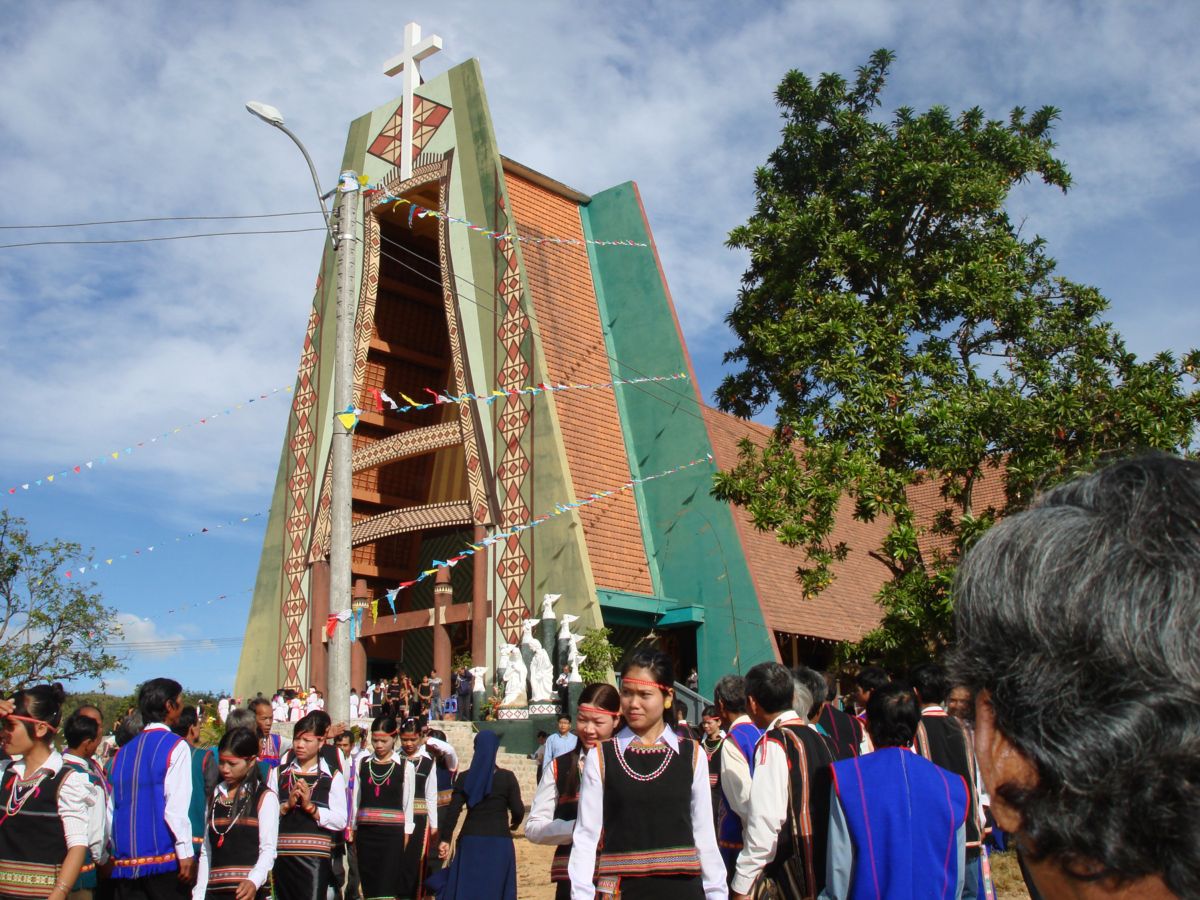
          Từ trung tâm thành phố Kon Tum, theo quốc lộ 24 đi lên hướng đông bắc (đi Kon Plong – Đức Mẹ Măng Đen), cách thành phố Kon Tum 15 km, đó là Nhà thờ giáo xứ Kon Xơmluh, thuộc thôn Kon Xơmluh, xã Dak Tơre, Huyện Kon Rẫy, Tỉnh Kon Tum. Ngôi nhà thờ mới được xây dựng khang trang, vững chãi, toạ lạc trên một ngọn đồi thoáng đãng, được phỏng theo mô-típ nhà sàn dân tộc Tây Nguyên. Lễ khánh thành nhà thờ mới vào ngày 06.12.2011. Cha sở hiện tại (từ 2006-…) là Linh mục Gioan Nguyễn Đức Hoà.
Hình 1- Khánh thành Nhà thờ Kon Xơmluh 06/12/2011
Giáo xứ Kon Xơmluh ngày nay gồm 21 làng dân tộc, với số tín hữu: 6.419 người, thuộc sắc tộc Bahnar – Jơlơng. Đó là các làng: Kon Dơnăng, Kon Tơneh, Kon Dơxing, Kon Xơmluh, Kon Longbuk, Kon Klơng, Kon Hơdrâm, Kon Jripen, Kon Rơlang, Kon Xơlak 1, Kon Xơlak 2, Kon Bokdeh, Kon Kơtuh, Kon Xơrek, Kon Kenh, Kon Wăng, Kon Rơxa, Kon Xơmuôn, Dak Tân, Dak Ngo (1)
          Bổn mạng giáo xứ:
-Từ 1891 – 1939: Tơring Kon Xơmluh chọn Đức Mẹ Lộ Đức (Notre-Dame de Lourdes) làm thánh bổn mạng (2).
-Từ 1939: Giáo xứ đổi tên thánh bổn mạng là Thánh Gia Thất (Saite-Famille), cho đến ngày nay (3).
Về tên gọi Kon Xơmluh: Xơmluh là một loại cây như cây le. Kon Xơmluh: Làng có nhiều cây như cây le, loại cây mọc nhiều ở vùng này.
II. VÀI DÒNG LƯỢC SỬ GIÁO XỨ KON XƠMLUH
          Ngược dòng lịch sử cách đây 120 năm, công cuộc loan báo Tin Mừng cho các dân tộc vùng phía bắc và đông bắc Kon Tum được xúc tiến bởi các vị thừa sai, trong số đó người có công đầu phải kể tới là Cha Gioan Baotixita Maria Guerlach (bok Kanh: sinh 1858, Lm 1882, Qđ 1912). Ngài là vị tông đồ nhiệt thành, đã làm việc tích cực để hoán cải lương dân và thu được nhiều kết quả hơn những vị tiền nhiệm: từ năm 1888 (khởi đầu làng Kon Kơtu xin theo đạo) đến năm 1894, ngài đã dạy dỗ và rửa tội hơn 1.200 tân tòng (4). Vào năm 1890, Cha Guerlach được bổ nhiệm làm bề trên tạm thời miền Thượng, trong thời gian này việc tòng giáo lan rộng khắp các buôn làng.
Vào ngày 08.06.1891, dân làng Kon Xơmluh và Kon Tơneh gia nhập đạo Công giáo, tiếp đến các làng lân cận trong vùng cũng xin theo đạo, lập thành địa sở (Tơring) Kon Xơmluh, dưới sự dẫn dắt của Cha Guerlach (5). Trong thời kỳ đầu từ 1891 – 1896, ngài phải vất vả biết bao nhiêu để đem từng ấy làng trở lại đạo, lo lắng dạy dỗ cho họ được rửa tội và xưng tội.
 
Hình 2- Các Địa sở thuộc sắc dân Bahnar-Jơlơng
(Trích: La Mission des Pays Mois en 1937)
Tiếp nối Cha Guerlach – vị chủ chăn tiên khởi, trong suốt chiều dài lịch sử 120 năm (1891 – 2011), địa sở Kon Xơmluh đã được dẫn dắt bởi các linh mục sau đây (6):
Năm 1896 – 1898: Cha Denis Poyet (bok Thuân) phụ trách.
Năm 1897 – 1898: có thêm Cha J. B Jurbert (bok Binh) phụ trách.
Năm 1899 – 1904: Cha Grégroire Bober (bok Ber) phụ trách.
Năm 1904 – 1914: Cha Louis Hutinet (bok Hu) phụ trách.
Năm 1909: Kon Longbuk tách ra khỏi địa sở Kon Xơmluh.
Năm 1911 – 1914: có thêm Cha Francoise Légis Louison (bok Luy) phụ trách.
Năm 1913: có thêm Cha Meymes phụ trách.
Kon Xơmluh có 14 họ đạo, với 1.413 tín hữu và 61 dự tòng.
Năm 1915 – 1925: Cha Joseph Gaillard (bok Biong) phụ trách.
Năm 1920: có thêm Cha Phêrô Nhì (Việt Nam) phụ trách.
Năm 1925 – 1928: Cha Anrê Tường phụ trách.
Năm 1926: có thêm Cha Stêphanô Cao Tấn Truyện phụ trách.
Năm 1928: có thêm Cha Bernard Iroz (bok Y) phụ trách.
Năm 1928 – 1935: Cha Phêrô Trần Ngọc Thích phụ trách.
Năm 1936 – 1938: Cha André Marty (bok Ty) và Cha Pêtrô Hiâu (Hoá, Bahnar) phụ trách.
Năm 1936: Khởi công xây dựng nhà thờ Kon Xơmluh.
Năm 1937: Hoàn thành nhà thờ Kon Xơmluh.
Kon Xơmluh gồm 20 họ đạo, với 1.450 tín hữu và 234 dự tòng (7).
Hình 3- Nhà thờ Kon Xơmluh (cũ)
          Năm 1938 – 1948: Cha Louis Giffard (bok Ngok) phụ trách.
Năm 1939: Kon Xơmluh đổi tên thánh bổn mạng thành Thánh Gia Thất (8);
gồm 16 họ đạo, với 1.455 tín hữu.
Năm 1946: Kon Xơmluh có 1.445 tín hữu và 134 dự tòng.
Năm 1948 – 1949: Cha Léon Dujon (bok Bưu) phụ trách.
Năm 1949 – 1956: Cha Louis Giffard (bok Ngok) phụ trách lần 2.
Kon Xơmluh có 15 họ đạo, với 1.413 tín hữu, 5 dự tòng.
Năm 1956: Cha Léon Dujon (bok Bưu) phụ trách lần 2.
Từ 1956 đến 1975, quí Cha phụ trách và tình hình giáo xứ Kon Xơmluh như  sau:
Năm
Linh mục phụ trách
Số họ đạo
Số giáo dân
Dự tòng
Giáo phu
1956
1958
1959
1960
1963
1964
1965
1966
1967
1969
1972
1974
1975
Cha Léon Dujon (bok Bưu)
-nt-
Cha Daniel Léger (bok Leh)
-nt-
-nt-
-nt-
-nt-
-nt-
Cha Micae Võ Văn Sự
-nt-
Cha Vinh Sơn Đặng Văn Tú
-nt-
-nt-
15
17
17
17
14
13
9
9
15
3
1.883
1.553
1.533
1.552
1.727
1.727
1.888
1.922
1.730
1.933
4.144
2.144
40
54
39
27
27
14
12
16
16
22
17
Năm 1968: Biến cố Tết Mậu Thân, nhà thờ Kon Xơmluh bị đánh bom sập bình địa.
Năm 1972: Các làng trong giáo xứ di dời về trung tâm Paradis, tức là làng Kon Rơwang
thuộc giáo xứ Chính toà bây giờ.
Tháng 3/1975: Các làng trở về làng cũ của mình. Số giáo dân là 2.144 người và giáo xứ Kon Xơmluh trực thuộc giáo xứ Chính toà Kon Tum. Từ đây, giáo xứ do các Cha sở giáo xứ Chính toà phụ trách.
Năm 1975 – 1978: Cha Phaolô Nguyễn Đây phụ trách.
Năm 1978 – 2004: Cha Giuse Nguyễn Thanh Liên phụ trách.
Năm 2004, giáo xứ Kon Xơmluh trực thuộc giáo xứ Kon Jơdreh, và Cha Antôn Nguyễn Văn Binh, cha sở Kon Jơdreh phụ trách cho đến 2005.
Năm 2005 – 2006: Cha Vinh Sơn Nguyễn Ngọc Quyền, cha sở Kon Jơdreh, phụ trách.
          Ngày 01.06.2006, Đức Giám Mục Micae Hoàng Đức Oanh bổ nhiệm Cha Gioan Nguyễn Đức Hoà làm chính xứ Kon Xơmluh với 21 làng và 6.419 giáo dân. Từ đây, giáo xứ Kon Xơmluh tách khỏi giáo xứ Kon Jơdreh và trở lại thành giáo xứ độc lập như lúc ban đầu.
          Ngày 01.01.2008: đặt viên đá đầu tiên, khởi công xây dựng nhà thờ Kon Xơmluh; và ngày 06.12.2011, lễ khánh thành ngôi nhà thờ mới trong niềm vui tạ ơn Thiên Chúa, tạ ơn Thánh Gia: Chúa Giêsu, Đức Mẹ và Thánh Giuse. Đây không chỉ là niềm vui của riêng giáo xứ Kon Xơmluh, mà còn là niềm vui chung của gia đình giáo phận Kon Tum, đánh dấu sự trưởng thành của giáo xứ, và cũng gợi lên suy tư truyền giáo: cánh đồng lúa còn mênh mông và còn nhiều khó khăn, bất trắc, đang rất cần những tâm hồn tông đồ đến cảm thông, chia sẻ Tin Mừng Cứu Độ.
MỘT SỐ HÌNH ẢNH
QUÝ LINH MỤC PHỤ TRÁCH GIÁO XỨ KON XƠMLUH
TỪ TRƯỚC ĐẾN NAY
šV

                          
H.4 -Cha J.B Guerlach H.5 – Cha Denis Poyet H.6 – Cha Joseph Jurbert
H.7 – Từ trái qua phải:
Hàng trên:  
     1/ Cha Louis Hutinet         2/ …    3/ Cha Fr. Régis Louison      4/ …
Hàng dưới:
      5/ Cha André Marty  6/ Cha Petrô Hiâu (Hoá)  7/ Louis Giffard  
                           8/ Cha Léon Dujon
                        
   H.8 – Cha Anrê Tường         H.9 – Cha Phêrô Trần Ngọc Thích


H.10 – Từ trái qua phải – Hàng dưới (có hình):
1/ Cha Daniel Léger  2/ Cha Micae Võ Văn Sự  3/ Cha Vinh Sơn Đặng Văn Tú
4/ Cha Phaolô Nguyễn Đây

H.11 – Từ trái qua phải:
1/ Cha Giuse Nguyễn Thanh Liên               2/ Cha Antôn Nguyễn Văn Binh
3/ Cha Vinh Sơn Nguyễn Ngọc Quyền        4/ Cha Gioan Nguyễn Đức Hoà
CHÚ THÍCH:
(1)   Theo SƠ ĐỒ TỔ CHỨC GIÁO XỨ KON XƠMLUH 2011, tại nhà thờ Kon Xơmluh.
(2)   x. La Mission des Pays Mois en 1937 và Échos de la Mission 10/1947. tr. 5.
(3)   và (8) x. La Mission des Pays Mois en 1939.
(4)   x. Tiểu sử Cha J.B Guerlach (Archives M.E.P).
(5)   Các linh mục phụ trách và các số liệu trong trong phần này:
x. Echos de la Mission 7-8-9-10-11-12/1947; Echos 5-6/1948 và Echos 15.8/1949, các trang  liên hệ.
Và x. Lịch Công Giáo Địa Phận Kon Tum, các năm liên hệ.
(6)   x. Echos de la Mission 10/1947. tr. 5.
(7)   x. La Mission des Pays Mois en 1937.
                                                                                                                          MINH SƠN 11/2011
———————-šV———————-
MỘT VÀI HÌNH ẢNH NHÀ THỜ KON XƠMLUH 2011
H.12 – Sứ Thần Toà Thánh Girelli thăm nhà thờ Kon Xơmluh
Ngày 10/09/2011
H.13 – Một số hình khánh thành 06.12.2011

Không có nhận xét nào:

Đăng nhận xét