Thursday, September 4, 2025

 TRẬN DAK TO-BEN HET 1969, PHẦN 2.

Chúng tôi không ăn mừng được lâu. Mặc dù các trung đoàn bộ binh của quân đội Bắc Việt (NVA) đã chịu tổn thất nặng nề, nhưng Trung đoàn Pháo binh 40 của NVA vẫn tiếp tục tấn công Dak To và Ben Het. Do họ đã tiến sát các trại để nổ súng, nên họ không bị ảnh hưởng bởi các đợt không kích của B-52. Vào tối ngày 28 tháng 5, lúc 17 giờ 28 phút, quả rocket 122mm đầu tiên trong đêm đã rơi xuống Dak To. Ngay sau đó là thêm mười một quả nữa. Một trong những quả rocket đó đã bắn trúng hầm chỉ huy của Đại đội Trang bị nhẹ 15 thuộc Tiểu đoàn Công binh 299 (299th CBE Battalion). Trớ trêu thay, lúc đó có một nhóm gồm 30 người đang tập trung trong hầm để dự buổi họp tối – họ là lực lượng phản ứng nhanh được phân công bảo vệ vòng ngoài. Quả rocket bay vượt qua tấm chắn nổ và rơi thẳng vào lối vào của hầm. Kết quả là chín người chết và mười chín người bị thương. Trong số người thiệt mạng có Đại đội trưởng – Trung úy Koch, Thượng sĩ nhất của đại đội, một Trung sĩ và thư ký đại đội.

Hai ngày sau, vào ngày 30 tháng 5, một chiếc trực thăng chở Trung tá Howard – Chỉ huy Tiểu đoàn Công binh 299 – đã đáp xuống căn cứ. Nhiều người rất ngạc nhiên khi thấy Đại tướng bốn sao Creighton Abrams – Tư lệnh Bộ chỉ huy Viện trợ Quân sự Hoa Kỳ tại Việt Nam (MACV) – bước ra khỏi trực thăng cùng đoàn tùy tùng. Ông đến để chúc mừng quân đội VNCH (ARVN) vì đã bảo vệ được Dak To, và ông sốc khi thấy căn cứ chỉ toàn binh lính Mỹ. Chiều hôm đó, lực lượng Avengers một lần nữa đã cứu nguy cho ARVN khi tiêu diệt nhiều lính csbv đang tấn công vị trí của họ.

Lúc này đã rõ ràng rằng csbv đã lên kế hoạch rất kỹ càng cho chiến dịch của họ, và đã xây dựng các công sự chiến trường nhằm dụ quân VNCH vào các trận chiến đẫm máu. Rõ ràng là Đại tá Liên – Chỉ huy BK 24 (24th STZ) – không có ý định trực diện đối đầu với NVA trên chiến trường. Ông sử dụng các tiểu đoàn cơ động của mình để xác định và xác định vị trí của địch, rồi gọi không quân, pháo binh và trực thăng vũ trang của Mỹ đến tiêu diệt quân địch. Trong tháng 6, csbv thay đổi chiến thuật, tập trung vào việc cô lập Ben Het và tiêu diệt căn cứ này thông qua chiến thuật tiêu hao. Họ dồn nhiều nguồn lực vào việc phong tỏa Đường 14 giữa Kontum và Tân Cảnh, cũng như Đường 512 nối Tan Cảnh, Dak To và Ben Het.

Trong tuần đầu tháng 6, Đại tá Liên ra lệnh cho Tiểu đoàn 3 của Trung đoàn Bộ binh 47 VNCH và Tiểu đoàn 4 của Lực lượng Mike Strike quay lại chiến trường. Lần này họ sẽ càn quét khu vực dọc theo Đường 512 giữa Dak To và Ben Het để đánh bật các đơn vị phục kích và chặn đường của NVA. Tổng số quân lực hiện có của Đại tá Liên lúc này lên đến 15.600 người.

Ngày 4 tháng 6, pháo cối và súng không giật của csbv lại tiếp tục gây thiệt hại. Hai pháo thủ thuộc Đại đội A, Tiểu đoàn Pháo binh 1/92 đã thiệt mạng tại Dak To. Căn cứ hỏa lực 6 cũng bị trúng đạn từ súng không giật 75mm.

Trong suốt trận chiến Dak To, những người lính công binh của Tiểu đoàn 299 đã dũng cảm bảo vệ căn cứ và sân bay. Ngoài ra, đơn vị này còn liều mình rời khỏi căn cứ để tiếp tục nhiệm vụ công binh: duy trì tuyến đường 512, rà phá mìn, sửa cầu, lấp hố bom, và dọn dẹp các vật cản do csbv dựng lên.

Ngày 7 tháng 6 không khởi đầu tốt và kết thúc còn tệ hơn. Đó là một ngày mà tôi và các chiến sĩ Tiểu đoàn 299 sẽ không bao giờ quên. Lúc 1 giờ sáng, csbv bắt đầu một đợt tấn công dữ dội bằng súng bộ binh, súng máy, 59 quả đạn cối và 15 quả đạn B-40. Năm lính công binh bị thương trong cuộc chiến này. Dù rất nguy hiểm, nhưng đến 7 giờ sáng, Đại đội D của Tiểu đoàn 299 vẫn rời căn cứ để thực hiện nhiệm vụ rà mìn trên Đường 512, hướng về phía tây đến Ben Het.

Khoảng một giờ sau, csbv tấn công. Tiếng súng AK-47 nổ chát chúa và tiếng rít của đạn B-40 vang lên từ các bụi cây ven đường. Hai lính công binh ngã xuống chết tại chỗ. Một số khác bị thương đau đớn. Những người còn lại nhảy khỏi đường để tìm chỗ ẩn nấp. Toán quân VNCH nhỏ được giao nhiệm vụ bảo vệ nhóm rà mìn thì quay đầu bỏ chạy. Những người Mỹ còn khả năng chiến đấu đã bắn trả bằng súng M-14. Lời kêu cứu được gửi về Dak To. Lực lượng phản ứng nhanh (QRF) lập tức được tập hợp: hai xe Duster, hai xe tải 5 tấn chở đầy lính, và một xe ben gắn súng máy 50 rời căn cứ. Khi đến hiện trường, csbv vẫn tiếp tục kháng cự. Nhiều lính công binh khác bị thương. Tôi đã điều trực thăng đến để di tản thương binh, nhưng trực thăng bị bắn trúng và phải cố gắng quay về Dak To trước khi rơi. Tôi đang kiểm tra chiếc trực thăng thì QRF trở về sân bay Dak To. Tôi tận mắt thấy những người bị thương được cáng vào Trạm Y tế. Một binh sĩ da đen bị trúng đạn vào ngực, có vẻ như đã chết. Một số khác đau đớn và hoảng loạn. Các lính công binh chạy đến trạm y tế để xem tình hình bạn mình. Tôi thấy một người rời khỏi đó, nước mắt lăn dài, vừa chạy ra vừa nức nở. Vài phút sau, tôi thấy một y tá bước ra, trên tay và quần áo dính đầy máu.


Nếu bạn cần chia đoạn, rút gọn, hoặc chỉnh sửa theo giọng văn phù hợp với mục đích cụ thể (ví dụ: cho sách, phim tài liệu, v.v.), cứ nói nhé.

 Our celebration did not last long. While the NVA infantry regiments had taken a beating, the NVA 40th Artillery Regiment kept up its assault on Dak To and Ben Het. Since they had moved in close to the camps to fire their weapons, they were not subject to the B-52 strikes. On the evening of May 28, at 1728, the night’s first 122 mm rocket landed at Dak To. That was quickly followed by eleven more. One of those rockets hit the command bunker of the 15th Light Equipment Company of the 299th CBE Battalion. As luck would have it, a group of thirty men had gathered in the bunker for the nightly briefing as the Ready Reaction Force for the perimeter defense. The rocket landed behind the blast shield and directly in the opening to the bunker. The result was nine dead and nineteen wounded. Included in the dead was the Company Commander, 1st LT Koch, the Company First Sergeant, a Staff Sergeant, and the Company clerk.

Two days later, on May 30, a helicopter carrying the 299th CEB Commander, LTC Howard, landed in the compound. More than a few were shocked also to see Four-star General Creighton Abrams, MACV Commanding General, step out of the helicopter with his entourage. The general had come to congratulate the ARVN for their defense of Dak To and he was shocked that only Americans were at the base. That afternoon the Avengers once again saved the ARVN’s bacon by killing numerous NVA that were assaulting their position.

It was clear at this point that the NVA had carefully planned their operation and constructed field fortifications that would draw the ARVN into bloody ground battles. It became obvious that Col. Lien, Commander of the 24th STZ, had no intent of going head to head with the NVA in the field. He used his maneuver battalions to locate and fix the NVA positions. He then called upon American air power, artillery, and helicopter gunships to destroy the enemy. During June, the NVA changed tactics and again concentrated on isolating Ben Het and destroying it through attrition. The NVA put considerable resources into blocking Route 14 between Kontum and Cahn Tan, and Route 512 between Cahn Tan, Dak To, and Ben Het.

During the first week of June, Col. Lien ordered the 3rd Battalion of the 47th ARVN Infantry Regiment, and the 4th Battalion of the Mike Strike Force back into the field. This time they would sweep the area along Route 512 between Dak To and Ben Het in an attempt to dislodge the NVA blocking and ambushing units along the road. The total units available to Col. Lien now totaled 15,600 men.

On June 4, the NVA mortar and recoilless rifle shelling again took its toll. Two artillerymen of Battery A of the 1st/92nd Artillery were killed at Dak To. FSB 6 was also hit with 75 mm recoilless rifle rounds.

Throughout the Battle of Dak To, the men of the 299th CEB courageously defended the compound and airfield. In addition, the unit fearlessly ventured outside the compound to continue their mission as engineers. Their job was to maintain Route 512, i.e., clear mines, repair bridges, fill in bomb craters, and clear obstructions constructed by the NVA.

June 7 did not start well, and it would end even worse. It would be a day both I and the men of the 299th CEB would not forget. At 0100 in the morning, the NVA began a barrage of small arms fire, machine-gun fire, fifty-nine rounds of mortar, and fifteen rounds of B-40 RPG’s. Five engineers were wounded in the ensuing fight. In spite of the danger, at 0700, D Company of the 299th left the compound to conduct mine sweeping of Route 512 west toward Ben Het.

About an hour later the NVA struck. The sharp crack of AK 47s and the whoosh of a B-40 RPG erupted from the foliage lining the road. Two engineers fell dead. Several others fell, withering in pain. The others dove off the road seeking cover. The small ARVN squad that was to provide security for the mine sweepers turned and ran away. Those that were still able returned fire with their M-14 rifles. The call for help came back to Dak To. A Quick Reaction Force quickly assembled. Two Dusters, two five-ton trucks full of men, and a dump truck mounted with 50-caliber machine-guns headed out of the gate. When they arrived at the ambush site, the NVA continued to put up a fight. Several more engineer were wounded. I sent a helicopter to the site to retrieve the wounded, but it was shot up, and had to depart, struggling to make it back to Dak To before crashing. I was inspecting the helicopter when the QRF returned to the DakTo airfield. I saw the wounded as they were carried on stretchers to the Aid Station. One black soldier had a bullet hole in his chest and he appeared to be dead. Others were clearly in pain and shock. Engineers ran to the Aid Station to check on their friends. I saw one leave with tears running down his face as he came running out of the aid station sobbing. A few minutes later I saw a medic come out of aid station with blood on his hands and clothes. His face showed extreme anguish. In a tone of deep frustration and pain he exclaimed, “He was shot in the neck. He was bleeding badly. I stuck my fingers into the mangled flesh of his neck to find the bleeding artery. I COULDN’T FIND IT! He bled to dead as I watched”. It was difficult to see such suffering. The engineers that gathered were all extremely upset by the ARVN failure to help protect their Americans buddies and friends. The strain of continuous combat, daily shellfire, and growing casualties could clearly be seen on the faces and the reactions of these men.

Col. Lien increased the pressure on the NVA by committing the 1st and 3rd Battalions of his 53rd Infantry Regiment. Two more Cavalry Squadrons where brought forward to begin clearing Route 512.

Two days later, on June 9th, A Battery of the 1st/92nd, at Dak To, again took casualties. Nine men were wounded when a 75 mm recoilless rifle round hit in the gun pit during a fire mission.

While I have detailed many combat assaults, and major engagements, the Ghost Rider and Avenger helicopters reported to Dak To daily. All the units in the field needed support and resupply continuously. Without food, water, ammunitions and replacement equipment, they could not continue their mission. The terrain, the weather, and the enemy made these missions extremely dangerous. Acts of courage and heroism occurred daily, to the point where it became routine. It was anything but common-place. Too many acts of valor went unrecognized. Even inside the compound WO1 Wilson valiantly operated from Mobile 1 to launch aircraft on their missions while dodging incoming almost daily.

On June 13, the Avenger gunships responded to an urgent request for close-in fire support.  The mission resulted in a reported 19 NVA KBA. But the battle to re-open the road to Ben Het continued. On June 16, I assigned a light-fire-team of Cobra gunships from the 361st Escort Company to a mission in support of a Vietnamese Cavalry Squadron that was working Route 512. During a close-in fire mission one of the cobras was shot down and both pilots were killed. The pilots were CWO Mark D. Clutfelter and WO1 Michael A. Mahowold. Due to intense enemy action in the area, and the failure of the ARVN to help, their bodies could not be recovered for several days.

There were two aspects to the South Vietnamese relief of Ben Het. One was to get supplies to the Special Forces Camp at Ben Het by road convoy. The second was to clear North Vietnamese forces from the surrounding hills. Evidently, Col. Lien did not use all his forces for the relief of Ben Het, diverting many of them to holding open lines of communication between Kontum and Dak To, and mopping up other points in his area of operation.

In mid-June the South Vietnamese succeeded in getting a road convoy into Ben Het. But for more than a week after that, NVA ambushes and mines prevented further success. ARVN officers admitted to losing 27 vehicles. The road to Ben Het was littered with the carcasses of burnt-out trucks and armored vehicles.

On June 21, a combat assault occurred to place an ARVN Battalion on the ground 3 miles Southeast of Ben Het. Eight Ghost Rider slicks and two Avenger gunships inserted over 800 troops of the 4th Mike Strike Force Battalion. The NVA challenged the operation with heavy small-arms fire and mortars. Ground fire damaged two aircraft, but the crews escaped injury.

For the remainder of June, the men of the 299th CEB continued to take casualties. Nearly every day the base was hit by rockets and mortars; sappers probed the perimeter almost every night. The mine-sweep teams continually ran into ambushes. Company D’s team was particularly hard hit again on June 23, east of Ben Het, near FSB 13. Again, the ARVN security force fled as soon as the firing started. A QRF was sent from Dak To, but it too was ambushed. A second QRF and air support by the Avenger gunships, had to be called in before the enemy broke contact and pulled out. Three engineers died and twenty-one were wounded.

This was not a good day for the artillery batteries either. A Battery, at Dak To, took a direct hit from a 75 mm recoilless rifle that landed in its powder magazine. The resultant explosion destroyed 350 cannisters of white bag powder, and five men were wounded. Later the same day four more artillerymen were wounded during a mortar barrage.

Another convoy reached Ben Het on June 24th. Again, the effort required a tough operation. The 1st Battalion of the ARVN 42nd Regiment provided the bulk of the convoy force and fought a half-day battle against ambushes just over half-way between Dak To and Ben Het. The ARVN admitted to five dead and fifteen wounded. They claimed to have killed 105 NVA. The NVA 40th Artillery Regiment responded by hitting Ben Het with 195 rounds of mortar and recoilless rifle fire.

To reinforce the road clearing operation, five Ghost Rider slicks and two Avenger guns inserted 1100 ARVN Rangers into an LZ nine miles west of Dak To on June 28th. Two slicks were damaged by small arms and mortars. One slick had 96 fragment holes from a mortar round that made a near direct hit. The combined forces of the four battalions recently inserted began working along both sides of Route 512 and Route 579 to Ben Het. Two more battalions cleared the area outside the perimeter. The next day, the NVA bombardment at Ben Het fell to just 53 rounds. Ten shells fell on July 1 when another convoy arrived at the camp. Not a single bullet was fired at the latest convoy.

On July 2, the battlefield fell silent as the NVA broke contact and moved, in mass, back across the border of Laos and into its sanctuary in Base Area 209. The current Battle for Dak To and Ben Het had ended. I left Dak To the following day and returned to Camp Holloway. My tour, as an Aviation Liaison Officer and as a Defender of Dak To, had ended. However, I, and the 66th NVA Infantry Regiment and the 40th Artillery Regiment, would meet again in September-October 1969 during the Battle for Bu Prang-Duc Lap-Bam Me Thout.

The ARVN claimed the victory, but it is clear that that would not have happened without the over-whelming support of American air power, artillery, engineer, and helicopter units. During the two-month period between May 1-June 30, 1969, artillery units fired more than 150,000 rounds, the Air Force flew 1100 sorties of Forward Air Control directed Tactical Air Strikes, 533 combat sky spots (Spooky and Shadow), and 142 B-52 strikes, totaling 18,000 tons of munitions.

Without the courage and bravery shown by the men of the 189th Assault Helicopter Company and the men of the 52nd Aviation Battalion the South Vietnamese would have lost Ben Het, Dak To and Kontum in 1969 rather than in 1975 when they were called upon to do the heavy lifting themselves.

Both the 1st of the 92nd Artillery Battalion and the 299th Combat Engineer Battalion were awarded the Valorous Unit Citation for their participation in the Battle of Dak To-Ben Het 1969.

My Company Commander recommended me for the Bronze Star Medal for my service at DakTo, but it was down-graded to the Army Commendation Medal. Few of the pilots and air crewmen of the 189th AHC received the recognition that they deserved.


189th AHC


Tuesday, September 2, 2025

 The Battle of Dak To

The Battle of Dak To took place between 3 and 22 November, and was one of the major battles of the Vietnam War and one of the bloodiest.

In late October, intelligence reports indicated that a large NVA force was preparing to attack US military units and installations at Dak To, located in Kontum Province, and close to the tri-border region where South Vietnam, Laos and Cambodia meet. Dak To lies on a flat valley floor adjacent to a river, and is completely surrounded by mountains with waves of ridgelines and peaks that stretch for many miles in all directions. Some of these ridges and peaks vary between 2500 and 4000 feet in height, and the slopes are very steep and covered with double and triple-canopy trees that are from 100 to 200 feet high and up to four feet in diameter. November was the beginning of the monsoon season, and temperatures in the mountains could reach 95 degrees during the day and drop to as low as 55 degrees at night.

An NVA soldier captured during the battle stated that all of October was used to prepare fortified positions on the key ridgelines surrounding Dak To, and carrying munitions and supplies to these positions from Laos. On 2 November, an NVA reconnaissance sergeant surrendered to Allied Forces at Dak To. When interrogated, he provided a detailed and accurate battle plan for the attack on the Dak To – Tan Canh area, which was to be conducted by four infantry regiments and one artillery regiment of the 1st NVA Division. Several other NVA formations participated in this large-scale operation and the total enemy strength was about 12,000 soldiers. The main NVA objective was to compel the US senior headquarters, Military Assistance Command Vietnam (MACV) to send reinforcements to Dak To and then to inflict heavy casualties on these units. Documents captured during the battle show that each NVA infantry regiment was assigned the mission of destroying one US battalion. A captured NVA battalion executive officer had a hand written directive in his pocket stating that he would defend his position to the last man. All of this demonstrates the fierce determination of the enemy and for the NVA leadership in Hanoi, this was an important political confrontation designed to send a crystal-clear signal on the vulnerability of US forces and that the NVA had the capability to launch large-scale attacks against American forces and installations.  

MACV responded to this enemy encirclement of Dak To – Tan Canh area by deploying several units to reinforce the US 4th Infantry Division. These formations were placed under the operational control of the 4th Infantry Division and included the 173rd Airborne Brigade and our unit, 1st Brigade, 1st Cavalry Division. According to a secret message prepared by MACV Deputy Commander, General Creighton Abrams (date/time 221325Z Nov 67), the 1st Brigade units arrived at Dak To as follows: 1st Battalion, 8th Cavalry arrived on 10 November; 1st Battalion, 12th Cavalry on 11 November; 1st Brigade Headquarters and our battalion, 2nd Battalion, 8th Cavalry on 14 November.  

The fighting had started on 4 November when US 4th Infantry Division units attacked to secure the ridges to the south of Dak To. Three days later, 173rd Airborne Brigade units pushed west and then southwest, while South Vietnamese Army (ARVN) units pushed north and east. All of these friendly units met stiff resistance from sizeable enemy forces occupying fortified positions on the tops of the peaks and ridges, which confirmed the accuracy of the detailed battle plan obtained from the NVA deserter. In conjunction with these ground attacks, the US initiated a massive bombardment of enemy positions employing all available means. The extent of this massive bombardment is evident from the munitions expended during the Battle of Dak To: 257 B-52 strikes, 2,096 tactical air sorties and a total of 151,000 artillery rounds. It is hard to imagine how anyone could survive such a  bombing inferno, however, during the course of the battle we discovered that some of the NVA fortified positions consisted of three concentric trenches around the top of a mountain and they had dug a series of holes deep into the mountain which they used as bomb shelters.

There were two phases to the Battle of Dak To; the first phase was between 4-12 November, and the second and most violent phase was from 17-22 November. According to General Abrahm’s message, our battalion arrived in the area on 14 November, however, the 4th Infantry Division Combat After Action Report states that our Battalion arrived on 18 November (other evidence supports our deployment on 14 November). The latter report went on to state that our battalion was deployed “into the hills east of TAN CANH and encountered strong enemy defences. The battalion operated in the area six days, again blasting the enemy out”.
 

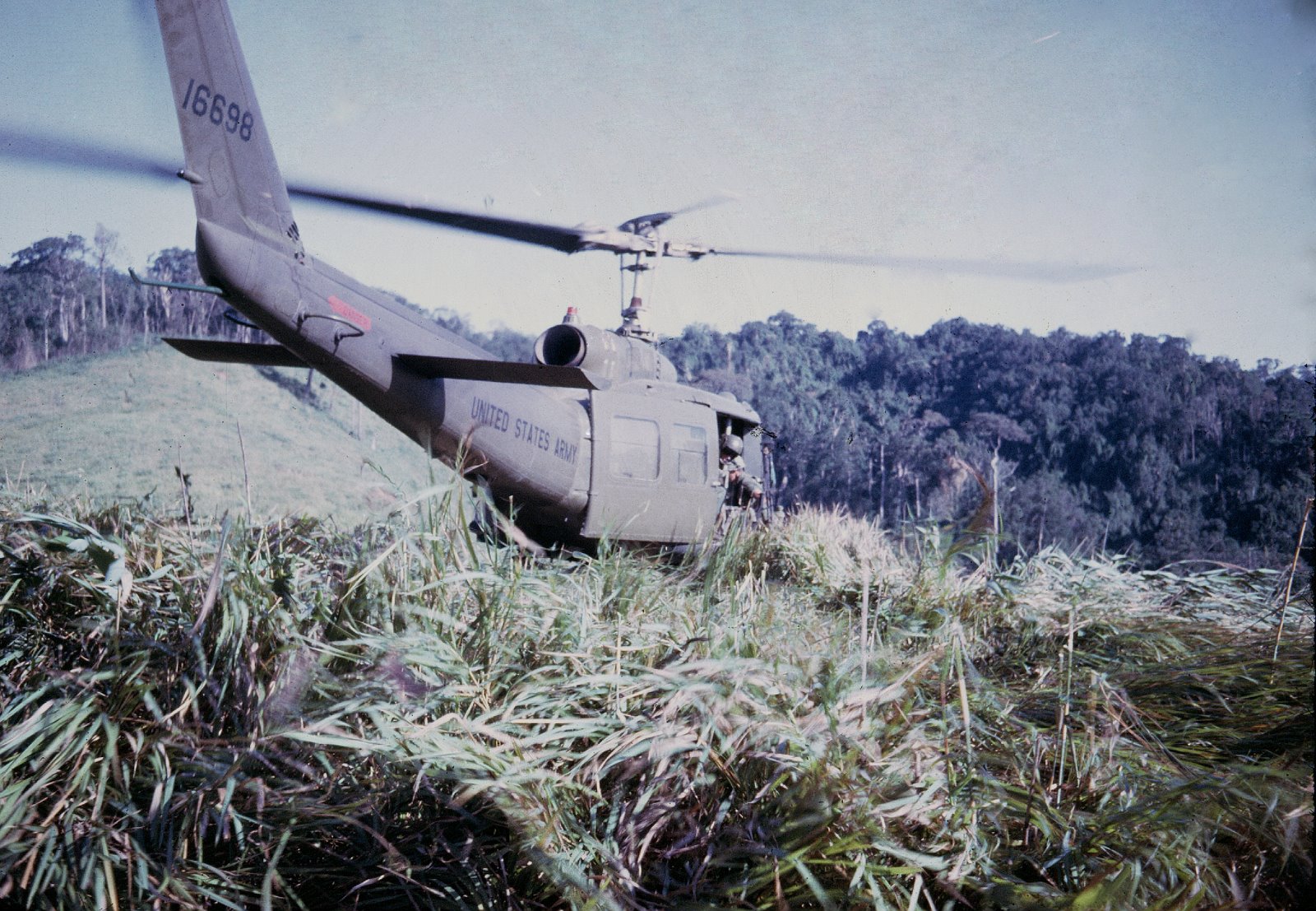
 LANDING ZONE ON ARRIVAL AT DAK TO


EXTRACTION OF BRAVO COMPANY 17-18 NOV (LOOKING TOWARDS SPECIAL FORCES CAMP)

Thanks to Fred Fish for the above photos

19 November will always be remembered by the many relatives who lost a loved one on this date at Dak To and by the many veterans who participated in this battle. The strongest enemy resistance was on the infamous Hill 875, located southwest of Dak To where two battalions of the 173rd Airborne Brigade, the 2nd Battalion and 4th Battalion, 503rd Infantry Regiment, fought for several days to seize this hilltop. The attack began on 19 November and Hill 875 was finally secured on Thanksgiving Day, 23 November. Both battalions suffered very heavy casualties and the fighting was so violent that the infantry companies were calling in artillery and air strikes 
dangerously close to their own positions. The casualty figures for these two battalions were158 killed and 402 wounded in action.


Bravo Company was also engaged in a fierce firefight on Hill 1034 on 19 Nov, but first some relevant background details from the 1st Bde, 1st ACD, Combat After Action Report, dated 1 Dec 1967. The 1st Brigade Task Force that deployed to Dak To consisted of two battalions; 2nd Bn 8th Cav Regt and 1st Bn 12th Cav Regt. Major supporting units included; 2-19th  Arty(-), A/2-20 Arty (ARA), B/229th AH Co(-),  and 228th ASH Co(-). Other supporting units included platoons or detachments of MPs, scout dogs, pathfinders, engineers, Military Intelligence, Tactical Air Control Party, and several others. 1st Brigade combat units deployed to Dak To on 14 Nov by C-130 from LZ English. A total of 37 C-130 sorties were required to move combat units and their essential equipment, while logistical and other units moved by road with an overnight at An Khe.

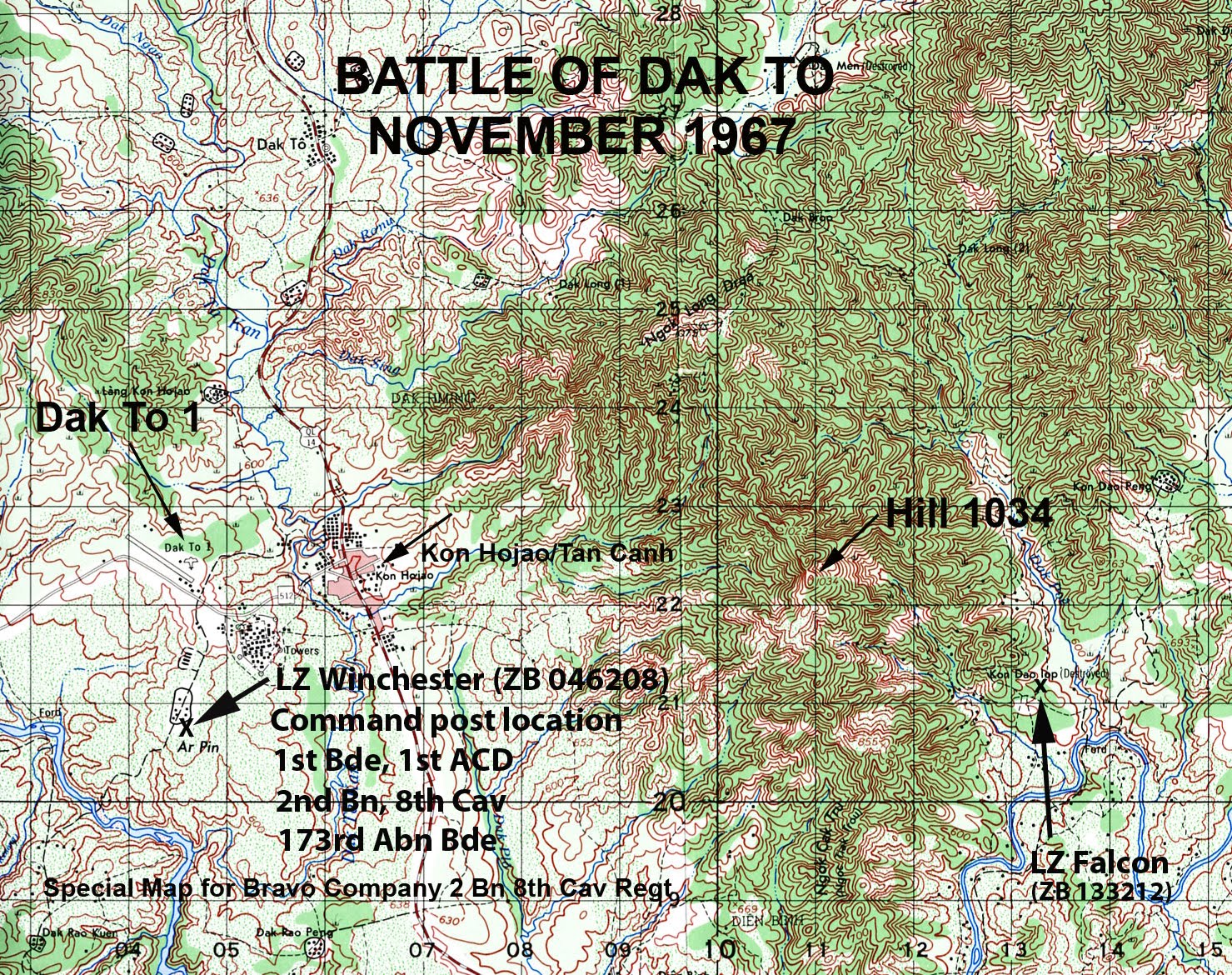
On 15 Nov, the 2-8th Cav initially released two companies to the 1st Bde, 4th Inf Div for the defense of Dak To. On 16 Nov, the 2-8th Cav Command Post moved from Kontum to the Dak To area (LZ Winchester), resumed control of their rifle companies and operated under the 1st Bde, 4th Div to assist in the defense of Dak To. D Co worked generally to the south, B Co to the north and C Co to the east of Dak To. C Co made contact with estimated NVA company at ZB 110210 and conducted a two day battle finally securing the hill top. A Co, 2-8th Cav, remained under the operational control of the 1st Bde, 1st ACD, and secured the proposed forward CP location at LZ Polly. It was determined on 16 Nov that the proposed forward CP location for the 1st Bde , 1st ACD, would not be at LZ Polly but instead be at LZ Winchester (ZB 046208), which was the location for the 2-8thCav CP and the 173d Abn Bde Rear CP.

On 19 Nov, the 2-8th  Cav (-) returned to the operational control of the 1st Bde, 1st ACD, and the battalion was assigned an area of operation in the general vicinity of where C Co had contact with enemy forces at ZB110210. This area of operation was called the WHITEHORSE AO.

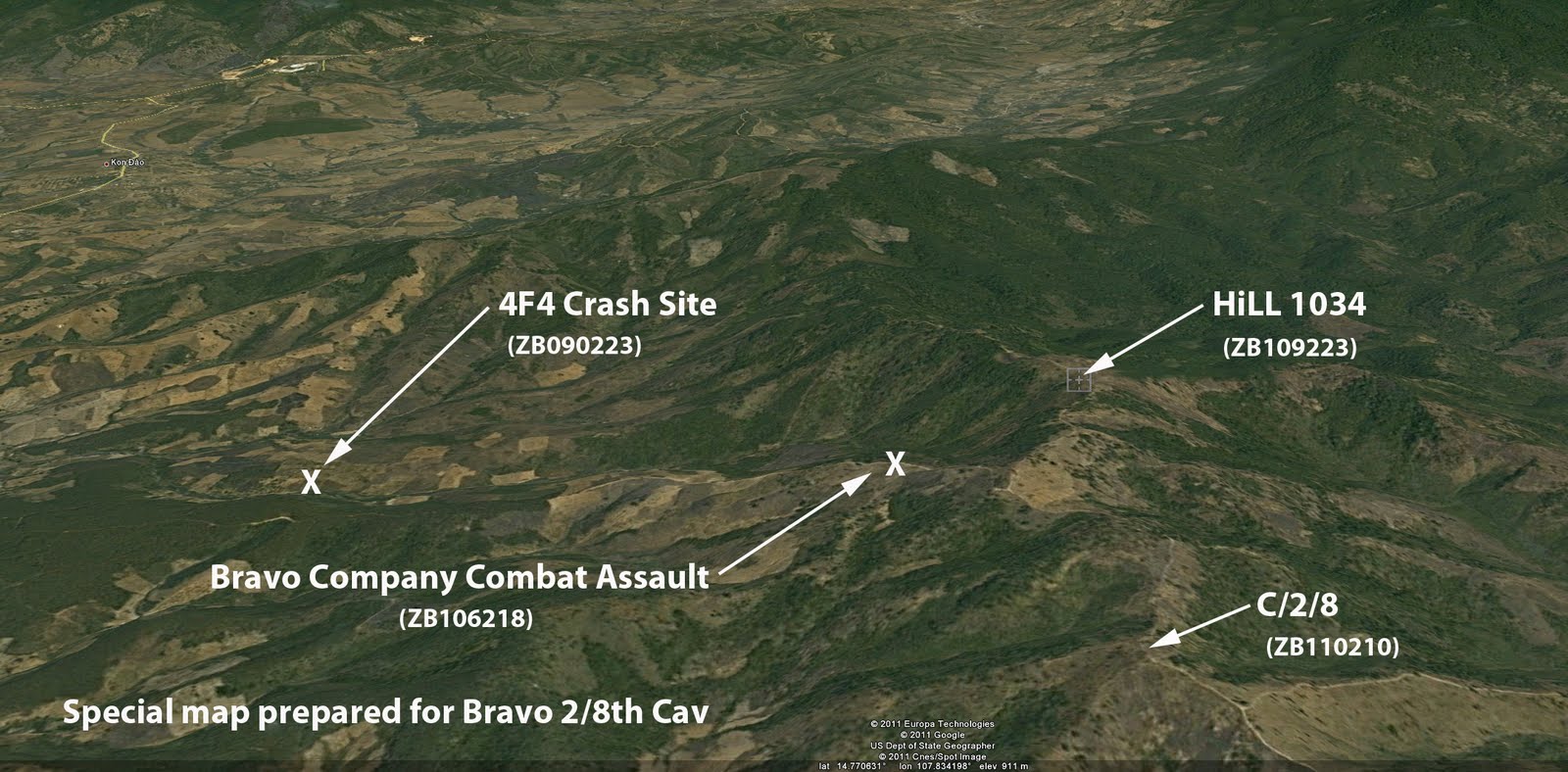
On 19 Nov, B Co conducted a combat assault on a narrow ridgeline at ZB 106218 with the mission of securing Hill 1034, located at ZB 109223. Bravo Company was not aware of any intelligence indicating that enemy forces had established extensive fortifications on Hill 1034. For their defense of Hill 1034 and to survive massive bombardments by US artillery and air-strikes, enemy forces had established a horseshoe defense consisting of an elaborate bunker system with connecting tunnels and the whole complex was skillfully camouflaged. Immediately prior to the beginning of this firefight, the lead elements of Blackfoot Platoon had reached the southern tip of Hill 1034 and had started occupying hasty defense positions, while the remainder of Bravo Company continued to close on Hill 1034. It is highly likely that Blackfoot approached Hill 1034 from one direction, while Cheyenne was the lead platoon for the remainder of Bravo Company who approached Hill 1034 from another direction. The command group with Captain Decker and his radio operator, SP4 Fowler, was located with Cheyenne.

This was the situation when Bravo came under intense and accurate fire from enemy forces occupying fortified positions on Hill 1034. It all started abruptly when enemy forces engaged Blackfoot from well-camouflaged fighting positions and our first casualty was Lieutenant Rodreick. In the course of a short period, Bravo Company sustained 10 casualties, representing 9% of our field strength. Among those killed in action was Captain David Decker, Commanding Officer of Bravo Company; Specialist William Fowler, Captain Decker’s radio operator; and Lieutenant Ronald Rodreick, Blackfoot Platoon Leader.  Specialist Thomas Olearnick, who was the pointman for Cheyenne on the approach to Hill 1034, was listed as missing in action but his status was later changed to “died while missing”. Based on a letter written home by one of our troopers, Bravo Company had a total of six troopers wounded during this action and they were medevaced by helicopters. Aztec Platoon was in a position to provide covering fire while Blackfoot and Cheyenne withdrew from the top of Hill 1034 with our casualties. The assault on Hill 1034 was suspended while we evacuated all of our casualties and it was also necessary to reorganize due to the loss of several leaders.     

Late in the afternoon of 19 Nov, B Co was extracted from ZB 106218 and inserted in the vicinity of C Co at ZB 110210. During the evening, night and the morning of 20 Nov, the entire ridge complex from ZB 110210 to ZB 103237 was pounded by artillery and air strikes. Estimates of the enemy strength on the ridgelines, based on contacts by B and C Co, 2-8th Cav and visual sightings by aerial observers, indicated a well dug-in enemy battalion.

During the night of 19-20 Nov, a F4F aircraft conducting an air strike on Hill 1034 received ground to air fire and crashed in the vicinity of ZB 09022. One of the pilots ejected safely and ARA gunships covered his extraction immediately after the crash. D Co returned to 2-8th Cav control on 20 Nov and conducted a combat assault to secure the wreckage of the downed aircraft, recover the body of the pilot who failed to eject and to extract sensitive items of equipment.

Early in the morning of 20 November, Captain Peter O’Sullivan assumed command of Bravo Company and landed at the company location at ZB 110210 with two replacement platoon leaders; Lt. Thomas Beach (Cheyenne) and Lt. Gus Pappas (Mohawk). On the same date, Lt. Thomas De Young (Blackfoot) was transferred from Charlie to Bravo Company to provide Bravo Company with a combat experienced platoon leader. Another replacement platoon leader, Lt. Charles Ready (Aztec), joined Bravo Company sometime during the afternoon of 19 Nov. The former platoon leader of Aztec, Lt. Bill Berry, was assigned duties as Bravo Company Executive Officer on 16 November. Another former platoon leader (Cheyenne) of Bravo Company, Lt. Alfred Lehman, was assigned to our Battalion Headquarters Company with an effective date of 21 November. 

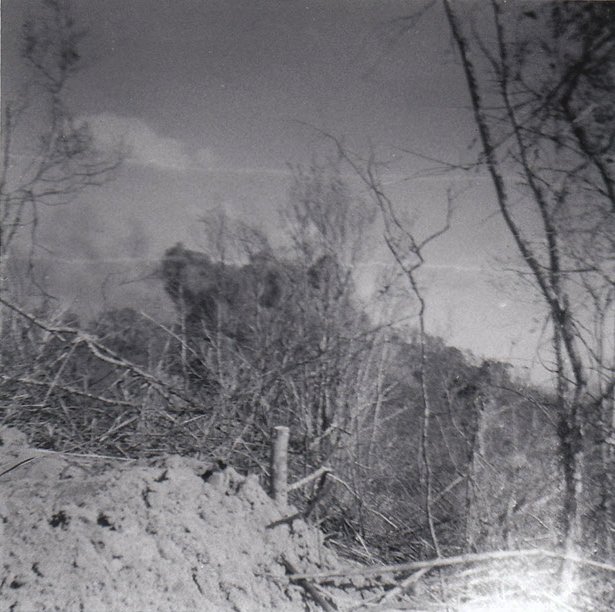
The following two photos on the bombing of Hill 1034 were taken during the morning of 20 Nov from our location at ZB 110210 and before we assaulted the hill. 


BOMBING OF HILL 1034

Thanks to Ralph Mercado

BOMBING OF HILL 1034

Thanks to Jimmie Hentkowski

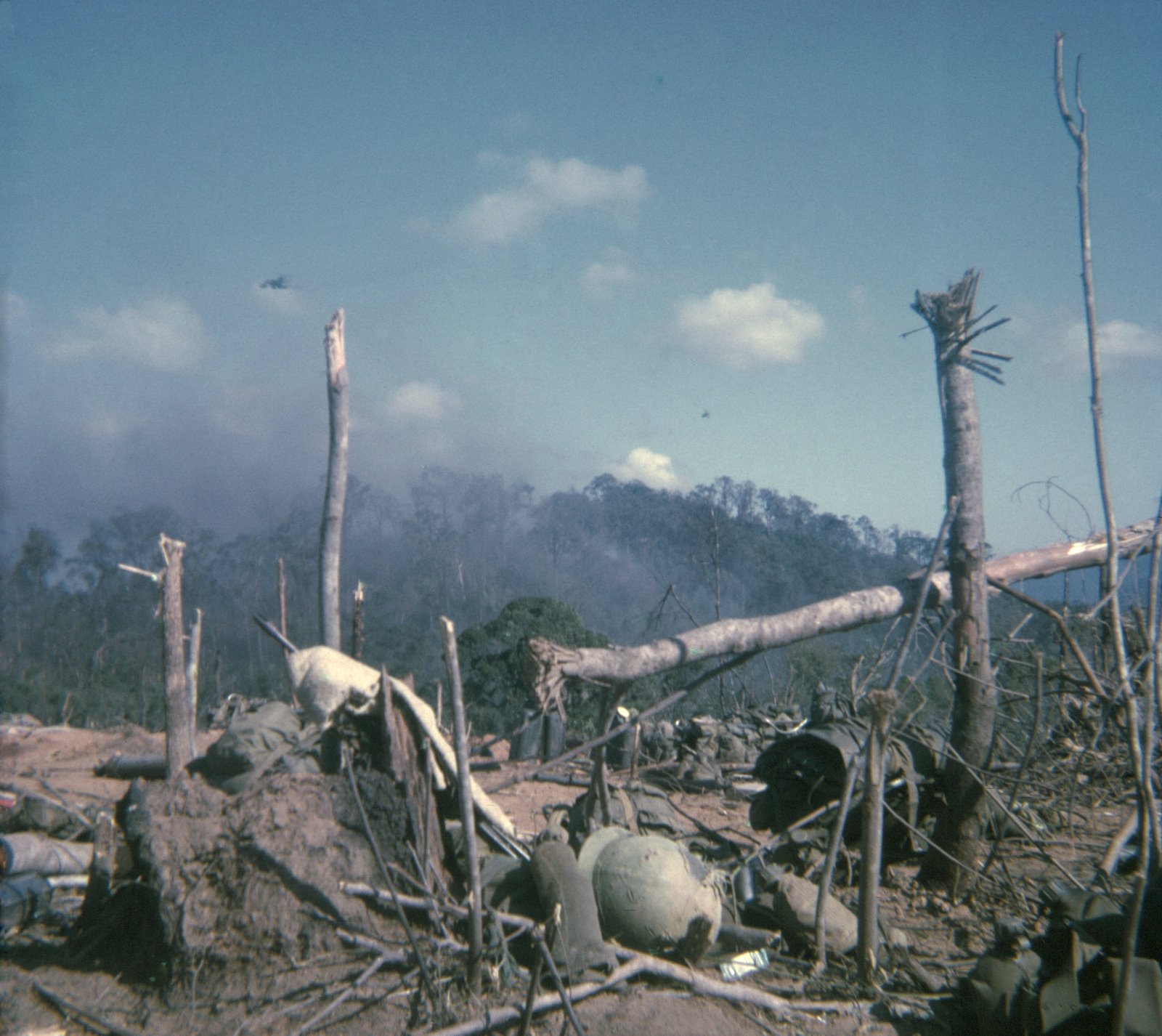
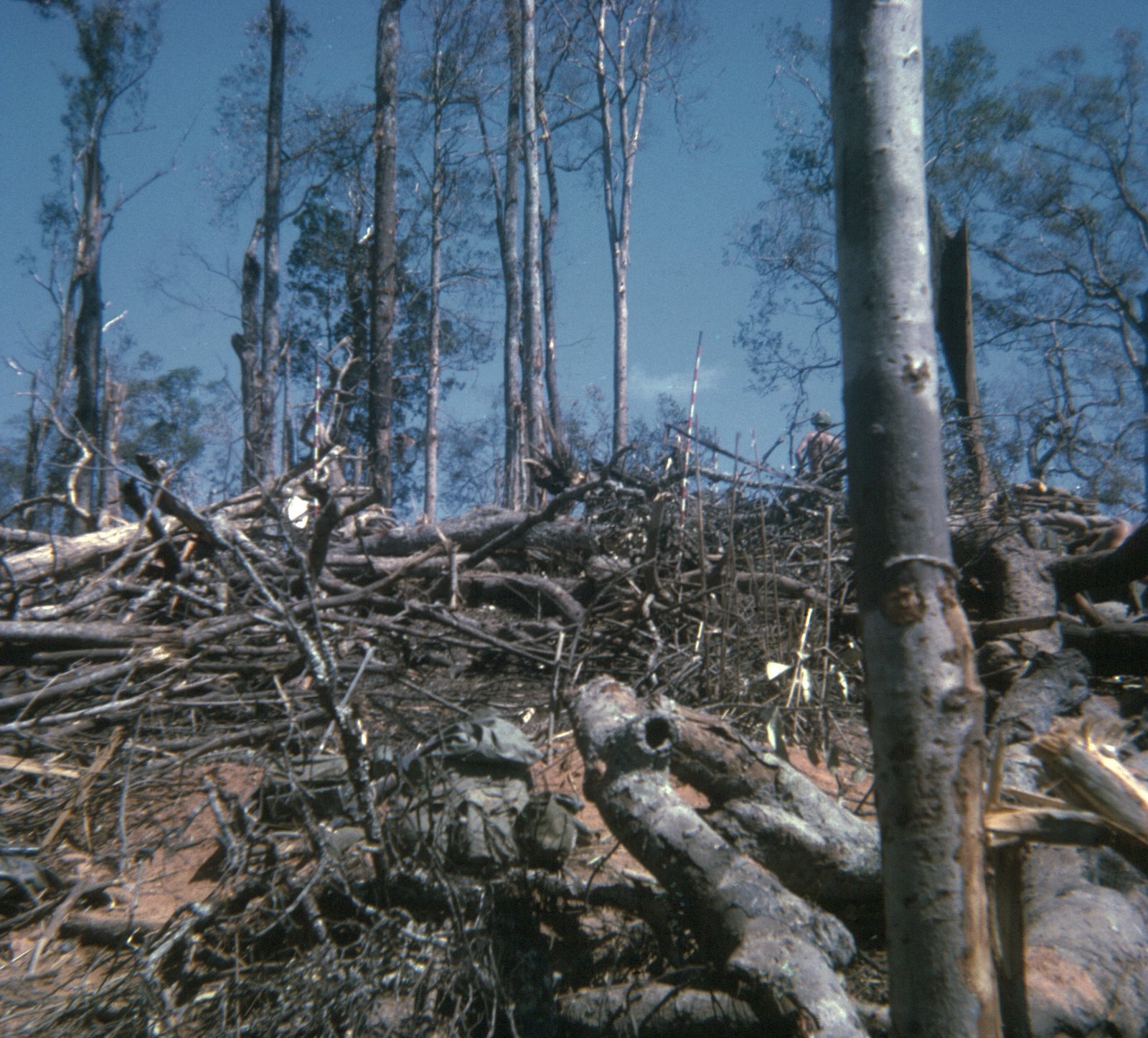
The following photograph was taken of shortly after we occupied Hill 1034 on 20 November 1967, and these troopers portray the anguish and sorrow that affected all of the members of Bravo Company.

 BRAVO COMPANY ON HILL 1034, DAK TO,
20 NOVEMBER 1967

Captain O'Sullivan and 1st SGT Rodriguez
 
HILL 1034


Thanks to Jimmie Hentkowski
 AFTER THE BATTLE FOR HILL 1034, DAK TO, 20 NOVEMBER 1967

Thanks to Sam Walker. Cheyenne - Ricky Day shirtless (?), Byron Shaw with canteen (?).
 

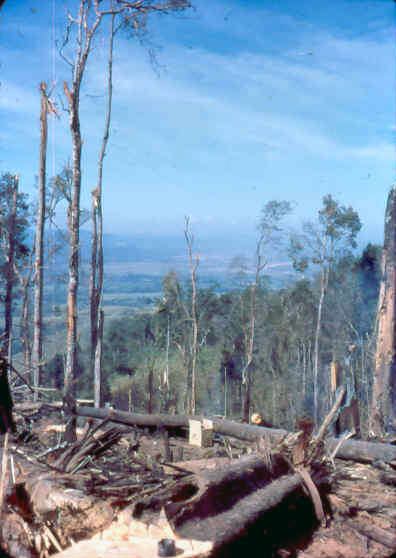
LOOKING TOWARDS DAK TO FROM HILL 1034

Thanks to Tom De Young


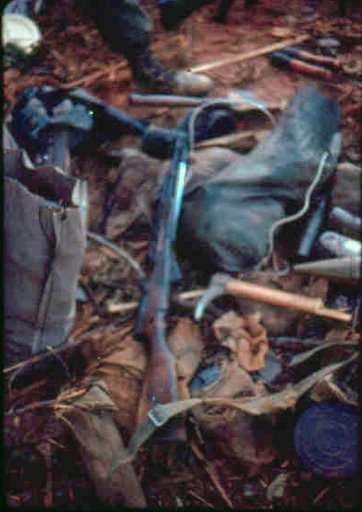
CAPTURED ENEMY WEAPONS AND
EQUIPMENT ON HILL 1034

Thanks to Tom De Young

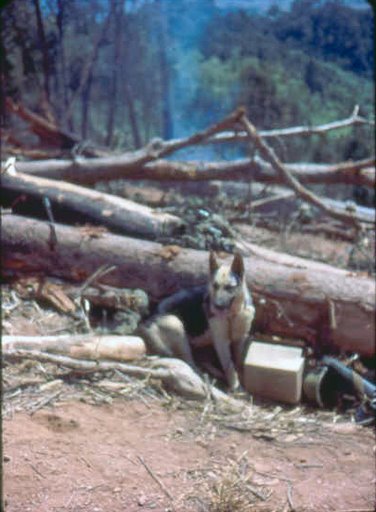
SCOUT DOG ON HILL 1034


Thanks to Tom De Young

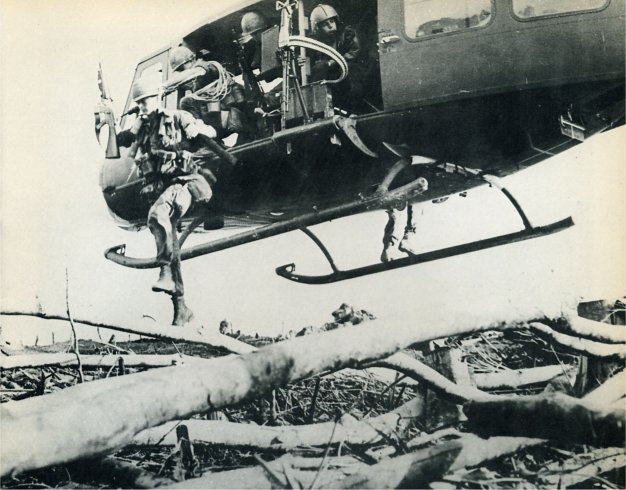
The difficulties of conducting combat assaults in the hills surrounding Dak To with double and triple-canopy trees is clearly evident from this photograph.

 COMBAT ASSAULT AT DAK TO DURING NOVEMBER 1967
 NIGHT DEFENSE POSITION

Thanks to Ralph Mercado

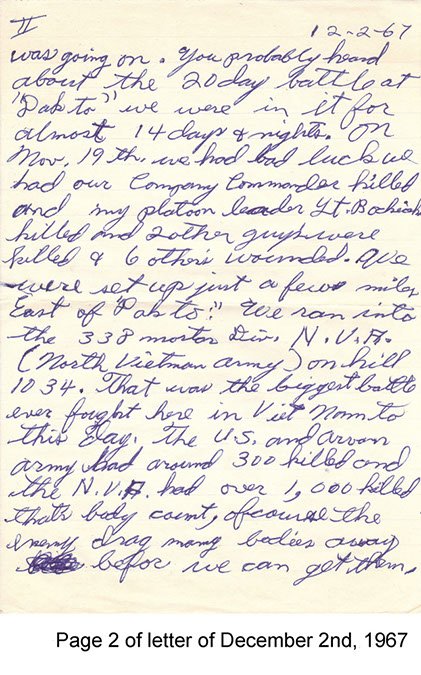
In the afternoon of 20 Nov and proceeded by a devastating air and artillery barrage, Bravo Company completed the assault of Hill 1034. We spent most of the evening and the following two days clearing the extensive enemy bunker complex surrounding Hill 1034, and collecting captured NVA weapons and a large supply of artillery and mortar ammunition, some of which had markings showing that they were manufactured in Russia. According to information recorded in a letter home, one of the enemy units occupying Hill 1034 was an NVA mortar unit with an identification number of 338. This information was obtained from enemy documents found in the bunkers. Another dangerous situation confronting us was the presence of numerous unexploded cluster bombs that were scattered all over Hill 1034 and an Explosive Ordinance Team spent many hours blowing them up. The entire ridgeline was cleared and secured by 21 Nov. On 23 or 24 Nov, Bravo was assigned the mission of securing LZ Winchester with three platoons, and one platoon (Blackfoot) was sent to Kontum to secure the 1st Bde, 1st ACD, rear command post.

On Thanksgiving Day, 23 November, we received the news that the battle of Dak To was over and the enemy had probably returned to their sanctuaries in Laos and Cambodia. Bravo Company (minus Blackfoot) was on another hilltop, called LZ Winchester, and late in the afternoon, choppers arrived with our Thanksgiving dinner, consisting of turkey with all the trimmings. Although we enjoyed our meal, there was a noticeable sadness among the troops as if they were silently thinking of their friends and colleagues who were not present.

On 23 Nov, the WHITEHORSE AO was expanded to the north and east to allow for pursuit to the northeast. A firebase, LZ FALCON (ZB 133212), was opened on 23 Nov. On 24 Nov, A and C Co’s combat assaulted to the northeast with no significant findings. Both companies were subsequently extracted to LZ WINCHESTER on 24 Nov in preparation for the return of the 1st Bde, 1st ACD, to the Pershing AO on 25 Nov.

On 25 Nov, the 1st Bde combat units moved by air on 37 C-130 sorties to LZ ENGLISH and the last unit landed at the Arrival Airfield at 1800H. 2-8th Cav units were moved from the Arrival Airfield by helicopters to their new missions:  C Co, 2-8th Cav assumed the security mission at LZ MUSTANG-TAPE at 251530H Nov 67. B Co 2-8th Cav(-) assumed the security mission at LZ LARAMIE at 251600H Nov 67 and provided two platoons to assist in securing LZ ENGLISH by 1600H. A and D Co 2-8th Cav conducted search and clear operations in the Bong Son AO.

NVA casualties during the Battle of Dak To were between 1200-1455 killed in action and it is likely that the figure for NVA wounded in action would be somewhere around 3000. Provoked by these high casualties, a NVA officer called Dak To a “useless and bloody battle”. US casualties during the Battle of Dak To were 289 killed in action, 985 wounded and 16 missing in action. Forty helicopters, two C-130 Hercules and one a F4F aircraft were destroyed by enemy fire. Because of the steep slopes and triple-canopy trees, there was a serious lack of suitable sites for landing helicopters and this meant that most troop movements had to be conducted on foot. There is no doubt that the scarcity of suitable landing sites made it very difficult to conduct airmobile operations in the Dak To area, and this greatly reduced not only our combat effectiveness but also our combat advantage over our opponents. In fact, there are numerous cases where the Battle of Dak To was a traditional “one on one” infantry contest and where we assaulted hills just like the US infantry did during the Korean War. Most military experts would agree that the battles of Dak To in November and Tam Quan in December were preliminary battles to the Tet Offensive in January 1968.

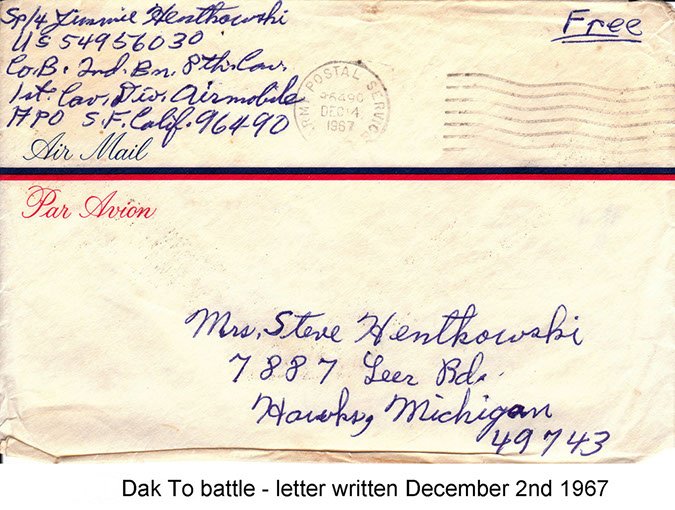
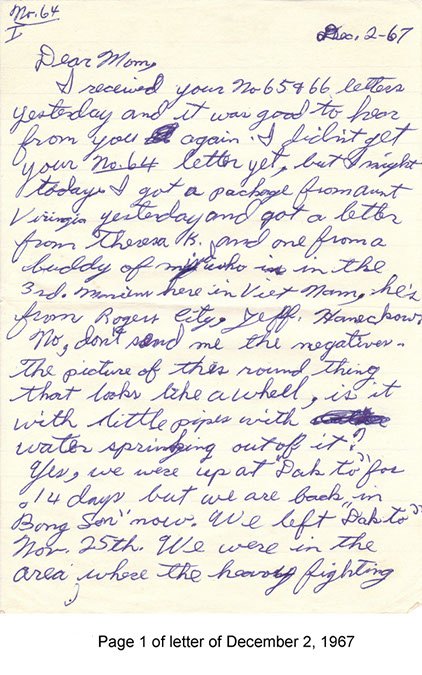
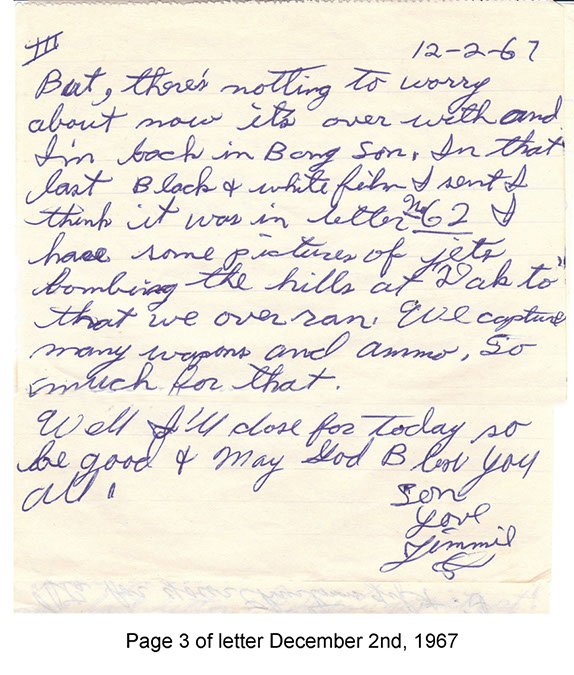
Mail was extremely important to all in Bravo Company and the following letter from one of our troopers to his mother shows how parents were kept informed  of the activities of Bravo Company. In addition, this letter contained very important information on the Battle of Dak To that was used for this article, in particular, the identification of Hill 1034 and the number of Bravo Company casualties. Notice that instead of using postage stamps, we wrote “FREE” on the envelope.


Many thanks to Jimmie Hentkowski.


Dro

 MỘT TÙ NHÂN SỜ MU RÙA_letamanh

(Để tưởng nhớ một bạn tù đã ra đi) – letamanh
Những năm gần đây, báo chí trong và ngoài nước thường xuyên đề cập đến hiện tượng, mà, theo “Biện Chứng Pháp” của Mac-Lenin, thì không bao giờ có thể xảy ra trong “thế giới Cộng Sản” được! Trong một chế độ theo chủ nghĩa “vô thần”, lúc mới nổi lên đã chủ trương phá chùa, đập miếu, nhà thờ biến thành nơi chứa lương thực…! Người Cộng Sản không tin có Phật, Chúa, Thần thánh gì cả suốt một thời gian dài mấy mươi năm… Cho đến một ngày, chính những “đảng viên” quỳ gối cúng bái, đốt vàng mã, tin phong thủy, sùng bái những phù thủy gọi là “nhà ngoại cảm”; thì người ta mới chợt hiểu ra!
Tôi còn nhớ kỷ niệm lúc còn ở tù trong các trại tập trung từ Nam ra Bắc Việt Nam. Kỷ niệm về một “Tù Nhân Sờ Mu Rùa” rất ư là lợi hại đã cùng với tôi “rong chơi” từ hết trại tù nầy đến trại tù khác với hàng bao nhiêu chuyện về “tử vi, tướng số”. Ông bạn già “Thầy Bói” của tôi, vì say mê “bốc quẻ, chấm lá số” mà phải bị cùm, bị truất phần ăn… Nhưng cũng từ trong nơi cùm gông đó, anh ta cũng có thời được cưng chiều, ăn no để “nói dốc”!
Anh lớn hơn tôi chừng năm sáu tuổi, người to con, không cao lắm nhưng bệ vệ. Lúc sau nầy không có đủ thức ăn nuôi cơ thể, có lúc anh ốm như bộ xương biết đi, hai mắt lồi ra, mỗi lần xin được bi thuốc lào, rít lên một hơi là ngã bổ xuống sàn giãy đành đạch… Xuất thân là một SQ Phòng 7 Đơn vị 101, làm việc tại Bộ TTM, ăn nói lưu loát, miệng “có quai có xách”! Tên cúng cơm là Đoàn Thế Lộc.
Anh nổi tiếng ngay những ngày đầu vào tù. Chúng tôi thường xuyên bu chung quanh anh, chờ cả giờ đồng hồ để xin anh nói cho một vài điều. Có lúc năn nỉ anh xem hộ tử vi sao hạn của chính mình rồi đến vợ con ở bên ngoài ra sao. Thù lao cho anh là những điếu thuốc lúc còn trong Nam, những bi thuốc lào hay là một vài cục đường, một vài khúc khoai mì lúc đã ở Bắc Kỳ – Hoàng Liên Sơn – Lào Cay – Yên Bái – Vĩnh Phú…
Đoàn Thế Lộc “quảng cáo” cho mình rằng: Hồi còn “huy hoàng”, anh ta thường xuyên xem tử vi cho các ông bà Tướng Tá trong Bộ TTM. Nghề xem tử vi của anh không biết ra sao, nhưng ăn nói rất lưu loát, đâu ra đó, hấp dẫn, tạo niềm tin cho người đối diện. Dĩ nhiên là lúc còn trong tù, anh nói quá khứ cho từng “tù nhân” đều nghe rất…hay, rất đúng. Nhưng về tương lai thì ai mà biết được!
Chúng tôi ở với nhau trong Nam cho đến năm 1977, lúc đó là mùa hè tại trại tù Long Giao. Anh Lộc và tôi ăn cơm chung, ngủ cạnh sát nhau. Hôm đó nhằm vào rằm tháng Năm, tôi không nhớ ngày Dương Lịch. Anh vừa ăn trưa với tôi vừa nói:
– Ba hôm nữa là mình huy hoàng!
Tôi ngạc nhiên nhìn anh nói vặn:
– Đừng nói là được thả về gặp vợ con, rồi Mỹ nó đưa máy bay rước tụi mình như anh từng nói nha!
Anh từ tốn cười, cầm khúc củ mì đưa vào miệng, vừa nhai vừa nói:
– Còn hơn việc thả về nữa, tụi mình sẽ xuống tàu ra khơi.
– Vừa thôi cha! Tỉnh lại đi, anh lấy đâu ra cái tin trời đánh đó?
– Tao bấm tử vi của tao và của mầy, hai số cùng có “mã khốc khách” và tương hội trong ba ngày nữa. Tao thấy mình được xe đưa đến NewPort (Tân Cảng), sau đó xuống tàu.
– Rồi sao? Chúng đưa cho Hà Bá nhai phải không?
– Tao nghĩ chúng sẽ đưa tụi mình ra Hạm Đội 7 để trao đổi!
Tôi trợn mắt nạt anh:
– Thôi đi! Đừng có mơ, anh bị bệnh hoang tưởng rồi.
Anh cười phân bua:
– Không tin thì ba ngày nữa mày sẽ thấy, chừng đó phải lạy tao mới nói tiếp!
Mà quả thật, buổi sáng ngày thứ ba như anh nói, chúng tôi có lệnh ở nhà chờ, không đi “lao động” bên ngoài. Lúc 7:30 sáng, bốn xe sơn màu xanh bịt bùng chạy vào đậu ở sân tập họp. Sau đó là lệnh tập trung ngoài sân nghe lệnh. Lần nầy là Cán Bộ thứ dữ “lên lớp”. Sau một hồi nói về chính sách khoan hồng và nhân đạo của Đảng, ông ta ra lệnh mọi người đem hết đồ đạc cá nhân ra sắp hàng chờ “Tổng vệ sinh”!
Thì ra mấy xe bịt bùng đó là những xe hấp hơi. Tất cả áo quần và chăn mền từng cá nhân dược cho vào cốp xe. Tiếng máy nổ, tiếng hơi xì khè khè, tiếng thì thầm bàn tán…! Lúc chờ đến phiên mình, anh Lộc khều tôi và mấy bạn ngồi gần nói nhỏ:
– Hôm nay tổng vệ sinh để chuyển chúng mình đi – Hãy vui lên, tốt!
Tôi nhớ ba hôm trước anh đã nói câu nầy nên bán tín bán nghi. Nhưng tôi vẫn phản đối ý nghĩ hoang tưởng của anh:
– Thôi cha nội, đừng có tuyên truyền. Lo giữ sức khỏe mà chống với thời gian tù đi.
Sở dĩ tôi không tin lời anh ta vì trước đó mấy tháng, trong giờ “học tập”, một Bộ Đội nói với chúng tôi: “Các anh cứ tin lời tôi nói, chừng nào nhà nước gọi tên các anh để thả về mà các anh không thấy vui mừng nữa; đó mới đúng thời gian “học tập” tốt!”. Ở tù đến khi không còn cảm thấy vui khi được tư do, có nghĩa là con người của ta thành chai đá, thành vô cảm rồi. Như vậy còn gì hy vọng được về …
Nhưng sau cơm chiều, mọi việc lại bắt đầu “ứng” với “quẻ” tử vi. Người đầu tiên được gọi xách theo “hành trang” là tôi, đến tiếp theo một vài chục người nữa mới đến tên anh Lộc. Tất cả xếp hàng, cứ ba chục mạng, ngồi sau một chiếc xe Motolova màu xanh lá cây. Anh Lộc cố lết đến gần bên tôi cao giọng:
– Mầy thấy chưa! Tao nói như thần mà! Tí nữa mình sẽ ra Tân Cảng và xuống tàu…
Tôi tiếp :
– Ra Hạm Đội 7 ăn hamburger!
Anh ta cười nham nhở:
– Nhớ qua bên Mỹ tụi mình phải ở chung với nhau để mai kia một nọ giúp đỡ nhau. Mà rồi họ sẽ đưa vợ con mình qua. Họ đã cất cư xá Sĩ Quan cho mình rồi. Nhớ phải ở gần nhau…!
Xe chở tù cũng ra đến Tân Cảng. Tất cả xuống xe tay xách nách mang lỉnh cà lỉnh kỉnh nào lon guigoz, nào đàn guitar tự chế. Có anh còn bê theo một con gà mái đẻ mập ú ù. Con gà vợ anh ta từ Bình Giả thăm nuôi. Anh nhốt nó bên giường, chia khẩu phần cho gà, gà đền ơn bằng cách đẻ trứng cho anh xơi!
Lần lượt rồi cũng xuống tàu, xuống tận đáy tàu, ngồi sắp lớp trên những rác và bụi xi măng. Ngồi sát nách nhau, không có chổ ngã lưng. Lòng tàu cao và phía trên chỉ chừa một lỗ nhỏ thông hơi. Hai giờ đầu tiên có mấy thằng ngợp thở, mùi xi măng và bụi bay chui vào mũi… Chỉ có một giây thừng từ trên cái lỗ nhỏ thòng xuống một thùng để chứa phân, nước tiểu. Cũng cái giây đó thòng xuống hàng ngày những lương khô Trung Cộng cho cái đám người mà theo như ông Thầy Bói, Nhà Ngoại Cảm Đoàn Thế Lộc là: Sắp trở thành những giá trị trao đổi với Mỹ… Đang nghẹt thở và sắp chết!
Anh ngồi bên tôi không một tiếng nói suốt từ khi thấy ánh sáng tròn của một lỗ trên trần tàu rọi xuống, Cứ sáng thì chỉ phía bên trái hông tàu, chiều thì đổi qua hông phải. Như thế có nghĩa là chúng tôi “được” chở ra Miền Bắc Xã Hội Chũ Nghĩa” để… lưu đày!
Anh Lộc bấm tử vi, biết được ngày giờ di chuyển, biết được “thiên cơ” trong muôn vàn “duyên nghiệp”. Nhưng vì quá chủ quan suy diễn theo tin thời sự dựng chuyện chuyền miệng nhau trong tù, nên anh phê phán “bản tin” tử vi theo ý mình! Tôi phục tài bấm số tử vi của anh. Có những việc anh đoán trúng phốc cho những người ngoài, nhưng bản thân anh thì không đoán được.
X X X
Ra Bắc một thời gian “treo chén” anh lại ra chiêu xem tử vi. Anh nói với tôi là bình sanh anh chỉ mê học xem tử vị vì theo anh, nó là một môn khoa học, rõ ràng, mạch lạc và… chính xác! Với tài ăn nói vui vẻ, cởi mở và hòa đồng, anh được anh em tù cùng cảnh ngộ “nuôi”; nhất là những anh thường được gia đình gởi quà, hay có người vợ thương yêu, băng tàu vượt rừng từ Nam ra Bắc thăm nuôi!
Anh xem tử vi nổi tiếng, nổi tiếng đến tai Cán Bộ Trại Giam bởi một anh tù làm Anten (Báo cáo viên) nằm bên kia dãy sàn ngủ. Anh được “mời” lên ngồi làm bản tự kiểm và sau đó bị “cùm hai chân” một tuần lễ về cái tội gieo rắc mê tín dị đoan, làm cho trại sinh không an tâm tin tưởng Đảng và Nhà Nước.
Có điều lạ là, sau một tuần lễ nằm cùm, con người anh lại khác hẳn. Anh “bị” liên tiếp, hết Trưởng Trại đến Cán Bộ Giáo Dục, Cán Bộ Quản Giáo… lần lượt “mời” xơi nước trà hút thuốc lá. Có hôm anh đi từ sáng đến tối mịt mới bò về chỗ ngủ, bê theo một xách, trong đựng chừng hai ký củ mì luộc. Anh dựng đầu chúng tôi dậy đãi củ mì và gãi bụng cười:
– Hôm nay được “chén” một bữa no!
Tôi chặn đầu:
– Anh khai ngay, từ ngày bị cùm ra đến giờ, luôn được Cán Bộ “chiếu cố”, có phải đang bán đứng anh em để được no, được về sớm phải không?
– Lại nói bậy, im cái miệng thối mày đi! Nói nhỏ cho tụi mầy nghe, đừng có học đi học lại, lỡ tụi anten nó báo cáo thì…
Chúng tôi bao quanh lấy anh, tay thì bốc củ mì, tai vểnh ra, miệng thì nhai… Anh chậm rãi:
– Tao xem tử vi cho bọn chúng!
– Trời! Thật không? Tụi nó nhốt anh, cùm anh vì cái tội xem bói toán. Mà bây giờ lại nhờ anh xem tử vi cho chúng là sao?
Anh kéo ống thuốc lào trên vách xuống, lấy cây chọc vào nõ, vê một bi thuốc… Rồi thong thả theo tiên ông… Một lúc sau, cảm thấy hết phê, anh chầm chậm “khai”:
– Hôm tao bị cùm, nằm trên sàn xi măng lạnh quá, tao nghĩ là sẽ chết vì bị lạnh lưng và đói. Mấy con gián cứ đến nhâm nhi ngón chân của tao. Vách bên kia là một ông cha đang bị cùm, hình như là Cha Song mới vừa chuyển về từ trại Cổng Trời. Cha hay hát thánh ca và đọc kinh. Hình như ông không sợ gì, kể cả bị cùm từ các trại nầy dến trại khác. Tao nằm như thế được hai hôm thì có một thằng Áo Vàng bước vào nhìn tao. Hắn có vẻ buồn, trẻ măng. Tao bèn lên tiếng: “ Chào cán bộ! Ông đang có chuyện buồn phiền gia đình. Ông mới vừa mất của!” Bò Vàng ngạc nhiên nhìn tao, đến sát bên hỏi tao: “ Sao anh biết tôi bị mất của?” Tao nói: “ Thì nếu Cán Bộ có mất thì tôi sẽ nói tiếp còn không thì thôi. Nhưng Cán Bộ tuổi con gì, sanh ngày giờ gì thì tôi mới nói đúng được!” Hắn nhìn trước ngó sau rồi kề tai nói nhỏ với tao. Tao nghĩ, trong chốn lao tù, chỗ tận cùng là nơi cùm gôm xiềng xích mà nó còn sợ có người rình nghe nữa thì hết ý.
Tôi nóng ruột thúc:
– Nói ngắn gọn thôi cha! Rồi sao?
Vẫn ra vẻ quan trọng, móc trong túi ra một cục thuốc lào to, nhìn mọi người cười:
– Hút đi! thuốc hạng nhất Hải Phòng đó! Cán Bộ Trực Trại thưởng cho tao hồi chiều! … Thằng nhãi con “thành thật khai báo” với tao là nó vừa mất chiếc xe đạp xịn mua ở dưới phố Yên Bái, đạp về đến bến phà Âu Lâu thì bị mất lúc nó dựng xe vào quán ăn tô bún riêu. Tao hỏi tuổi và ngày giờ sanh rồi nói với nó là hãy về tìm ở cách nhà nó bốn cây số về hướng Đông sẽ lấy lại được. Nó lật đật chạy đi không kịp nói gì thêm. Sau khi tao hết bị cùm, về lán thì mầy với thằng Chánh Ruồi dìu tao thê thảm, tưởng không gượng giậy được. Ai ngờ chiều hôm sau Cán Bộ Trại xuống gọi tao lên phòng làm việc. Tao tưởng lại bị cùm nữa về cái tội tuyên truyền mê tín với cán bộ nhà nước!
Nói đến đây, anh Lộc lại làm một bi thuốc lào “câu giờ”! Một đám bu quanh la lên nóng ruột:
– Hút lẹ lên, khai mau! Còn đi ngủ mai cuốc đất!
– …Cha cán bộ trại mời tao ngồi, rót nước trà đậm, rút thuốc lá mời tao chứ không phải mời thuốc lào. Tao ngạc nhiên đứng như trời trồng. Hắn ta cười mời một lần nữa. Hắn nói: “ Anh tài thật, Cán Bộ Văn đã tìm được chiếc xe đạp theo hướng anh chỉ và đã bắt được tên trộm lấy cắp chiếc xe đạp.” Tao mừng quá, nghĩ là mình “chó táp phải ruồi”, bèn đủng đỉnh ngồi xuống ra cái điều tài thánh! Thế là từ bữa đó tao liên tục được chiếu cố, hết thằng nầy đến thằng khác “lãnh” lên xem tử vi” thay vì đi cuốc đất với tụi mầy! Bây giờ thì tụi nó tin tưởng tao còn hơn cha mẹ nó…
Thằng Chánh Ruồi cười nham nhở:
– Anh Lộc! Hôm sau có gì anh bỏ vào bọc đem về cho tụi em ăn với nha! Coi bộ anh mập ra và đẹp trai…
– Mầy chỉ được cái nịnh.
Anh Lộc từ đó cho đến ngày về Nam luôn là một ông thầy bói tử vi có hạng của tù và là Thầy của bọn Bò Vàng. Nhưng khi được thả về, anh tiếp tục cái nghề “sờ mu rùa” không phải dễ. anh mướn một xe xích lô, hàng ngày đạp ra đường kiếm khách. Nếu có khách gọi là anh có “mối tử vi”! Trong lúc đạp xe, người ngồi trên xe được gợi ý về tướng số, tiếp theo là bấm quẻ. Nếu “khách” lạ khoái thì cả hai cùng dừng lại ở đâu đó để “Xem cho kỹ”. Cuối cùng thì khách “hồ hởi phấn khởi trả tiền xe lẫn tiền “thầy”!
Năm 1984, tôi từ vùng kinh tế mới Đồng Nai dẫn vợ lên Sài Gòn thăm gia đình ba má, tôi gặp anh đang khệnh khạng trên chiếc xích lô không khách ở góc dường Bà Hạt và Nguyễn Duy Dương. Mừng quá, chúng tôi vào quán uống nước nói chuyện tránh nắng trưa. Anh nhìn vợ tôi và nói: “Chị đừng để nó vượt biên một mình, không được đâu. Sẽ có ngày cả gia đình qua Mỹ bằng máy bay…!” Tôi cười nhìn anh chế diễu: “ Giống như cái tin anh nói xuống tàu ra Hạm Đội 7 năm nào chứ gì!” Anh cười: “ Thì để xem!”
Anh đã nói đúng khi chúng tôi lên máy bay qua Hoa Kỳ, không những chỉ gia đình tôi mà còn cả tập thể những gia đình là tù nhân chính trị suốt bao nhiêu năm từ Nam ra Bắc. Anh đã nói đúng nhiều việc, nhưng chính anh không thể nào bấm trúng lá số của chính anh khi anh nằm trên giường bệnh vì bệnh gan, kết quả của những năm anh hay “ăn bậy” trong trại tù.
Anh nằm xuống ở Nam California sau khi đưa hết vợ và bầy con của anh định cư trên xứ tự do. Từ ngày biết mình bị bệnh dến khi nhắm mắt, anh vẫn “sờ mu rùa” cho những thằng bạn tù thỉnh thoảng đến thăm anh trên giường bệnh, trong nhà thương hay những ngày cuối cùng ở một Apartment trên trường Flower ở Garden Grove. Một ông “thầy bói”, một “nhà ngoại cảm”, một thầy “sờ mu rùa” vốn xuất thân từ đơn vị ẩn danh 101, một tù nhân đáng nhớ đã vĩnh viễn ra đi.
letamanh